UAH researchers find new method to “weigh” neighboring galaxies using pulsars as ultra-precise gravitational probes
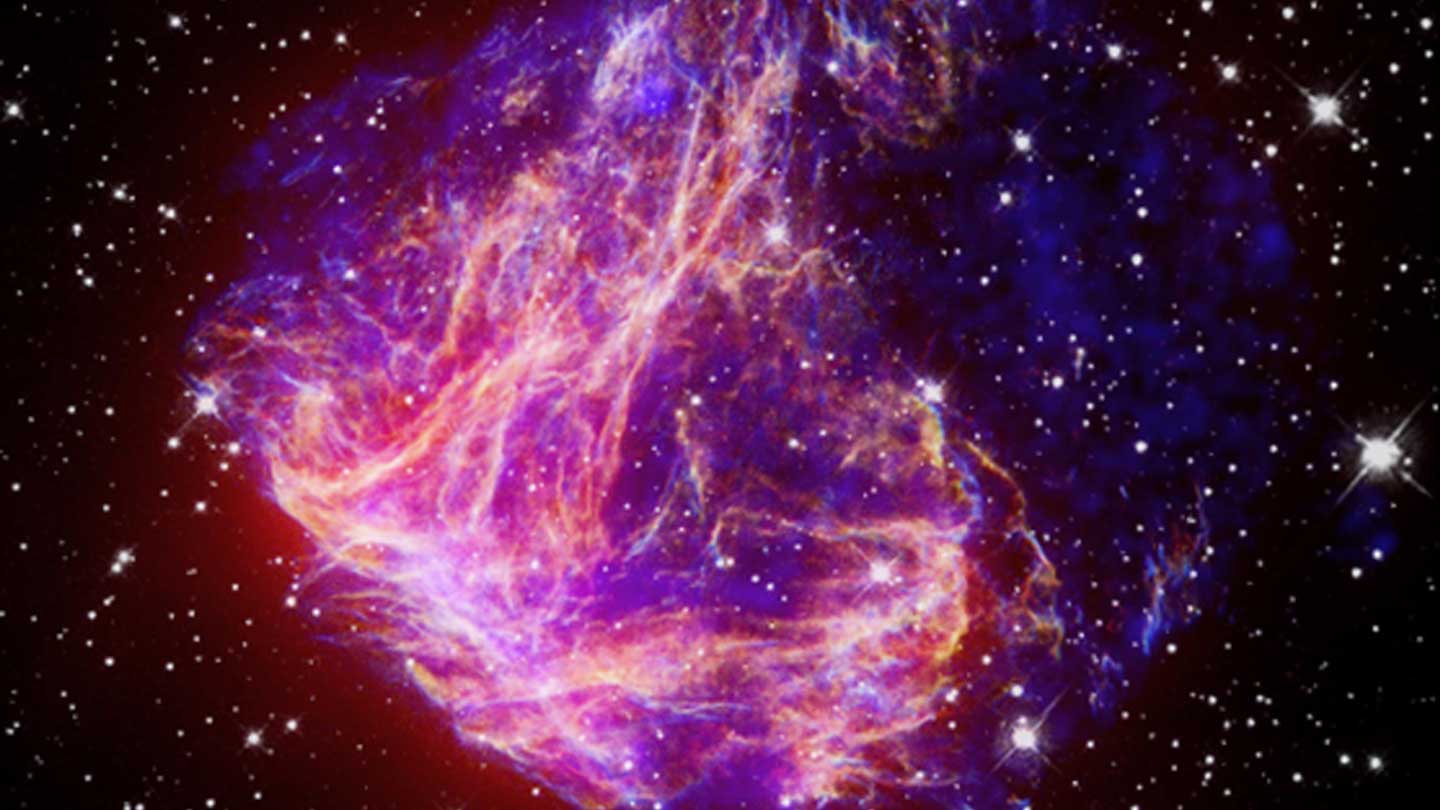
The Large Magellanic Cloud has a mass of approximately 41 billion times that of the Sun.
Researchers at The University of Alabama in Huntsville (UAH), a part of The University of Alabama System, have identified a promising new method for measuring the mass of galaxies orbiting the Milky Way by using pulsars, some of the universe’s most precise natural clocks, to detect tiny gravitational effects across our galaxy. The work offers a novel approach for studying the hidden dark matter contained within nearby satellite galaxies. The findings could have broad implications for astrophysics and cosmology.
The study was authored by UAH astrophysicists Dr. Thomas Donlon, postdoctoral research assistant II, and Dr. Sukanya Chakrabarti, a professor and Pei-Ling Chan Endowed Chair in the College of Science, in collaboration with Dr. Jason A. S. Hunt, an astrophysicist at the University of Surrey, U.K. The research examines how the gravitational pull of neighboring dwarf galaxies subtly disturbs the Milky Way. By analyzing highly precise pulsar timing data, the team demonstrated these disturbances can manifest as small asymmetries in galactic acceleration near the solar neighborhood.
Pulsars are rapidly rotating remnants of collapsed stars that emit beams of radiation at extraordinarily regular intervals. Because their timing is so consistent, astronomers can use them as cosmic reference clocks to detect minute changes in motion caused by gravity. The research team used this principle to investigate the influence of two of the Milky Way’s satellite galaxies: the Large Magellanic Cloud and the Sagittarius Dwarf Spheroidal Galaxy.

UAH astrophysicist Dr. Thomas Donlon, postdoctoral research assistant II.
“It's been known for many years that dwarf galaxies cause ripples and waves in the disk of our galaxy, but we've only recently been able to use pulsars to obtain accelerations,” Donlon explains. “Building off of our previous work, we realized that disturbances in the disk will cause accelerations today that we can pick up on using pulsars as gravitational antennae.”
Traditionally, astronomers estimate the masses of these types of galaxies by studying the motions of stars. However, those measurements can be difficult to interpret because stellar motions are influenced by many overlapping galactic processes, including factors like spiral arms, gas clouds and past galactic interactions. The pulsar-based method offers a cleaner and more direct way to measure gravitational acceleration itself.
“The main difference between the traditional method, known as kinematics, and direct acceleration measurements, is that acceleration measurements rely on time-series, extreme-precision observations,” Chakrabarti says. “These observations have to be made at extreme-precision, since galaxies are large, timescales are long, and therefore accelerations are very, very small. Kinematics relies on modeling a single snapshot in time of the positions and speeds of stars under simplifying assumptions – like that the galaxy is in equilibrium, which we now know is inaccurate – to estimate an acceleration. We do not make these assumptions with our acceleration measurements which is why they're more accurate.
“In 2020, I started working on direct acceleration measurements, and we made the first measurements with pulsar timing in 2021,” the researcher adds. “At that time, we could only constrain the smooth component of the gravitational potential with 14 pairs of millisecond pulsars. Acceleration measurements become more precise with time. When he joined my research group, Tom expanded the usable sample to 26 pulsars and later to 54. With this larger set, we now have sensitivity to the impact of dwarf galaxies to the extent that we can effectively weigh these dwarf galaxies.”
“Stars orbiting around our Galaxy will stay on fixed paths, unless they are perturbed in some way, say, by a dwarf galaxy passing nearby,” Donlon notes. “Over billions of years, the motions and positions of these stars are changed by many perturbations from many different events, and this makes it hard to determine how much of each star's path depends on each individual disruption event. However, accelerations don't stick around for long like velocities do. They disappear once the actual disruption is over. Since the actual disruptions only last for a short time, this means that the pulsar accelerations we observe today come from just the current disruptions from these two dwarf galaxies.”
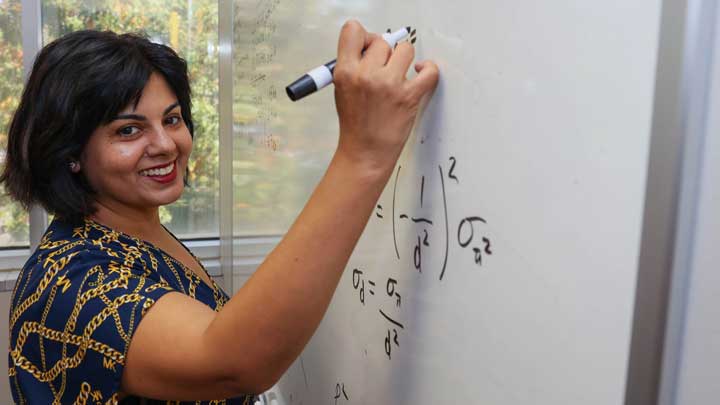
Dr. Sukanya Chakrabarti, professor and Pei-Ling Chan Endowed Chair in the UAH College of Science.
Using computer simulations combined with pulsar timing observations, the researchers estimated that the Large Magellanic Cloud has a mass of approximately 41 billion times that of the Sun, while the Sagittarius dwarf galaxy has a mass of roughly 350 million solar masses. Those measurements include both visible matter and dark matter, the invisible substance believed to make up most of the universe’s mass.
“Weighing these dwarf galaxies can help us understand the impact of these dwarf galaxies on the Milky Way's formation history,” Chakrabarti says. “Since it is now clear that we have sensitivity to these very small accelerations, we should be able to map out distribution of dark matter sub-halos. We did some work on this recently, but the evidence for the dark matter sub-halo is still tentative. If we can map out the distribution of dark matter sub-halos in the Milky Way, we should be able to figure out the nature of dark matter.”