The program offers many opportunities for students interested in exploring hypotheses in Systems Engineering, which itself is a vast field with countless applications across industries. To further illuminate all that the ISEEM program has to offer by way of hands-on laboratory research, please visit our laboratory pages:
Complex Systems Integration Laboratory - CSIL
The UAH Complex Systems Integration Laboratory (CSIL) is located in Olin B. King Technology Hall N-106. The CSIL is a state-of-the-art facility for advanced systems engineering, focused on Model-Based Systems Engineering (MBSE) and Digital Engineering.
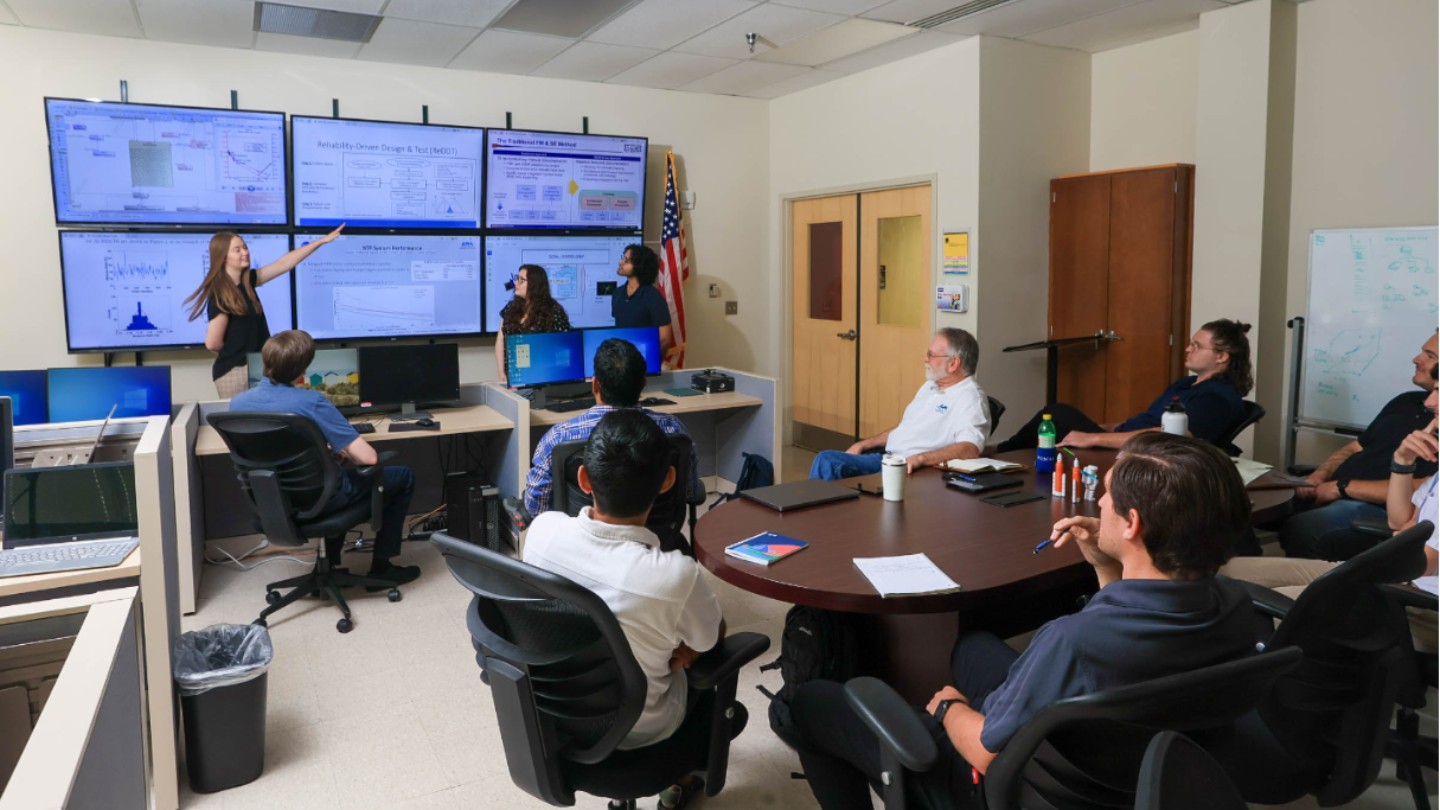
The CSIL hosts system models on platforms including Dassault Systèmes Cameo (MagicDraw) using the Systems Modeling Language (SysML). Parametric models are developed with tools such as MATLAB/Simulink/Simscape, ModelCenter, the Copernicus trajectory design and optimization system, Ansys Systems Tool Kit (STK), and lab's in-house Spacecraft Integrated System Model (SISM). Together, these tools enable high-fidelity mission modeling by integrating domain-specific engineering analyses with time-dynamic, three-dimensional simulations. The CSIL also maintains ontology development capability for semantic modeling and knowledge integration, using Protégé for OWL ontologies, Rosetta for OML ontologies, and OwlReady2 for programmatic interaction with OWL ontologies.
Current research in the CSIL includes:
- Digital systems engineering methods and tools for NASA Marshall Space Flight Center's Advanced Concepts Office to improve early-phase design of advanced space systems and exploration campaigns;
- Executable integrated systems models and digital twins for NASA's Space Nuclear Propulsion Program;
- Applying a federated, open-architecture MBSE framework to regulatory gap analysis for Advanced Air Mobility (AAM) platforms, including an FMECA-based reliability assessment methodology that moves safety considerations earlier in the design lifecycle;
- Mathematics as the foundation for AI-enabled systems engineering and project management.
Decision-making for Operations and Job Outcomes (DOJO) Lab
Dr. Nicholas Loyd and his students research the principles of strategic planning, Lean systems, and leadership development, specifically in their applications for manufacturing and engineering management. In the Decision-making for Operations and Job Outcomes (DOJO) Lab, research focuses on workstation design for human factors, process improvement for Lean value streams, and team dynamics in problem-solving scenarios.
Digital X Lab – Tech Hall OKT N102
The Digital X Lab is dedicated to the advancement of smart manufacturing research and digital engineering and is directed by Dr. Ana Wooley and Dr. Cheng Chen, both assistant professors in the ISEEM department at UAH. This lab is equipped to support the development, integration, and validation of Digital Twin solutions across the manufacturing lifecycle, providing a robust physical and digital testbed to execute research on advanced manufacturing. This lab supports full-stack DT development, from sensor integration and protocol implementation to simulation modeling and decision-support tool creation, including: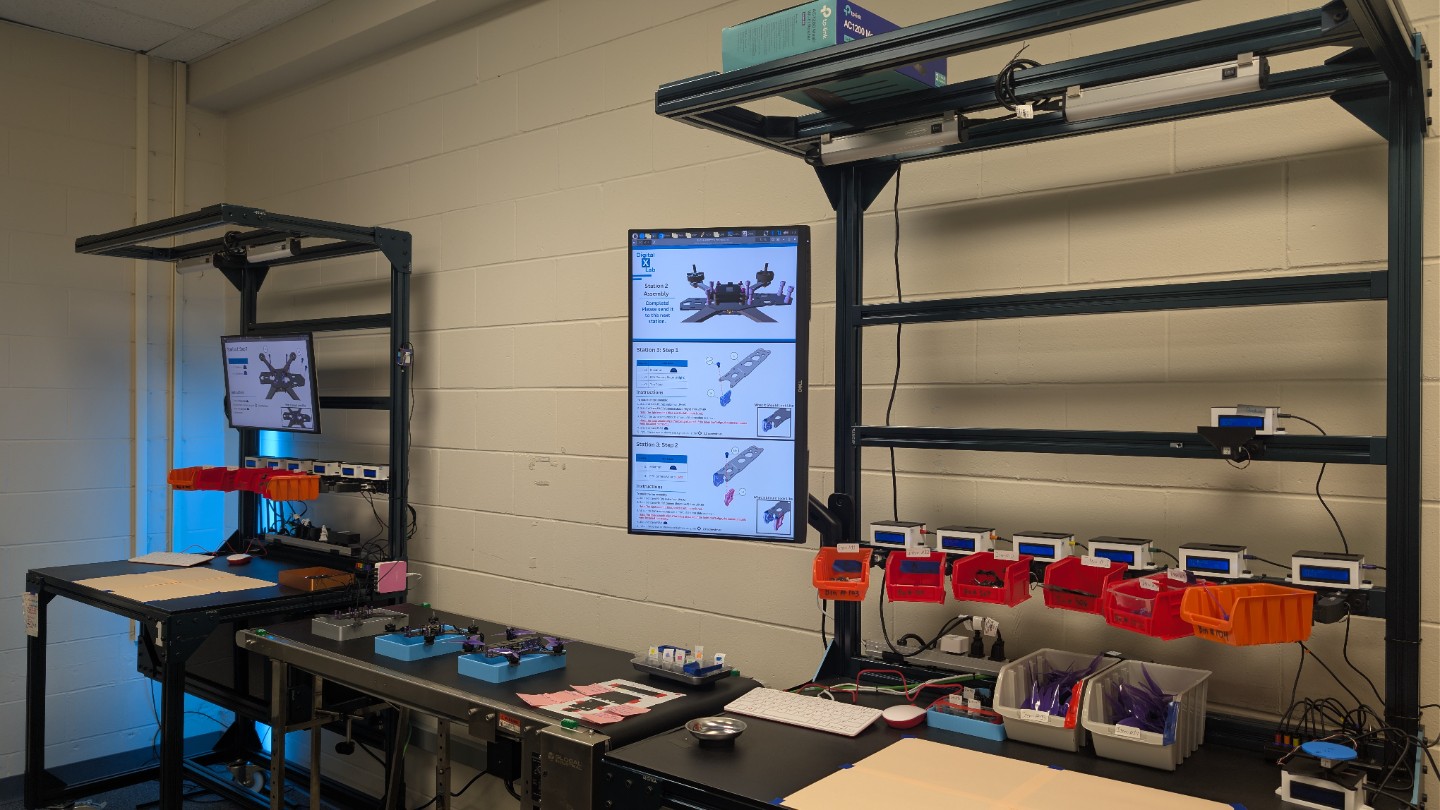
- A manual assembly line for drone manufacturing that includes two workstations connected by a conveyor system. It currently can manufacture complete drone kits and is being enhanced with load cell sensors (for inventory control) and proximity sensors (for process timestamping), supporting data collection for digital twin implementation, sensor connectivity, and data integration.
- An automated assembly line that is built around the Lucas Nuelle CBP 44 Variant Production with Ejection system and integrates Siemens Simatic S7-1500 PLCs, robot arms, and autonomous workstations. This system supports cyber-physical manufacturing research through real-time communication and modular reconfigurability. Workpieces are created based on cloud-based order input and follow a conveyor system through programmable stations for processing and quality checks.
- Capability to implement three core layers of DT architecture: Data Layer (Real-time sensor data of manufacturing process), Service layer (Open-source technologies such as MQTT (with secure TLS/SSL implementation), Node-RED, and InfluxDB support IIoT data transmission, storage, and visualization. Raspberry Pis, ESP32s, and LAN/Wi-Fi networks are used for secure, local deployment), and Model Layer (Simulation tools like Simio are used for discrete event modeling). This layer includes mechanisms for bidirectional communication between physical and digital systems and incorporates 2D/3D visual representations, data governance protocols, and system visualization dashboards (e.g., Grafana, Node red, ThingWorx). Unity 3D is also installed in the computers in the lab.
Systems Engineering Applied Research (SEARCH) Lab
The SEARCH Lab, directed by Dr. John Morris, is focused on discovering new methods for advancing digital engineering for model-based enterprises. Complex systems have complex behavior that is captured in models, such as geometries, requirements, motion, and architectures. These behaviors can be understood mathematically as functional constraints on the virtual representation of the system.
 In the SEARCH Lab, the theory driving system deconstruction is explored and applied to the real world. Researchers work with the underlying mathematics of system representation via constraint hypergraphs, ontologies, and categories. These theoretical insights are then applied to real world cases in developing composable digital twins and system simulation tools.
For information about our latest developments, check out our lab website at SEARCH Lab.
Charger Robotics and Biomechanics Lab (CRABLAB)- (OKT S117)
The Charger Robotics and Biomechanics Lab (CRABLAB), directed by Dr. Howard Chen, is dedicated towards solving fundamental and applied problems pertaining to ergonomics, biomechanics, and robotics with a particular focus on improving human motion analysis and robot navigation. The lab is equipped to handle all aspects of hardware/software integration from developing sensor interfaces with custom sensor drivers and circuit boards to developing multi-agent autonomy stacks deployed on real hardware. The lab has significant experience working with human participants, unmanned aerial vehicles (UAVs), inertial sensors, and hardware/software integration within the Robot Operating System ecosystem. Lab Hardware includes 12-camera Vicon Optical Motion Capture system, a Delsys Trigno Avanti Surface Electromyography System, Movella XSENS Inertial Motion Capture System, as well as various electronics and mechanical prototyping equipment, computer workstations, single-board computers, stereo cameras, multi-channel Lidars, tactical-grade inertial measurement units, single and dual-antenna GPS-INS systems, and robotic platforms (two Clearpath Husky, multiple custom-built UAVs).