UAH researchers develop antiviral candidate for deadly mosquito-borne brain infections
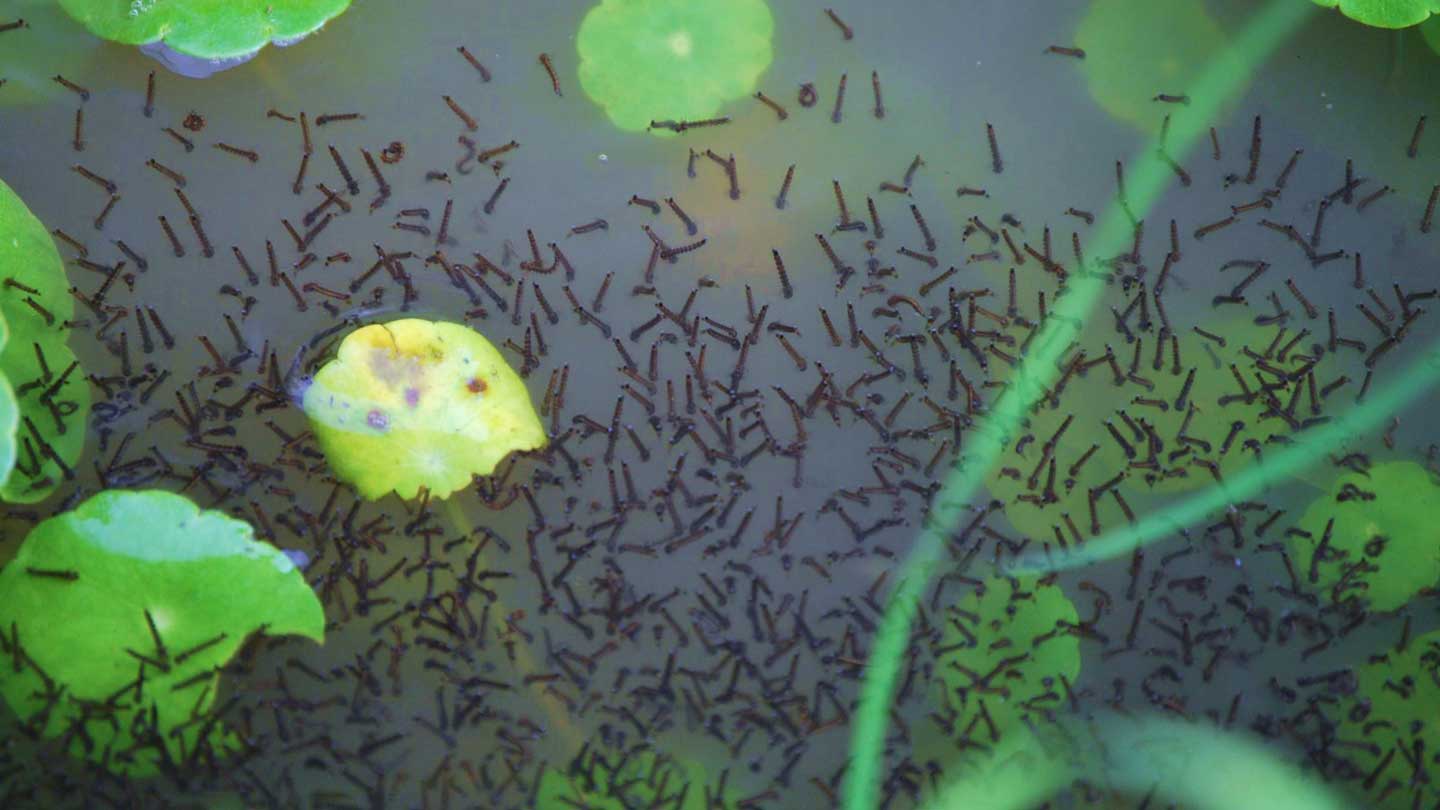
Mosquito larvae in a storm puddle.
Can newly identified antiviral compounds help stop some of the most dangerous mosquito-borne viruses that attack the brain? A research team led by scientists at The University of Alabama in Huntsville (UAH), a part of The University of Alabama System, has generated a new class of antiviral compounds that show strong therapeutic potential against Venezuelan equine encephalitis virus (VEEV), considered the most dangerous neurotropic alphavirus known to infect humans. The breakthrough study was published in the European Journal of Medicinal Chemistry.
Neurotropic alphaviruses can infect the central nervous system (brain and spinal cord). Most are transmitted by mosquitoes and usually cause fever, rash or joint pain, but the neurotropic variety are capable of invading nervous tissue, potentially leading to encephalitis (brain inflammation), a growing public health concern.
The interdisciplinary collaboration, involving the UAH College of Science and partners at George Mason University, details the discovery of broad-spectrum inhibitors targeting the viral non-structural protein 2 (nsP2) protease, an enzyme essential for viral replication and immune evasion. The lead compound, BFB78, demonstrated a 100 percent survival rate in lethal mouse models of VEEV infection and reduced viral loads in brain tissue by more than 10,000-fold.

Dr. Victor Ogungbe, an associate professor of chemistry in UAH’s Biotechnology Science and Engineering program.
Researchers also found that BFB78 is metabolically stable, can cross the blood-brain barrier, and maintains strong exposure in plasma, all key properties for advancing antiviral drug candidates toward clinical development.
The UAH research team included lead author Dr. Olawale S. Adeyinka, Dr. Damilohun S. Metibemu, Tamia Hampton, Jane-Frances Chinenye Ojobor, Dr. Olamide Crown and Dr. John Falode, all affiliated with the UAH Department of Chemistry. The project was led by Dr. Victor Ogungbe, an associate professor of chemistry and a faculty member in UAH’s Biotechnology Science and Engineering program, who was a co-author and principal investigator of the work.
“Many RNA viruses, such as alphaviruses, that have biodefense and public health relevance, lack specific, targeted drugs,” Ogungbe explains. “The importance of this work lies in the potential to develop therapeutics with compelling selectivity for alphaviruses and sufficient preclinical data to enable rapid deployment against emerging viral threats.”
Constructing a chemical defense
The study identifies three chemical scaffolds with antiviral activity, including pyrrole, tetrahydroquinoline and indole-based structures, with activity spanning multiple members of the Togaviridae family. A chemical scaffold is the core molecular framework of a compound, a kind of “backbone” that different chemical groups can be added to or modified to create new drug candidates. Researchers often start with a scaffold that shows biological activity against a virus and then make small changes to improve properties such as potency, safety, stability or the ability to reach specific tissues like the brain.
The findings suggest that nsP2 protease inhibition could serve as a foundation for both broad- and narrow-spectrum antiviral development.
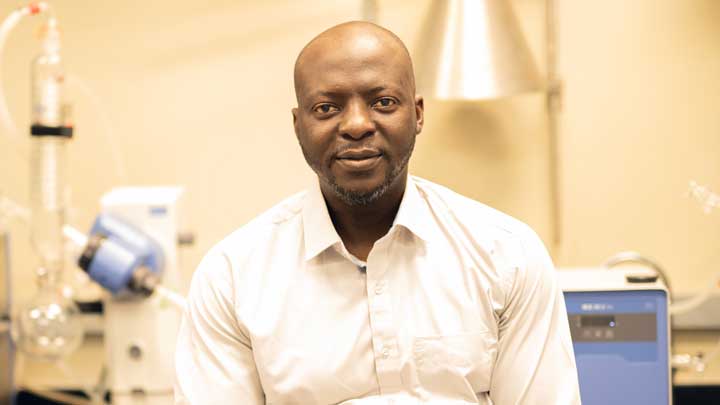
Dr. Olawale S. Adeyinka, a research assistant II in UAH’s Department of Chemistry.
“nsP2 protease is an essential protein responsible for processing the viral polyprotein, a function required for alphavirus replication, and the virus cannot bypass this without losing its ability to infect human cells,” Ogungbe says. “Our work focuses on proteases across three groups of diseases, and, like all our projects, the nsP2 protease work is driven purely by curiosity, perseverance and the ‘short memory’ that a medicinal chemist must have.”
By “short memory,” the researcher is referencing the fact that there are many false starts in drug discovery. “We started with a simple screening experiment using about 400 molecules against one of the alphaviruses a few years ago, hoping to find a starting point for developing antiviral agents targeting the nsP2 protease,” Ogungbe points out. “As with many medicines, it takes many twists and turns to get from the starting point to the drug on a pharmacy shelf.”
Beyond VEEV, the research indicates that select compounds also inhibit related alphaviruses like Chikungunya and Mayaro, underscoring their potential as broad-spectrum antiviral candidates. The team reports that continued optimization and preclinical development are underway, with a focus on advancing lead compounds toward Investigational New Drug (IND) studies.
“Our breakthrough came through painstaking investigation of nearly 200 slightly different versions of our original molecules to find the ones that can survive the drug-clearance pathways,” Ogungbe says. “We received some incremental funding at the right time, paired with a group of dedicated colleagues and collaborators.
“We now have a few molecules that are quite stable against human and monkey drug-clearing enzymes in test tubes. This is particularly important for antiviral agents. The compounds need to be stable enough in the blood and vital organs to interfere with the viral replication cycle. Impactful research requires substantial funding; there is no getting around it. All the wonderful things around us today, at home and at work, are made possible with that type of support.”
Looking ahead, the researchers emphasize the importance of advancing the most promising candidates into further safety and efficacy studies.
“The immediate priorities are evaluation in non-human primates to establish appropriate doses, safety and efficacy, and in the medium term, on the path towards Phase I studies in humans,” Ogungbe concludes. “We hope to translate the work through private funding and through funding mechanisms at the National Institutes of Health (NIH) and BARDA.”
BARDA is the Biomedical Advanced Research and Development Authority, a major funder and development partner within the Department of Health and Human Services that helps move promising medical countermeasures from the laboratory into advanced testing, manufacturing and potential deployment.