UAH student researcher leads discovery of fastest gamma-ray burst ever recorded
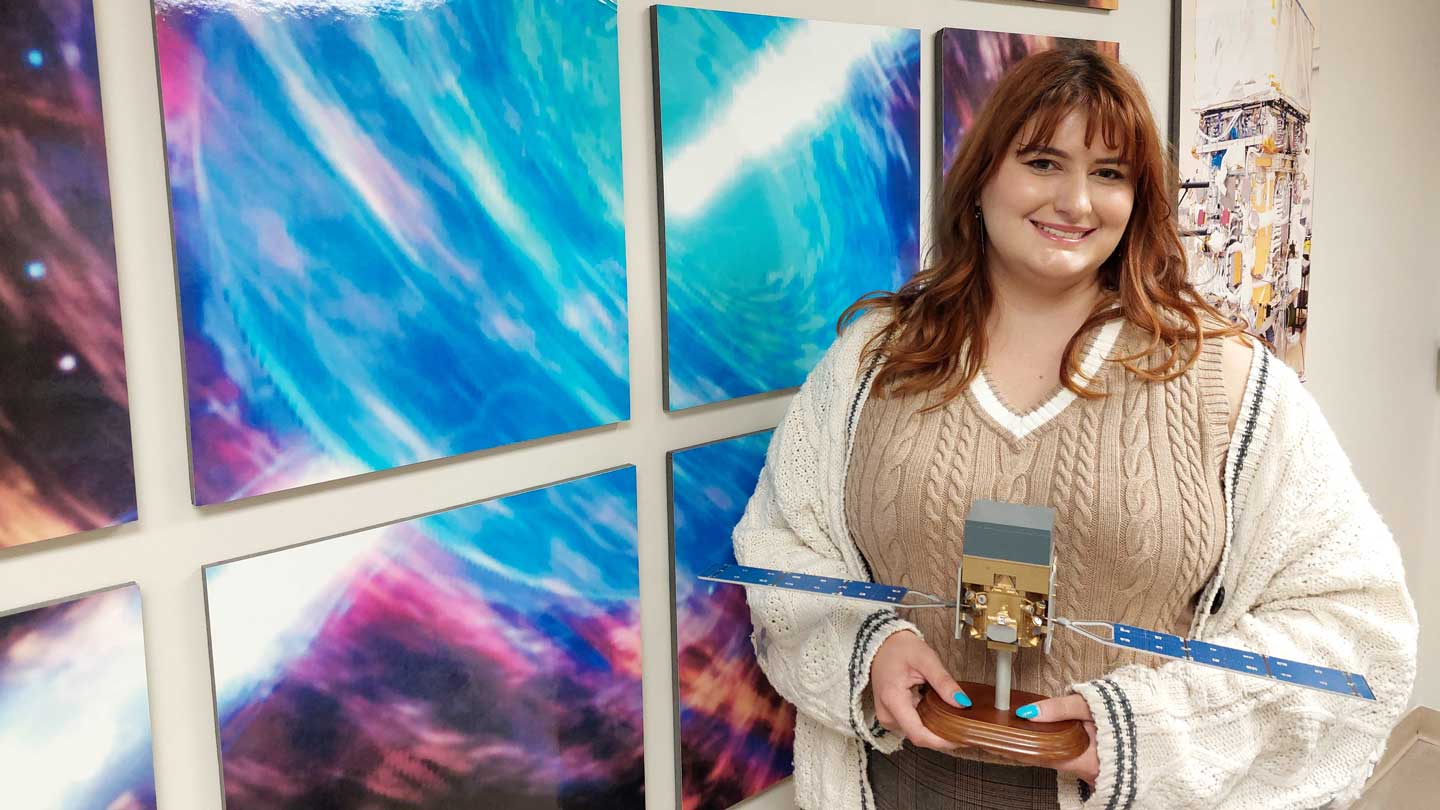
Sarah Dalessi, a graduate student in the UAH College of Science, holding a model of NASA’s Fermi Gamma-ray Space Telescope.
Sarah Dalessi, a fifth-year student in the College of Science at The University of Alabama in Huntsville (UAH), a part of The University of Alabama System, is the lead author of a paper published in The Astrophysical Journal detailing the discovery of the fastest gamma-ray burst (GRB) ever recorded. GRB 230307A is a gamma-ray burst in the ultrarelativistic category, meaning the velocity of the GRB’s jet, a focused beam of high-energy particles and photons, came within 99.99998 percent of the speed of light – 186,000 miles per second – making it the fastest GRB ever observed. The observation was made possible with data from the Fermi Gamma-ray Burst Monitor, one of two instruments on NASA’s Fermi Gamma-ray Space Telescope.
“The Lorentz factor is the measure of speed of the jet here, and 1,600 is the highest we ever measured,” explains Dr. Peter Veres, an assistant professor who works in the UAH Center for Space Plasma and Aeronomic Research (CSPAR) and is co-author on the study.
The Lorentz factor measures the relativistic velocity of the ejected fireball, providing insights into the GRB's energy, luminosity and the surrounding environment. GRB jets are thought to have Lorentz factors ranging from about 100 to 1,000, with typical values around 300.
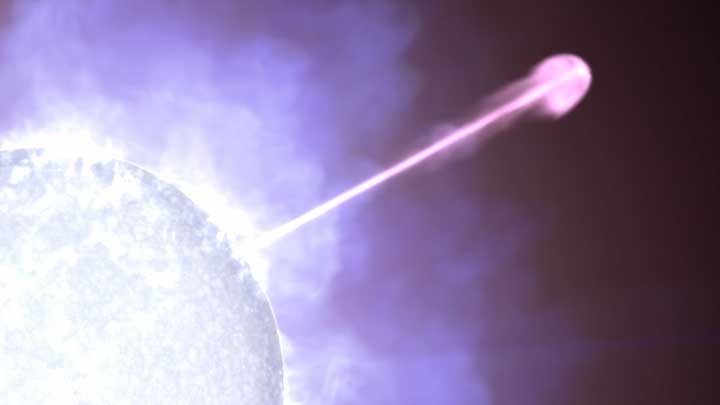
An illustration of a gamma-ray burst erupting from a dense environment around a collapsing massive star.
Dalessi began working with the Gamma-ray Burst Monitor (GBM) team in 2021. The group is a collaborative effort between NASA and the National Space Science and Technology Center (NSSTC) at UAH, which acts as the operations center, and the Max Planck Institute for Extraterrestrial Physics (MPE) in Germany. The team also recently discovered the brightest GRB ever observed.
The Fermi observatory launched in 2008 to study the highest-energy light, or gamma rays, from violent cosmic phenomena in the universe's most extreme environments.
“Part of my responsibilities on the team is to be what is called a ‘Burst Advocate,’” Dalessi explains. “Which means I have a number of shifts per month where I am responsible for processing and classifying incoming triggers from the satellite. It was during one of my shifts when I got the trigger notification for GRB 230307A, and right away, I knew that this was an extraordinarily bright event, perhaps the second or third brightest GRB ever. To be a part of such a unique discovery is not something I ever planned or dreamed of.”
“GRB 230307A is the second brightest gamma-ray burst observed in over 50 years,” Veres adds.
The research also produced new insights through observations of a phenomenon called a “kilonova,” an optical signal, brightest after about a day, that accompanies mergers of neutron stars. A kilonova can provide information about the source of the GRB and the creation of the heaviest elements in the universe.
“The mergers of compact binary objects, such as those involving two neutron stars, serve as almost a cosmic kitchen for heavy elements,” Dalessi notes. “During the merger, there is an abundance of neutron-rich matter that is expelled, and then is decompressed in space and can generate rare heavy elements such as gold and platinum.”
Follow-up observations of the kilonova remnant of GRB 230307A by researchers in the Netherlands and the United Kingdom using NASA’s James Webb Space Telescope showed evidence of the rare heavy element tellurium.
Dalessi says one of the highlights of her experience as part of the GBM team has been working alongside NASA scientists at Marshall Space Flight Center, also in Huntsville.
“A main part of the reason that I chose to attend UAH was that I knew the Space Science Department had opportunities for students to work with NASA collaborators,” the student says. “Working with Dr. Michelle Hui has been the absolute best part of my graduate school experience. I am forever grateful to the GBM team for putting their faith in me and letting me take the lead on such a project. To have such a wealth of knowledge freely available any time I had questions or needed guidance has been such a gift.”
Looking to the future of gamma-ray burst research, the UAH graduate says there are many potential avenues to explore.
“The most significant is finding another long GRB resulting from a merger,” Dalessi says. “This could involve either detecting a new trigger or identifying possible candidates. Currently, it is not possible to fully confirm the origin of GRBs without additional observations, so I am interested in identifying any signatures in the prompt emission that could signal a long burst is potentially from a merger.”