UAH researcher wins $1.27M award to study dynamic evolution of plasma conditions during a solar flare

Image of MaGIXS-2 sounding rocket launch, July 30, 2024, from White Sands Missile Range, NM
Despite decades of observations, our understanding of plasma conditions during solar flares has been limited by instrument capabilities. Understanding the physical processes that transfer energy during solar flare evolution is crucial for developing techniques to forecast when flares will occur and how they will impact Earth's magnetosphere and atmosphere. To investigate these phenomena, Dr. Athiray Panchapakesan at The University of Alabama in Huntsville (UAH) has received a $1.27 million grant for a third sounding rocket flight of the Marshall Grazing Incidence X-ray Spectrometer (MaGIXS) as part of its second solar flare campaign. This forecasting capability is central to NASA's mission to protect astronauts, satellites and power grids from solar radiation – a growing priority as human presence in space expands.
An Assistant Professor in the Center for Space Plasma and Aeronomic Research (CSPAR) at UAH, a part of The University of Alabama System, Panchapakesan is the Principal Investigator for the project, slated to launch in 2026. The mission is a joint collaboration led by Panchapakesan at UAH/CSPAR and Dr. Patrick Champey at NASA’s Marshall Space Flight Center, with support from other key science partners.
“The overall goal is to understand how plasma temperature and composition in the solar corona change and evolve during the decay phase of a solar flare," Panchapakesan explains.
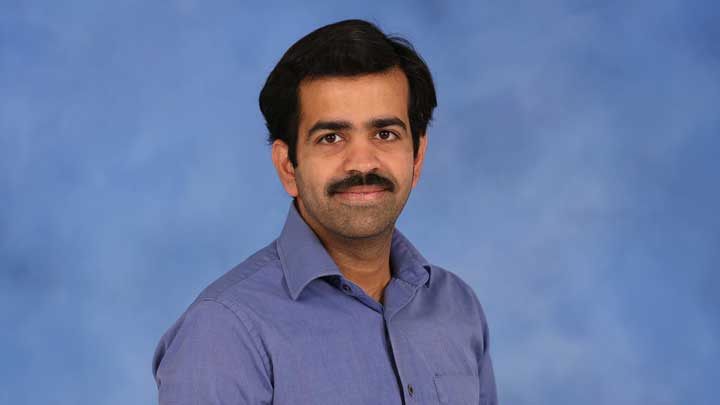
Dr. Athiray Panchapakesan, an assistant professor in the Center for Space Plasma and Aeronomic Research (CSPAR) at UAH.
The MaGIXS experiment has a long history with UAH, beginning with a key role in the initial development of the optical system more than a decade ago. When MaGIXS was selected for its first flight in 2014, then-graduate student Champey took on development of the grazing incidence mirror system as his dissertation topic in the Optical Science and Engineering Program. Under the advisement of Distinguished Professor of Physics Dr. Don Gregory, Champey developed groundbreaking mirror fabrication and metrology techniques to achieve the required mirror quality and created methods for aligning the complex optical system.
The MaGIXS instrument has already completed two successful flights, in 2021 and 2024. Both flights observed hot, X-ray emitting plasma from non-flaring solar active regions to characterize plasma diagnostics such as temperature, density and composition under normal conditions. These active regions are also where flare eruptions often occur, which can drastically alter plasma properties. Temperatures can reach up to 15 million degrees Kelvin before gradually cooling during the decay phase.
“MaGIXS-3 is a follow-up to flights 1 and 2 that will observe solar flares during their decay phase, which is critical to understanding the long-term effects of a flare, how energy is dissipated and how the Sun's atmosphere recovers,” Panchapakesan notes. “I served as Deputy Instrument Scientist for MaGIXS-2, and those observations inspired me to propose a solar flare rocket campaign with MaGIXS. This phase will reveal details about the flare's energy release, plasma heating and compositional changes in the solar atmosphere – all important for space weather forecasting and space physics.”
MaGIXS is a slitless X-ray imaging spectrometer that produces spectrally dispersed, wide-field images of the Sun. It captures both the spatial position and spectral information of X-ray sources simultaneously – a much more efficient approach than narrow-field (slit) spectrometers, which must collate multiple smaller, spectrally dispersed images to form a larger composite. The advantage of MaGIXS is its ability to capture data much more rapidly over a larger field of view, providing the superior temporal resolution needed to study how solar flares evolve.
“X-ray photons from the Sun first enter the telescope at shallow angles and reflect off finely polished surfaces – think of skipping a rock across the smooth surface of a calm pond,” Champey, a UAH alumnus, explains. “These X-ray photons then reflect off a grating, which disperses them into different wavelengths – similar to how a prism separates white light into its color constituents. These photons are finally detected by a camera, where the images of the solar flare, broken into different X-ray energies, are digitized and recorded. MaGIXS gets its name from the way X-ray photons graze off the reflective mirror and grating surfaces – they are called grazing-incidence optics.”
However, this novel approach comes with a tradeoff. One challenge of the slitless design is that spectral and spatial information can overlap, making data analysis complex. The data collected by MaGIXS are called “overlappograms” – spatially overlapped images that correspond to different X-ray wavelengths. The MaGIXS team has pioneered techniques to unfold overlappograms using novel inversion methods and has curated the first dynamic, spatially resolved, soft X-ray spectra. Under the mentorship of Dr. Amy Winebarger, Principal Investigator of MaGIXS-1 and MaGIXS-2, Panchapakesan successfully calibrated MaGIXS and demonstrated the unfolding of solar X-ray overlappograms.
MaGIXS-3 will participate in the upcoming solar flare campaign with a planned launch from Poker Flat Missile Range, Alaska, in late 2026. During this flight, MaGIXS will capture the first-ever spatially, spectrally and temporally resolved soft X-ray observation of a solar flare during its decay phase.