UAH researcher finds Martian dust storms may generate atmospheric electrical conditions that could impact Mars missions
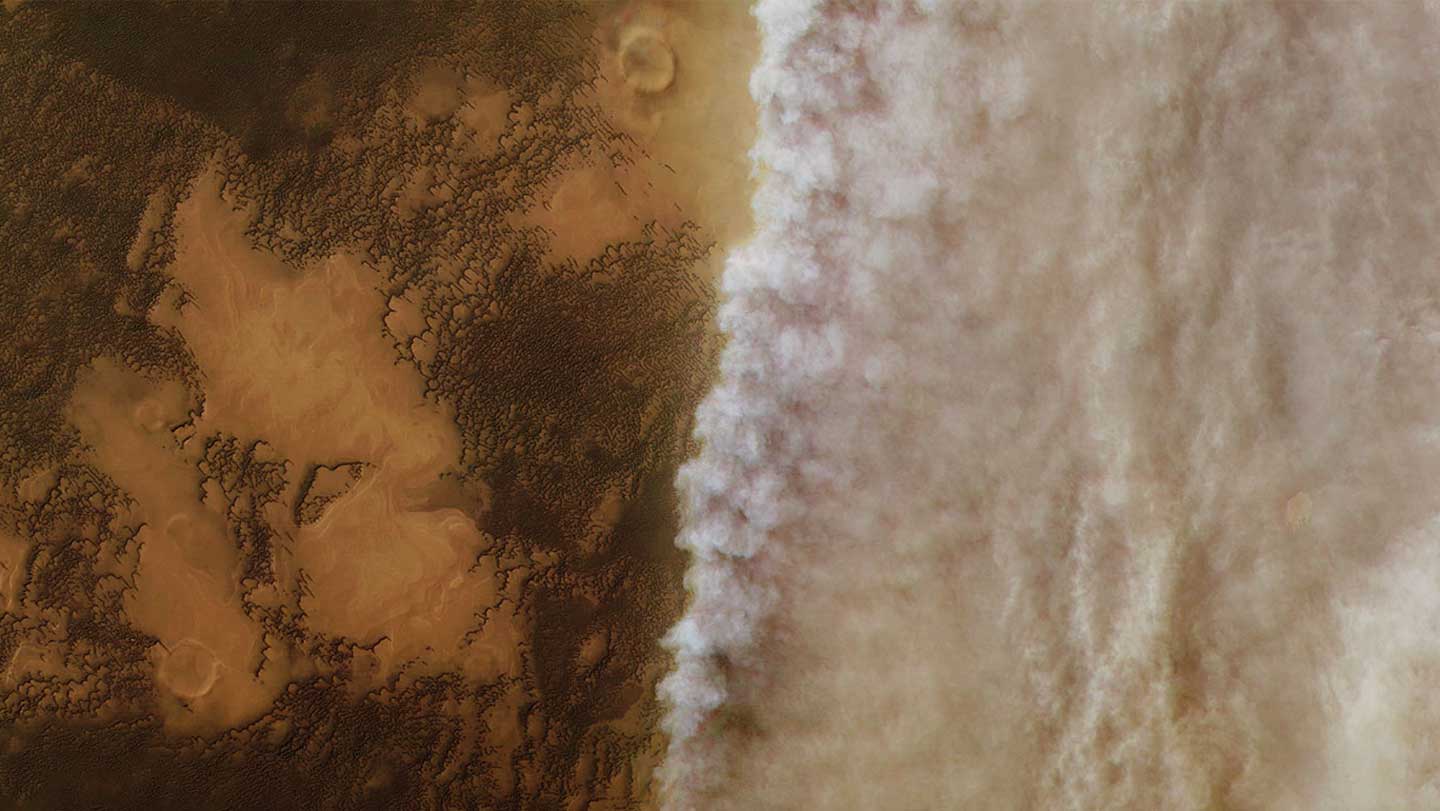
The Martian Year 34 global dust storm, a planet-encircling event that occurred on Mars in 2018.
A new study by a doctoral researcher at The University of Alabama in Huntsville (UAH), a part of The University of Alabama System, suggests global dust storms on Mars may organize the Martian atmosphere into regions favorable for electrical activity, increasing the potential for electrostatic discharges that could impact missions to the Red Planet, interfering with electronics, causing arcing between conductive surfaces and damaging exposed scientific instruments and spacecraft systems. The research, conducted by Chali Idosa Uga, a third-year Ph.D. student in the Department of Space Science at UAH, appears in The Planetary Science Journal.
The work focuses on the Martian Year 34 global dust storm, a planet-encircling event that occurred on Mars in 2018. It is one of the best-studied Martian weather events because multiple orbiters and rovers observed it simultaneously. Uga’s research focused on whether such events can create conditions in which electric fields may build up to levels favorable for electrical breakdown in localized regions of the lower atmosphere. The researcher was advised by Dr. Gary Zank, director of UAH Center for Space Plasma and Aeronomic Research (CSPAR) and Dr. Dennis Gallagher at NASA Marshall Space Flight Center.
“Mars does not have thunderstorms in the terrestrial sense, but it does have intense dust storms in a thin carbon dioxide atmosphere,” Uga explains. “During such events, dust is lifted, transported and mixed through the lower atmosphere, creating conditions in which grain collisions can separate electric charge while the weakly conducting atmosphere may allow that charge to persist.”
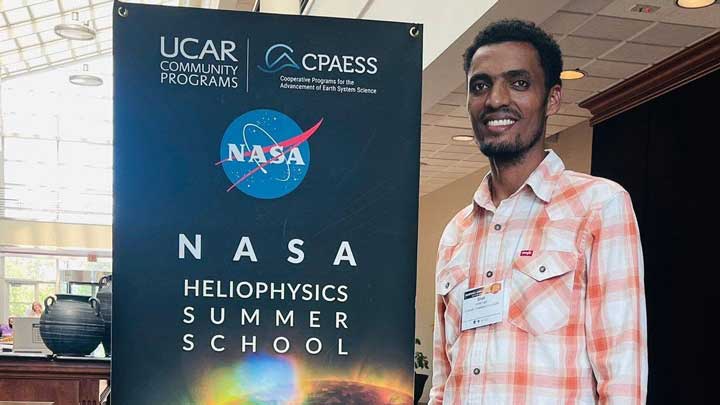
Chali Idosa Uga, a third-year Ph.D. student in the UAH Department of Space Science.
The study also highlights potential implications for future Mars missions, which may need to account for electrostatic environments during dust storms.
“For future Mars exploration, our study suggests that major dust storms should be evaluated not only as atmospheric, thermal and visibility hazards, but also as structured electrostatic environments,” Uga notes. “We do not quantify risk to a specific spacecraft, habitat, instrument or communication system. What we show is that during the Martian Year 34 global dust storm, the lower atmosphere developed localized and altitude-dependent regions where charge separation could persist, and modeled electric fields approached breakdown-favorable conditions.”
“Breakdown-favorable conditions" means that the electric field in the atmosphere became strong enough to approach the point where electrical discharge (like a spark or lightning) could occur. Uga emphasizes that the research was not aimed at claiming lightning detection on Mars but instead at understanding the physical conditions that could allow electrical processes to emerge.
“The Martian Year 34 global dust storm offered an exceptional opportunity to examine this problem in a realistic planetary setting,” the researcher says. “Rather than asking simply whether Mars produces lightning, I wanted to address a more precise and scientifically useful question: when and where does a global dust storm create the atmospheric conditions needed for strong electric fields and possible electrical breakdown?”
The study has implications for how scientists think about Martian chemistry and habitability.
“If electrical breakdown occurs in such regions, it could alter the local reaction environment of Mars’s dusty carbon-dioxide atmosphere,” the researcher says. “That is important because the chemical state of the near-surface atmosphere influences how we interpret oxidants, perchlorate-related chemistry and the preservation of organic molecules, key issues in assessing habitability.”
Uga added that electrostatic effects may influence how dust interacts with spacecraft systems and instruments. “This result is important for surface operations because electrostatic charging can change how dust interacts with exposed mission systems. Under intense storm conditions, charged dust may behave not only as a mechanical contaminant, but also as part of the electrical environment near the surface, influencing dust adhesion to materials, dust deposition on sensitive surfaces, instrument stability and charge accumulation.”
This month, Uga’s findings were recognized at the National Science Foundation 2026 Coupling, Energetics and Dynamics of Atmospheric Regions (CEDAR) conference in Des Moines, Iowa, an event that brings together researchers studying Earth's upper atmosphere, ionosphere, thermosphere and their interactions with space weather. The doctoral student’s presentation received an Honorable Mention award.
Looking ahead, Uga says the next step is to connect modeled predictions with laboratory work and future Mars observations.
“The future of this research is to move from diagnosing where Martian dust storms become electrically favorable to testing whether those conditions produce measurable electrical effects in the real atmosphere. Our study provides a physics-based framework that connects dust loading, atmospheric structure, turbulence, conductivity, charge relaxation and breakdown favorability during a global dust storm. The next step is to strengthen that framework with laboratory experiments, improved atmospheric-electrical modeling and future mission observations able to test whether the electrically favorable regions predicted by the model correspond to detectable signals.”