UAH researcher earns NASA Early Career Achievement Medal for advancing AI-driven foundational models for science
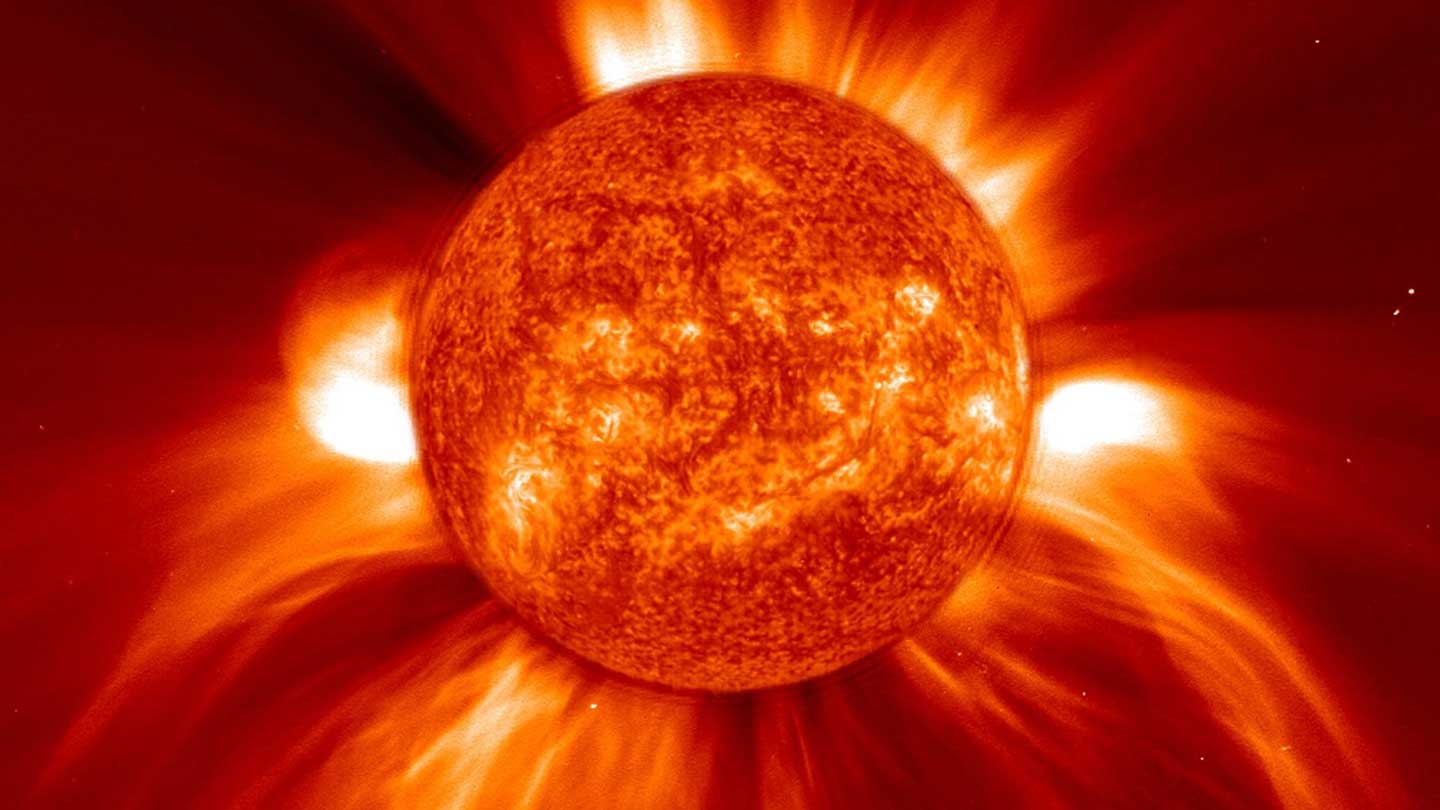
A widely spreading coronal mass ejection (CME) blasts more than a billion tons of matter out into space at millions of kilometers per hour. NASA’s Surya Heliophysics Foundation Model (Surya) studies and predicts the Sun’s behavior.
Dr. Sujit Roy, a researcher in the Earth Systems Science Center (ESSC) at The University of Alabama in Huntsville (UAH), a part of The University of Alabama System, has been awarded the NASA Early Career Achievement Medal. The honor is presented to government employees or contractors within their first 10 years of service who demonstrate unusual initiative or creative achievement that significantly advances NASA’s goals. Roy’s research supports NASA’s efforts to build artificial intelligence (AI) foundation models for science, models that are pretrained on large quantities of NASA data and can be fine-tuned for a variety of research applications.
Roy has worked with UAH’s ESSC since 2022, where he currently serves as the lead AI researcher for the foundation models team supporting the IMPACT AI team within NASA’s Office of Data Science and Informatics at Marshall Space Flight Center. The team collaborates with IBM Research and academic partners to design and develop foundation models for science.
The researcher has also collaborated with UAH researchers in the Center for Space Plasma and Aeronomic Research (CSPAR) to help secure access to advanced computational resources to develop and train AI foundation models. The general-purpose AI system is trained on huge amounts of space and solar data to help scientists study the Sun and space weather more efficiently.
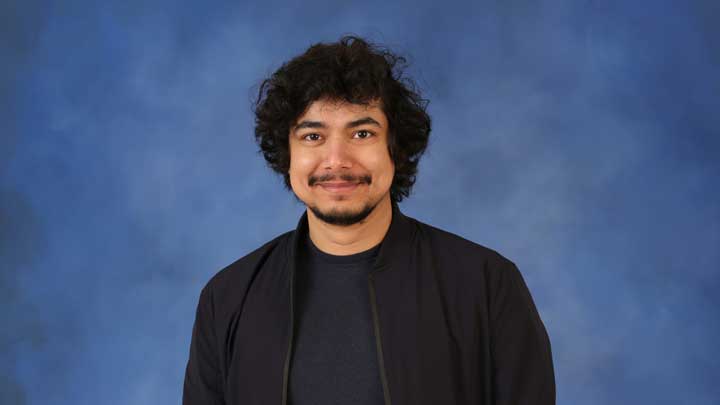
Dr. Sujit Roy, a researcher in the UAH Earth Systems Science Center (ESSC).
Roy’s work has significantly contributed to the development of multiple AI foundation models. One example is the heliophysics and space weather foundation model known as Surya, designed to enhance space weather forecasting by pushing the boundaries of what is currently possible in predicting and studying solar activities and their effects on space weather. The model is expected to improve predictions of solar flares and coronal mass ejections, phenomena that can significantly impact satellite operations, communications systems and power grids.
“Heliophysics and space weather have definitely been a big part of it, but the work has actually been broader than that,” Roy explains. “My journey with NASA foundation models started with Prithvi Geospatial, the Earth observation foundation model developed by NASA and IBM, which was really about proving out the idea that you could pretrain a large model on NASA's Earth science data. That was a formative experience for me, because it taught me how to think about building models that serve a whole community, not just one research question.”
From there, Roy’s research moved into Prithvi WxC, an open-source AI foundation model aimed at exploring weather and phenomena. “This pushed things further into physics-heavy domains and got me thinking about how you respect the underlying dynamics of the system you're modeling,” the researcher notes. “Now we're extending that foundation model thinking to the Moon and to Mars, building models for lunar surface science and Mars atmospheric prediction.”
For the Surya heliophysics foundation model, Roy and his collaborators leveraged extensive datasets from the Solar Dynamics Observatory, which has collected more than a decade of high-resolution solar observations. Training a model at this scale requires immense computational power, making access to national AI infrastructure essential. That need is being met through the National Artificial Intelligence Research Resource, a federally supported initiative that provides researchers with access to advanced computing, data and training resources. Roy and his collaborators were awarded approximately 650,000 GPU hours on cutting-edge systems, resources valued at nearly $5 million, enabling them to accelerate development of the heliophysics foundation model.
“Since this is an early career achievement medal, I truly feel the credit belongs to the mentors who shaped me along the way, from my Ph.D. advisors, to my postdoc, to NASA,” Roy says. “I want to especially acknowledge Rahul Ramachandran and Manil Maskey at NASA, who gave me the opportunity and the trust to take on problems that most people wouldn't hand to someone early in their career. Without that kind of mentorship, I wouldn't be standing here, and I don't take that for granted.”
Roy recently received the UAH Sapphire Excellence Research Impact Award on behalf of his team, celebrating partners whose work expands and strengthens UAH’s research enterprise. The inaugural award honored the NASA Surya Heliophysics Foundation Model Team, which draws on the expertise of individuals from different institutions, including UAH, to fuel NASA’s solar artificial intelligence (AI) model. The team collaborates with many academic and industry partners to design and develop foundation models for science, including IBM Research, Nvidia, the Jülich Supercomputing Centre, Clark University, Stanford University, the University of California at Berkeley, Arizona State University, Oak Ridge National Laboratory, Oregon State University and other institutions.
Looking to the future, Roy believes this research has reached an important inflection point.
“The foundation model paradigm has shown serious promise in Earth observation, and NASA is uniquely positioned to lead that same shift for space science, whether that's heliophysics, planetary atmospheres or lunar surface characterization,” the researcher says. “I'm very passionate about using these foundation models not just for prediction, but for genuine science discovery. Can we look inside what these models have learned and find they've captured physical relationships we didn't know to look for?
“Ultimately, I want to contribute to a future where AI is a first-class scientific instrument across NASA, not replacing scientists, but giving them the leverage to ask bigger questions than any single team could take on alone,” Roy concludes. “That's what keeps me running.”