UAH, NASA partnership pushes nuclear thermal propulsion toward making deep space exploration a reality
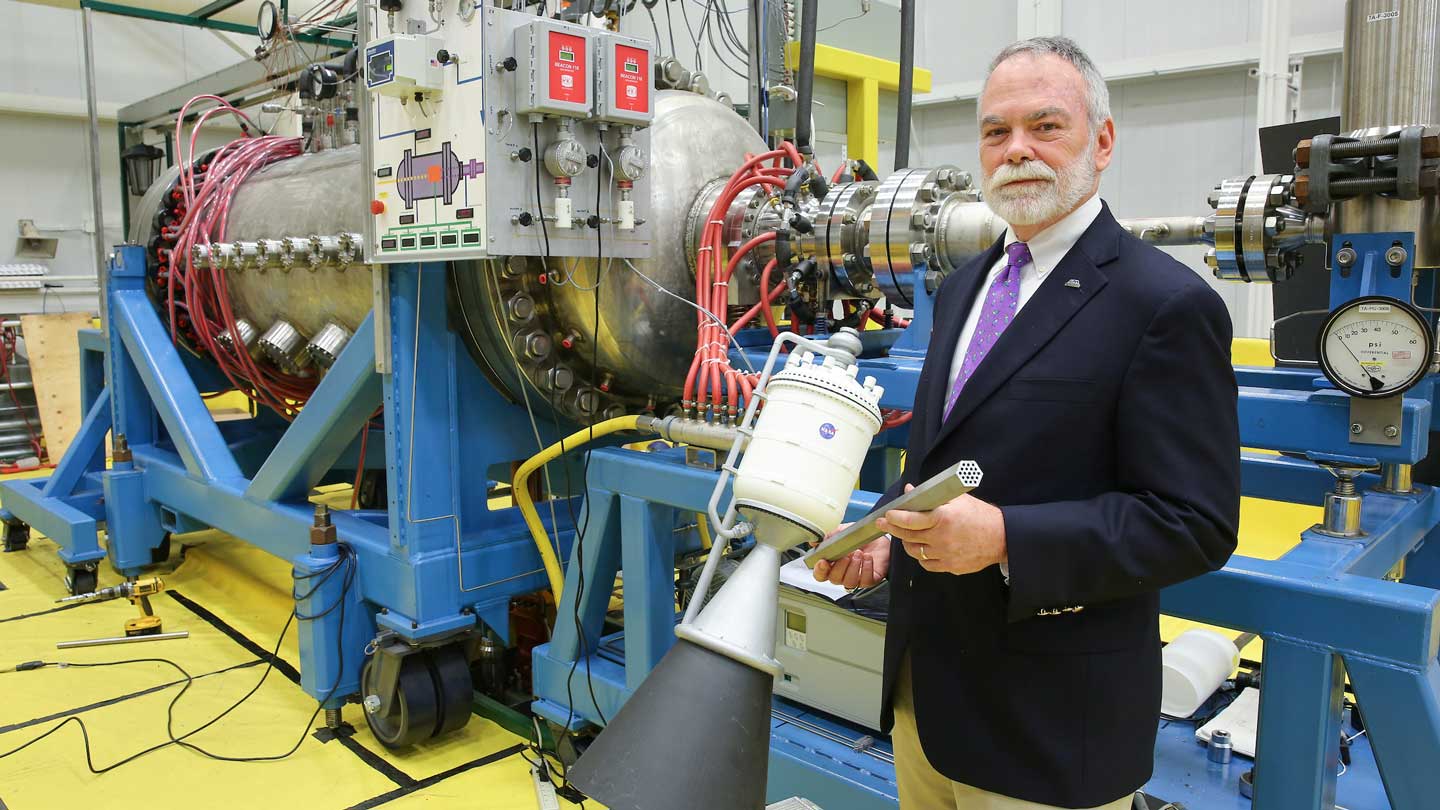
Dr. Dale Thomas, deputy director of the UAH Propulsion Research Center, holding a model of the nuclear engine and power rod that may be used for future space exploration power plants.
For decades, the challenge of deep space exploration has been less about where we want to go and more about how long it takes to get there. To meet those challenges, over 70 years ago researchers began experimenting with early nuclear propulsion systems as a means to power a future mission to Mars. Fast-forward to 2026, and The University of Alabama in Huntsville, a part of The University of Alabama System, has built a direct link to that long-ago era of invention and innovation to continue shaping the future of deep space exploration through nuclear thermal propulsion (NTP), a technology widely viewed as one of the most promising pathways for human beings to actually visit the wonders of our solar system.
NTP is a rocket propulsion method that uses a nuclear reactor as a heat source instead of chemical combustion. Inside the reactor, nuclear fission generates intense heat, which is used to superheat a lightweight propellant, usually hydrogen. That hot gas then expands and is expelled through a nozzle to produce thrust, pushing the spacecraft forward in much the same way a traditional rocket does. The key advantage is efficiency: nuclear heating can reach far higher temperatures than chemical rockets, allowing more thrust per unit of propellant, potentially drastically cutting travel times to destinations like Mars.
Working with NASA’s Marshall Space Flight Center (MSFC) and regional aerospace partners, UAH researchers are contributing to efforts aimed at advancing propulsion systems that are capable of dramatically reducing travel times while expanding the range of missions considered possible. Today’s renewed interest in nuclear propulsion is not the beginning of the story, however, but a continuation of work that dates back to over decades ago.
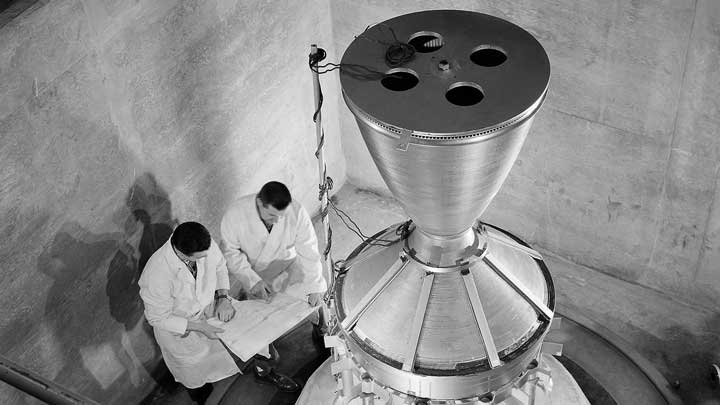
Technicians manufacture a nozzle for the Kiwi B-1-B nuclear rocket engine in the Fabrication Shop’s vacuum oven at the National Aeronautics and Space Administration (NASA) Lewis Research Center. The Nuclear Engine for Rocket Vehicle Applications (NERVA) was a joint NASA and Atomic Energy Commission (AEC) endeavor to develop a nuclear-powered rocket for both long-range missions to Mars and as a possible upper-stage for the Apollo Program. The early portion of the program consisted of basic reactor and fuel system research. This was followed by a series of Kiwi reactors built to test basic nuclear rocket principles in a non-flying nuclear engine. The next phase, NERVA, would create an entire flyable engine. The final phase of the program, called Reactor-In-Flight-Test, would be an actual launch test.
Revisiting a technology ahead of its time
“A lot of people don’t know there was a nuclear thermal propulsion program called Nuclear Engine for Rocket Vehicle Application (NERVA) in the 1950s and 1960s,” explains Dr. Dale Thomas, an eminent scholar of systems engineering at UAH and deputy director of the UAH Propulsion Research Center. “NASA had already completed extensive ground testing and was only a few firings away from certification. They made tremendous progress and were basically building the engine needed to get us to Mars. When Apollo wound down and the Space Shuttle became the focus, there was no longer any mission need for that kind of high-performance engine, so the program was canceled.”
NERVA’s legacy remains important today because much of the foundational engineering work has already been completed.
“That history is why nuclear thermal propulsion is much closer than many people realize,” Thomas says. “We have the designs and a treasure trove of ground-test data. We’re not starting from zero.”
Building the next generation of NTP
Today, UAH researchers are helping NASA study where and how these advanced propulsion systems could be used most effectively. Through collaborations with MSFC, UAH is currently supporting work in mission analysis, propulsion modeling, digital engineering and advanced nuclear propulsion concepts.
“When NASA studied human missions to Mars, NTP consistently emerged as one of the most practical options because it can shorten transit time significantly,” Thomas says. “The biggest issue on a Mars mission is radiation exposure from cosmic rays. Cutting travel time from six months to something much shorter, like two to three months, can make an enormous difference in crew safety. That difference matters for missions to Mars and beyond.”
Scientists had written off some outer-planet missions because the travel times were simply too long, Thomas adds. “With advanced nuclear propulsion, we’re looking at mission profiles that could reach Jupiter in about five years, Saturn in six, Uranus in eight and Neptune in nine. Those missions suddenly move from the ‘can’t do’ category into the realm of possibility. For the science community, that’s a game changer. Instead of waiting for rare planetary alignments or accepting missions that take 15 years or more, these propulsion systems could make outer-planet exploration routine enough so that scientists could realistically complete missions within their careers.”
UAH is also heavily involved in digital engineering efforts designed to help NASA evaluate future propulsion systems before physical hardware is constructed.
“One area we’re working on with MSFC is developing digital prototypes and digital twins for future nuclear propulsion systems so NASA can better understand performance, operations and mission tradeoffs before hardware is built.”
A “digital twin” is a detailed virtual model of a real-world system that mirrors how the physical system behaves in real time or under simulated conditions. In aerospace, a digital twin can represent an entire spacecraft, propulsion system, reactor or even a single engine component.
Despite the momentum surrounding nuclear propulsion research, major technical and infrastructure challenges remain. In the 1960s, engineers could conduct open-air testing, while modern environmental and safety requirements demand far more sophisticated facilities.
“The challenge today is testing,” Thomas notes. “In the 1960s you could test in the desert and exhaust into the atmosphere. That would not happen today because of concerns about radioactive contamination. The real bottleneck for nuclear thermal propulsion is ground testing infrastructure. Modern nuclear thermal testing would require exhaust capture and specialized facilities.”
Testing concerns have influenced recent program decisions across the aerospace industry. Thomas points to the Defense Advanced Research Projects Agency (DARPA) project DRACO, originally targeted as an orbital demonstration around 2027 or 2028 before being cancelled. Short for Demonstration Rocket for Agile Cislunar Operations, DRACO was an ambitious NTP effort that explored the idea of conducting the first real high-power engine firing in orbit instead of on the ground. The goal was to launch the spacecraft into a “nuclear-safe” region of space before activating the reactor.
“DRACO was a very high-risk approach because they were considering flying a nuclear thermal engine without a full hot-fire ground test,” Thomas said. “Historically, essentially no rocket engines have flown without ground testing first.”
The road ahead
Even considering the challenges, Thomas believes progress could move quickly if the necessary testing infrastructure is developed. UAH’s work with NASA has expanded into future-focused concepts beyond first-generation systems as well.
“We’ve been researching advanced concepts like centrifugal nuclear thermal rockets, gas-core systems and even fusion propulsion concepts,” the researcher says. “Those are still early-stage ideas, but they represent the next steps beyond today’s technology. NTP could also move quickly from an engine standpoint. You could potentially have an engine on a test stand within a year if the testing infrastructure already existed.”
Huntsville’s concentration of aerospace expertise positions the region to play a major role in that future development, creating a unique network of technical capabilities.
“One reason Huntsville is so well positioned is the concentration of expertise here,” Thomas notes. “You have MSFC, major aerospace contractors and the Oak Ridge National Laboratory just a few hours away. From a national perspective, this region is uniquely suited to support nuclear propulsion development and testing.”
NTP in particular aligns naturally with the region’s historic strengths in propulsion systems and space transportation. “NASA Marshall’s strength is traditional propulsion systems and overall space nuclear propulsion leadership, so nuclear thermal propulsion is very much in our wheelhouse,” Thomas says.
The researcher believes the implications extend far beyond any single mission, as UAH’s role in these efforts continue to expand through both near-term mission support and long-range research initiatives. “If the infrastructure comes together, Huntsville could become a major center for the future of space nuclear propulsion,” Thomas adds. “That’s why UAH and its partners are exploring these opportunities now.”
Looking to the future of NTP, UAH is leading development of the Centrifugal Nuclear Thermal Rocket, or CNTR, a revolutionary propulsion concept. Unlike traditional solid-core nuclear thermal engines, CNTR uses molten uranium contained within a rapidly spinning centrifuge, allowing hydrogen propellant to bubble directly through the liquid fuel and absorb extreme heat before being expelled as thrust. Researchers believe the approach could nearly double the efficiency projected for current solid-core nuclear thermal systems, potentially opening the door to even faster missions with lower astronaut radiation exposure and greater payload capability for deep-space expeditions.
“NASA is still defining exactly what the next phase of nuclear propulsion will look like, but UAH’s role is growing,” Thomas says. “We’re continuing advanced research while also moving back into more first-generation nuclear propulsion work tied directly to near-term missions.”