UAH graduate student turns childhood fascination with storms into award-winning research career
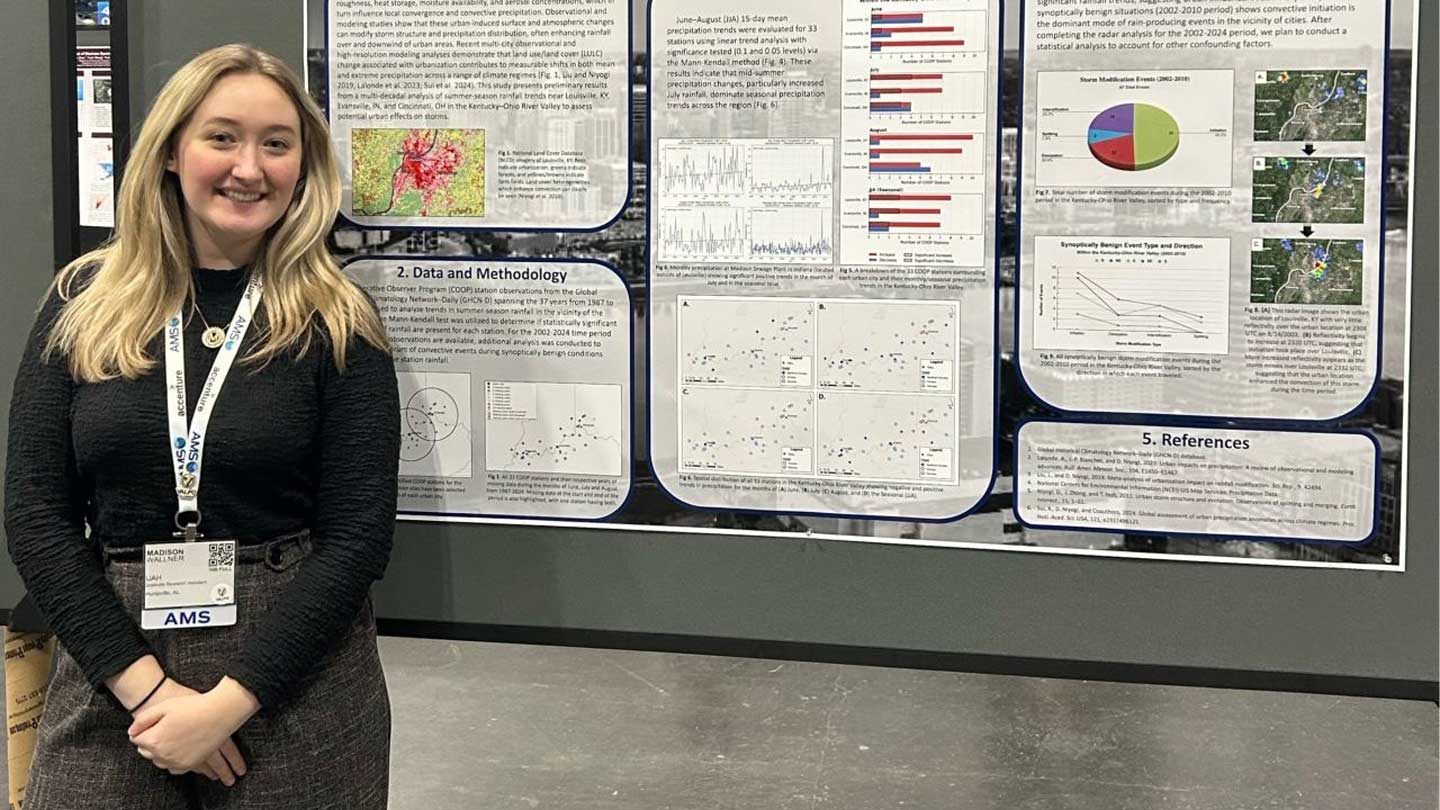
Madison Wallner is a graduate research assistant of Atmospheric and Earth Science (AES) at The University of Alabama in Huntsville (UAH).
For Madison Wallner, a graduate research assistant of Atmospheric and Earth Science (AES) at The University of Alabama in Huntsville (UAH), a part of The University of Alabama System, a childhood moment of awe has grown into a professional pursuit: the study of thunderstorms to predict why some events grow so much larger, leading to potential new prediction models.
Growing up in Columbus, Ohio, Wallner’s curiosity about the atmosphere began early. “The moment that truly solidified my decision to pursue this path came when I was 10 years old and experienced the June 2012 Midwest derecho firsthand,” she explains. “I still vividly remember being outside as the storm approached, leaning into the powerful wind gusts behind me just to stay upright.”
A derecho is a thunderstorm event that builds into an intense line of powerful straight-line winds. The 2012 derecho Wallner witnessed formed in the Midwest, then raced eastward across 700 miles and multiple states, including Indiana, Ohio, West Virginia, Virginia and the Washington, D.C. region, leaving millions without power and resulting in widespread damage, as well as 22 deaths.
That awe-inspiring demonstration of weather’s incredible force helped transform the researcher’s childhood wonder into a life mission. “That experience sparked a deeper curiosity about how storms form and what allows some of them to become so powerful and destructive in comparison to others,” Wallner says. “More than a decade later, that curiosity has led me to pursue my master’s degree at UAH.”
Now in her second year as a graduate research assistant in Atmospheric and Earth Science, Wallner has found a place where that early fascination has evolved into meaningful, real-world research. At UAH, she works alongside faculty and peers in a collaborative environment that has helped shape both her academic and professional trajectory.
“Working with Dr. Udaysankar Nair and being part of his research group has been one of the most rewarding experiences of my academic career,” the researcher notes. “During my time here, I’ve had opportunities I never would have imagined – from participating in weather balloon launches in support of the National Weather Service in Huntsville to conducting fieldwork along the Tennessee River.”
Her latest research examines how urban environments influence weather patterns, particularly precipitation in the Kentucky–Ohio River Valley. Her project depicts “how urbanization and land use change influence precipitation patterns,” Wallner notes. “Overall, the work highlights that cities are not just passive environments, but rather they actively influence where and how storms develop.”
Using decades of observational data and advanced analytical techniques, she has identified increasing precipitation trends and uncovered how storms can form or intensify near urban areas. “Understanding how cities influence rainfall is something that can directly impact communities, and contributing to that conversation within the Kentucky-Ohio River Valley – being from the region myself – is something I take a lot of pride in.”
Her journey at UAH has been defined not only by research, but by the invaluable support she has received. “I’ve been fortunate to work with incredible mentors, especially my advisor, Dr. Nair, who has guided me through every stage of the research process – from shaping the scientific questions to thinking critically about my results.”
Wallner also recognizes the broader network that has supported her success. “I’ve also benefited from collaboration with researchers across multiple institutions which helped strengthen both the technical and broader impacts of the work,” she says. “Similarly, I couldn't have done it without the constant reassurance and support from my friends and fellow graduate students at The University of Alabama in Huntsville.”
Making an IMPACT
The researcher’s time at UAH has offered her the chance to work directly with NASA resources as well. Wallner credits the NASA Office of Data Science and Informatics (ODSI) program – formerly NASA IMPACT – for helping advance her research and professional development. The initiative is an effort that seeks to advance scientific progress by providing users access to massive amounts of NASA Earth-observation data – weather, climate, land use, disasters – to act as a bridge between scientists and users that decision-makers can apply directly to real-world solutions.
Leveraging the combined resources of both UAH and NASA has not only supported her work as a graduate research assistant, it has also provided Wallner the opportunity to present her findings on the national stage, recently culminating in a moment at the 106th American Meteorological Society Annual Meeting that she will never forget.
“Receiving the First Place Best Urban Student Poster Presentation award at the 106th American Meteorological Society Annual Meeting was incredibly meaningful to me,” the researcher says. “This project represents years of work, from learning the fundamentals of atmospheric science throughout my undergraduate and graduate career, to developing my own research questions and analytical methods.
“Having it recognized at a national conference was both exciting and validating,” Wallner says. “Finding out about the award on my birthday made the moment even more special and memorable. What made this recognition especially rewarding was knowing that my research resonated not just scientifically, but also in terms of its real-world relevance. I also want to thank the UAH AES department for funding me to go to the conference.”
As Wallner prepares to defend her thesis this summer, she is already looking ahead. “Pursuing a Ph.D. is something I am strongly considering. I hope to continue working with NASA and to remain involved in advancing research within the meteorological community,” the graduate student concludes.
Wallner’s achievements highlight the impact of UAH’s research environment in helping students turn passion into profession. From a 10-year-old watching a powerful storm roll in to an award-winning researcher studying how cities shape the weather, her journey is a testament to where curiosity – and the right support – can lead.