For 2025 UAH grad Delaney Enlow, collaboration between academic disciplines builds path to success
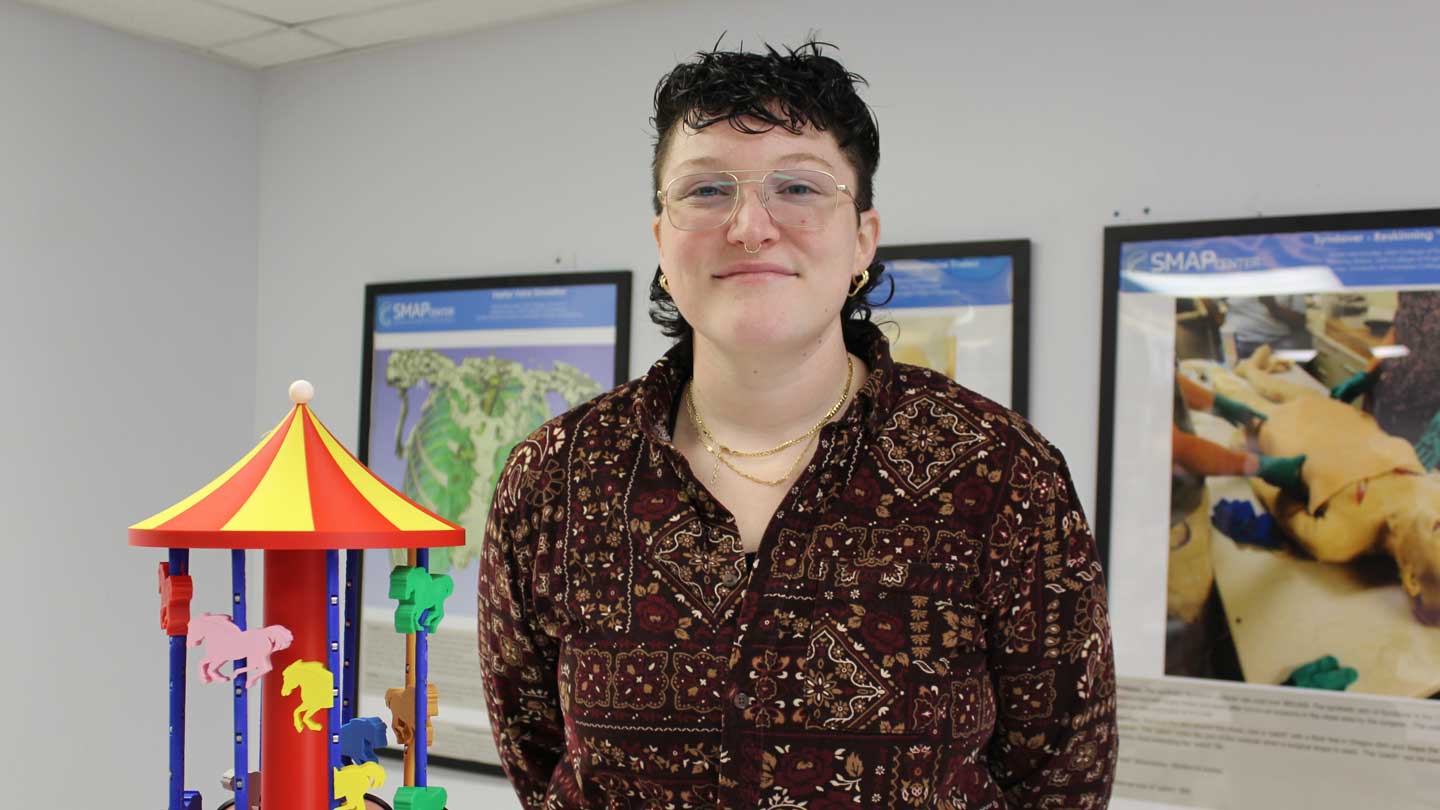
As a student employee of the Systems Management and Production (SMAP) Center at The University of Alabama in Huntsville (UAH), Delaney Enlow created custom medical training devices, like this carousel to illustrate bipolar stages, for the UAH College of Nursing. She graduates from the UAH College of Engineering during commencement ceremonies on Dec. 15, 2025, at the Von Braun Center.
Delaney Enlow contributed to better health care in our community as a student at The University of Alabama in Huntsville (UAH), a part of The University of Alabama System. But when she receives her diploma during UAH fall 2025 commencement ceremonies on Dec. 15 at the Von Braun Center, her bachelor’s degree will come from the College of Engineering, not the College of Nursing.
As a part-time employee at UAH’s Systems Management and Production (SMAP) Center, the mechanical engineering major learned how to design and produce custom devices to help nursing faculty train their students to perform medical procedures and evaluations.
“Working at SMAP has been a great experience,” Enlow said. “We get to learn how to work with customers. We get to practice our CAD (computer-aided design), very important for mechanical engineers. We get to go through the whole design process from beginning to end before we graduate. I think it allows me to feel more comfortable to go into the real world.”
SMAP, UAH’s largest research center, works primarily as a defense contractor to the U.S. Army. Under Director Dr. Gary Maddux, the center has also developed a thriving partnership with the College of Nursing that grew out of SMAP’s efforts to make personal protective equipment for local and regional hospitals during the COVID-19 pandemic.
SMAP produces realistic artificial skin pads at substantial cost savings so UAH nursing students can get lots more practice with injections, sutures and IVs. Along with refurbishing some of the college’s existing simulation training devices, SMAP engineers have designed models that more accurately mimic the look and feel of actual human bodies, again improving the training process.
“We’ve saved upwards of $50,000 to $80,000 for the College of Nursing because we’re able to do things at a much cheaper cost,” Enlow said. “Things that cost $20 commercially cost us $1. That’s just a small example. With the larger things we do, we are saving much more money.”
And, she adds, “I personally would rather my nurse practice on a fake simulator than on me.”
Nurses save lives, and better trained nurses save more lives. Enlow never forgets SMAP’s role.
“I’m really proud of what we’ve done for women’s health. We have some of the highest mortality rates with pregnancy and birthing (in our state). Making these simulators feel more realistic than some of the stuff that was commercially available, I believe, is going to help nurses help mothers.”
The engineering component is serious, but it can be a lot of fun, too.
“This is kind of my hobby. I use 3D printers at home, and so I get to do what I enjoy at work, too.”
Enlow points to the training tools for psychiatric evaluations that she produced for Dr. Veronica Sullivan, clinical assistant professor, College of Nursing. At first glance, they could be mistaken for toys and games. In particular, the brightly colored carousel stands out.
“Dr. Sullivan came to me with a drawing idea of bipolar stages on a carousel with horses at different spots. I was able to take that sketch and throw it into some CAD and fabricate something that was much more animated for the students.”
The spinning carousel is hard to forget – and that’s the point.
“The weirder or the cooler or the more interesting you can make a topic,” Enlow said, “the more likely students are going to remember it.”
SMAP’s medical group grew to add the Model Exchange and Development of Nursing and Engineering Technologies (MEDNET) program, an economic development effort targeting high school students interested in medical or manufacturing careers. Enlow helped teach the program to a group of Albertville City Schools teachers during its rollout in the spring 2025 semester.
“MEDNET definitely shows engineering isn’t just an engine or a car or a machine,” she said. “It shows that engineering goes into every realm. It’s allowed us to branch out and learn different things – and understand how broad engineering can be.”
Enlow hasn’t found another university that offers anything quite like SMAP’s direct collaboration with the College of Nursing and its MEDNET program. That’s why she’s taken a full-time job with the center.
“I was lucky enough that they want to keep me around and let me keep doing all this fun stuff. I will take a more managerial position with this group to continue to expand the medical group and MEDNET. We’re looking to go statewide and see what happens after that.”
Contact
Julie Jansen
256.824.6926
julie.jansen@uah.edu
Ann Marie Martin
(256) 824-5294
annmarie.martin@uah.edu
