UAH Earth System Science Center scientist selected as U.S. Drought Monitor author
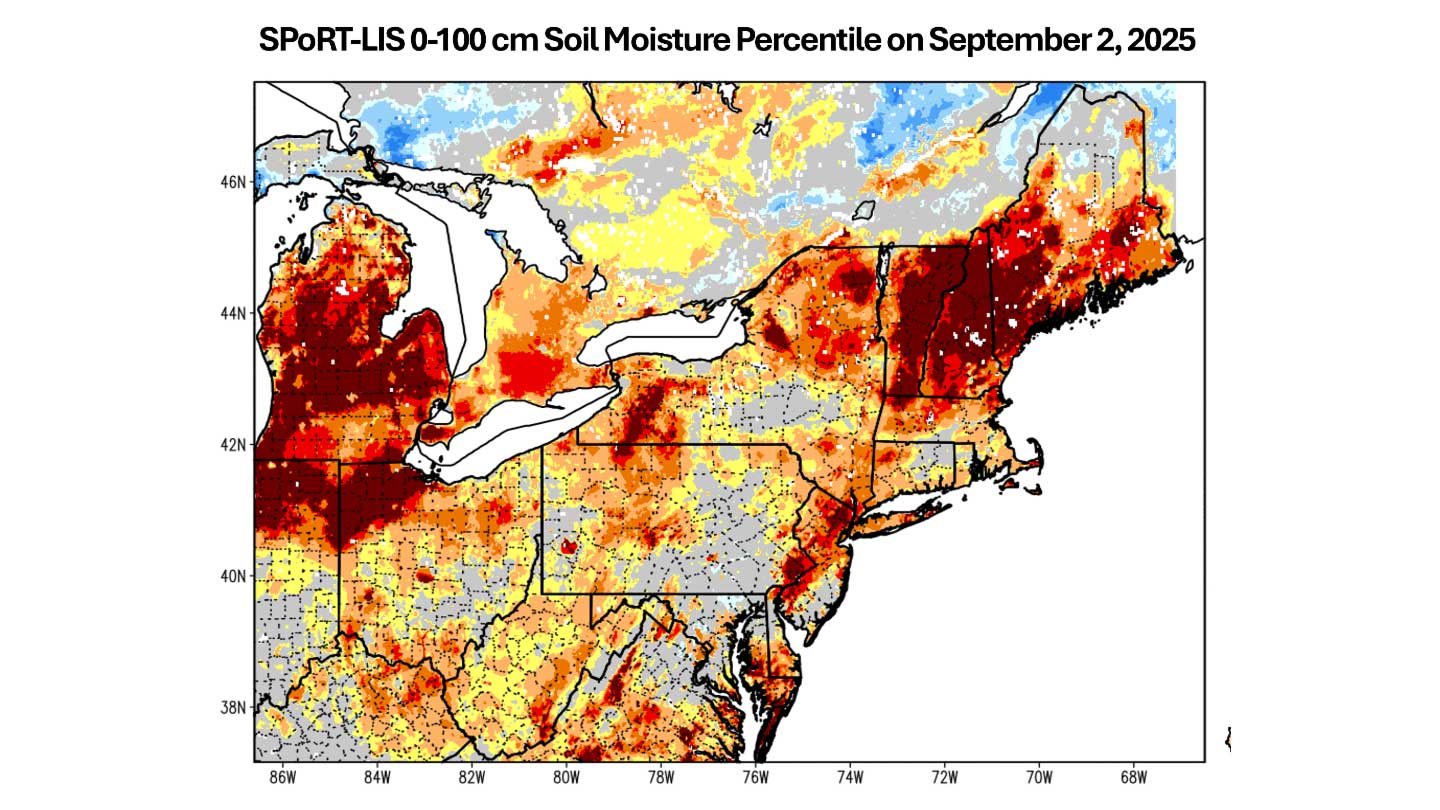
NASA SPoRT-Land Information System SPoRT-LIS.
A University of Alabama in Huntsville (UAH) scientist is stepping onto the national stage to help shape how the country understands and responds to drought. Jonathan Case, a principal research scientist for the Earth System Science Center at UAH, a part of The University of Alabama System, has been selected as one of two new NASA-affiliated authors for the U.S. Drought Monitor. His appointment strengthens the partnership between NASA and the U.S. drought community, while positioning UAH research at the forefront of one of the nation’s most trusted environmental decision-making tools.

Jonathan Case, Principal Research Scientist.
“I’m truly humbled and honored to join the team of U.S. Drought Monitor authors as a NASA affiliate and UAH scientist,” Case says. “My goal is to serve the drought community as well as previous and current Drought Monitor authors have done.”
As part of a rotating team of 11 experts, Case will contribute to the nation’s weekly drought assessment, helping define conditions that guide agricultural planning, water resource management, drought response efforts and drought aid across the country. He will formally enter the author rotation later this year.
The U.S. Drought Monitor is hosted by the National Drought Mitigation Center at the University of Nebraska Lincoln, and includes partnerships with the U.S. Department of Agriculture, the National Oceanic and Atmospheric Administration (NOAA) and NASA. These weekly products provide a national snapshot of drought conditions across the United States and its territories. Case’s selection reflects the growing role of NASA-supported science, including work conducted at UAH, in shaping this critical national resource.
While he formally joined UAH as a Principal Research Scientist in June 2025, Case has supported NASA’s Short-term Prediction Research and Transition Center (SPoRT), at Marshall Space Flight Center (MSFC) since 2006. Throughout his career, he has focused on research-to-operations efforts that translate satellite observations and land surface modeling into practical tools for decision makers.
A central part of his work has been the development of tools that turn complex satellite data into actionable insights. He co-developed the NASA SPoRT-Land Information System (SPoRT-LIS), a real-time and high-resolution land surface modeling framework that estimates soil moisture, evapotranspiration and other hydrologically relevant variables across the continental U.S. The SPoRT-LIS is frequently used with numerous other drought indicators by state, regional and national agencies who contribute to the weekly U.S. Drought Monitor initiative.
Case is also a member of NASA’s North American Land Data Assimilation System (NLDAS-3) applications development team, contributing to the next generation of national land surface datasets that underpin many operational drought tools. His research has examined lightning-initiated wildfires, tropical cyclone flooding, rapid drought-to-flood transitions in the Southeast U.S., satellite soil moisture data assimilation and improvements to numerical weather prediction through enhanced land surface initialization.
The researcher’s new role aligns closely with the mission of the Alabama Office of the State Climatologist (AOSC), which provides local context and stakeholder input that informs national drought assessments. By serving as a Drought Monitor author, Case reinforces the connection between NASA and UAH science and the broader network of state climate partners.
His appointment also underscores Huntsville’s growing influence in Earth system science. Long a contributor of NASA Earth Science data to the U.S. Drought Monitor, the region will now play a more direct role in shaping the weekly assessment, further showcasing the growing collaboration between MSFC, UAH and national climate services.
