UAH Distinguished Lecture Series speaker K.T. McFarland sees Iran war, global economic policies and burgeoning technologies as pivotal to U.S. security
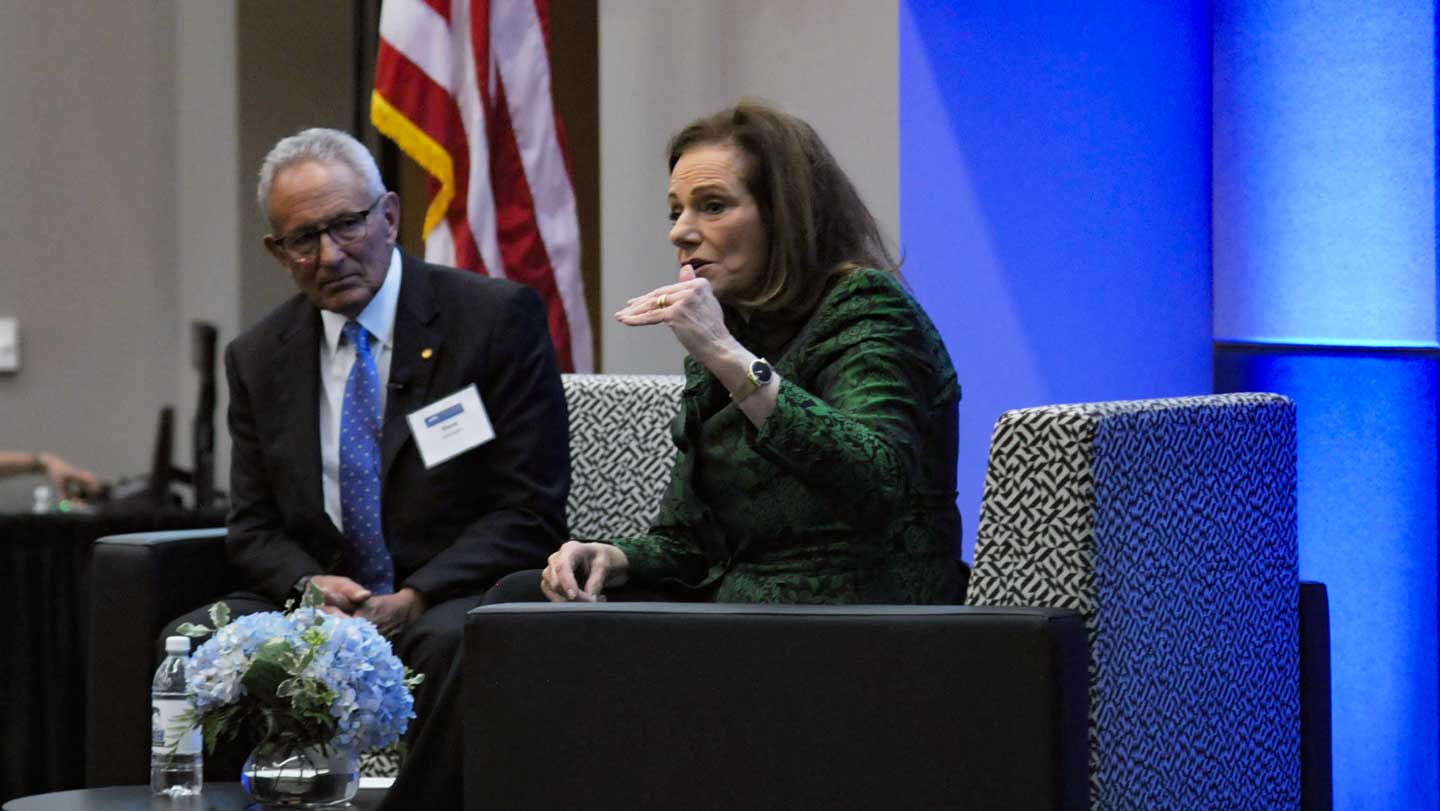
(L-R) Former WHNT news anchor Steve Johnson sits down for questions with K. T. McFarland, a longtime national security analyst and former government official, hosted by the UAH Distinguished Lecture Series.
The University of Alabama in Huntsville (UAH), a part of The University of Alabama System, hosted K.T. McFarland, formerly Deputy National Security Advisor to President Donald Trump, for a wide-ranging discussion on U.S. national security strategy, global economic shifts and the Iran war. McFarland’s talk centered on concerns about China’s economic rise, Iran’s nuclear ambitions and prolonged U.S. military involvement abroad, providing her perspective on how Trump-era policies and global market forces could shape the next generation of global leadership.
McFarland is a longtime national security analyst, former government official and media commentator with decades of experience spanning multiple presidential administrations. She served as Deputy National Security Advisor in the early months of the Trump administration and previously held roles in the U.S. Department of Defense during the Reagan era. Known for her focus on geopolitical strategy, energy policy and defense, McFarland has been a prominent voice on U.S. foreign policy, particularly regarding the Middle East, China and global economic competition.
The speaker opened her remarks by describing the broader strategic vision behind President Trump’s approach to national security, one she argued is often misunderstood. The speaker said Trump’s initiatives focus on reshaping long-standing global systems in trade, energy and security.
“Nobody speaks for Donald Trump, but I'm very familiar with his thinking,” McFarland said. “This is nothing new for him. If you look at things he said 30 or 40 years ago, he always said China was the issue, particularly China’s economy and science technology, and he also talked about nuclear weapons in Iran and forever wars in the Middle East.”
As she traced the origins of Trump’s Middle East strategy, McFarland described the administration’s early efforts to strengthen ties with Gulf nations and encourage regional cooperation against extremism and Iranian influence.
“The first term, Trump wanted to improve relations with the Arab Gulf states,” the speaker explained. “His first trip abroad was to Saudi Arabia. The young prince, Prince Mohammed bin Salman, got a leg up on everybody else, and he was able to consolidate his power during Trump’s first term. That ultimately led not to Saudi Arabia joining the Abraham Accords, but to the Abraham Accords themselves.”
Addressing longstanding goals and challenges
McFarland connected those diplomatic initiatives to broader energy and security goals she believed continue to define Trump’s strategic thinking. Central to that vision was American energy independence and the economic leverage created by domestic oil production.
“He talked about ‘drill, baby, drill,’ which he understood was probably the main reason we were stuck in all these wars in the Middle East, going back to the Bush administration and even the Suez crisis, because we needed access to oil. We always knew that you could get oil and gas out of shale rock, but it was very not feasible. It was dirty, complicated and really expensive, but by about 2005, 2010, we realized that we could get it out at a pretty reasonable cost. So, that might actually make the United States a real energy superpower.”
McFarland focused as well on the administration’s current strategy toward Iran, which she characterized as a campaign of sustained economic and military pressure intended to force negotiations while avoiding another prolonged ground war in the Middle East.
“Trump comes in and he says, ‘Okay, we’re going to squeeze Iran economically.’ It’s called the maximum pressure campaign,” the speaker explained. “The price of oil was going way down. And that bankrupts any country that needs to sell a lot of oil.”
The speaker described recent U.S. military actions and deployments in the region, including efforts to counter Iranian missile systems, naval operations and threats surrounding the Strait of Hormuz. “We went after the drones. We went after the missiles. We went after command and control. We went after all their ability to talk to each other and we went after their navy.”
Despite the military buildup, McFarland emphasized that the administration’s broader objective remains economic rather than territorial. “The plan right now is operation Economic Fury, not just kinetic fury,” she said. “I think the plan is a good one. We don’t want to invade anybody. We’ve seen how that doesn’t ever work, whether it’s Vietnam or Afghanistan.”
McFarland also warned that internal instability in Iran could intensify if economic conditions continue to deteriorate. “Right now, there are probably four factions in Iran,” she noted, citing concerns about the influence of the Iranian Revolutionary Guard Corps. “The worry is that the guys with the guns are the ones calling the shots, not the guys in the suits.”
Dominating the next generation of energy and technology
Beyond the Middle East, McFarland argued that Trump’s policies toward China, global trade and manufacturing are part of a broader effort to reposition the U.S. for technological and economic competition in the coming decades.
“Ten, 15 years ago, the world sort of had three places that would buy stuff. The United States has always been a good consumer society, but we assumed Europe would buy things, that they would be a big market. And we thought China would come along, as they developed a middle class, that they would buy things. But Europe has had flat economic growth, so they're not buying any consumer goods. China never recovered from Covid, so they don't buy stuff. So, the United States becomes the single most important consumer market in the world, and Trump thought that's worth something.
“We're giving it away, and we should charge for it,” the speaker continued. “So, he used tariffs to blow up the global trading system. It was due to be blown up because a lot of it had been put in place at the end of World War II. The system they came up with was that the United States would underwrite the security of our allies, including our former adversaries. We'd pay for their defense and underwrite their economies. We gave them really favorable trade deals.”
McFarland also addressed concerns over American dependence on China for critical manufacturing and rare earth minerals, warning that the next generation of competition will center on artificial intelligence, quantum computing and advanced technologies.
“There’s only one country that potentially has both,” she said, referring to energy and technological capacity. “We have the energy. And if we dominate the world’s energy supplies, and if you guys do your job, we then continue to dominate the technology, and we are in the position that no other country in the world is in to dominate the next generation.”
In closing her remarks, McFarland challenged UAH faculty and students to view themselves as participants in that future competition. “It’s going to be up to you to make sure that we have that technological edge. We’re in for a scary time, but I think in the end, we’ll prevail.”
The UAH Distinguished Lecture Series was conceived to enhance community collaboration among The University of Alabama in Huntsville, Redstone Arsenal agencies and corporations in Cummings Research Park. One desired outcome is to raise awareness and acquire a better understanding of current events and future trends, and how these activities could be positively influenced through the knowledge and actions among the region’s government, corporate and academic partners.