UAH awarded contract to support DARPA MICA program, a first for Department of Biological Sciences
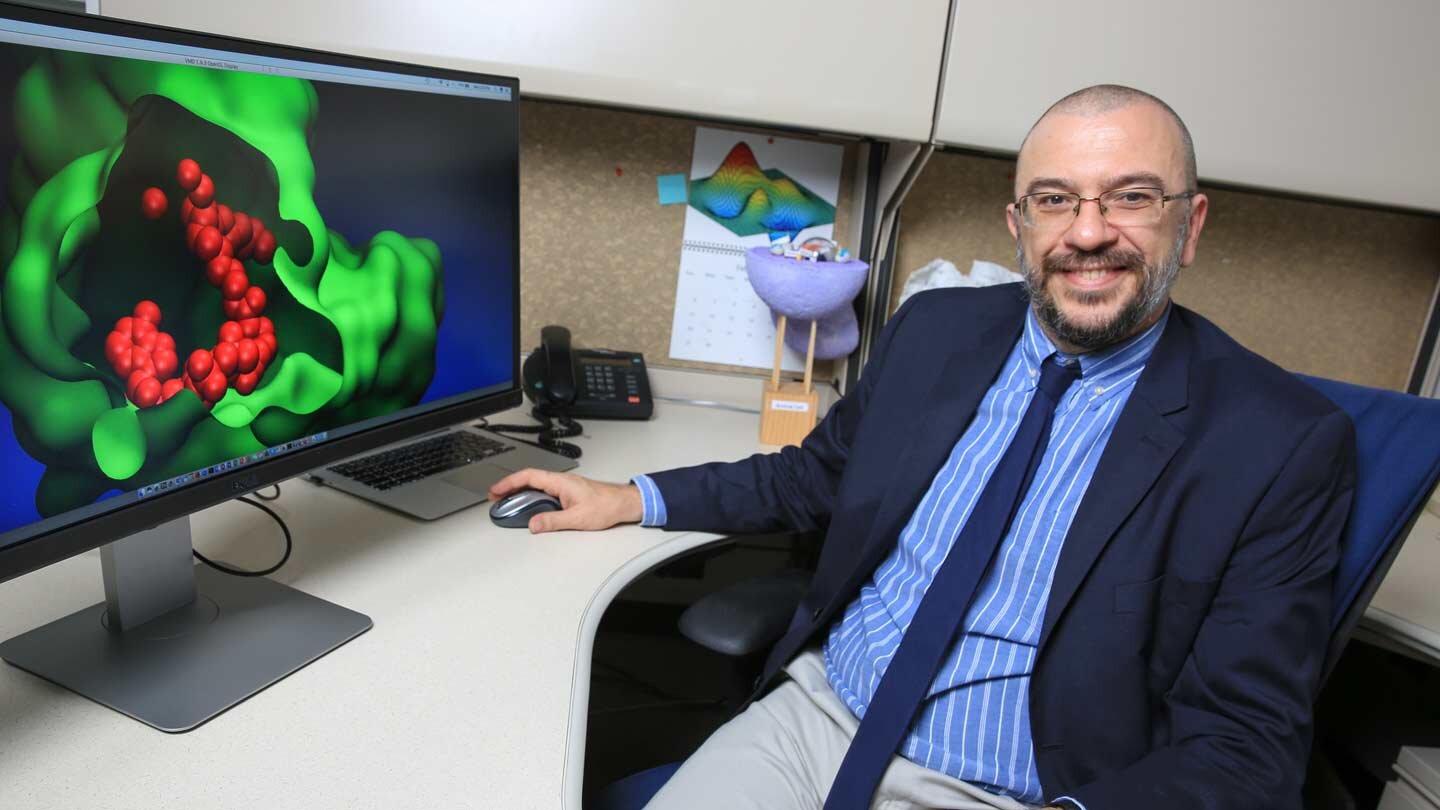
Dr. Jerome Baudry, Pei-Ling Chan Chair and chair of the UAH Department of Biological Sciences.
A researcher in the College of Science at The University of Alabama in Huntsville (UAH) has helped UAH land a Defense Advanced Research Projects Agency (DARPA) contract to support the Microsystems Induced CAtalysis (MICA) program. Professor Jerome Baudry, the Pei-Ling Chan Chair and chair of the Department of Biological Sciences at UAH, earned the contract in partnership with CFD Research Corporation, a Huntsville R&D company that develops engineering simulations, advanced prototypes and software where Dr. Ketan Bhatt, director at CFD, is leading the project. The award marks the first DARPA contract ever granted to the Department of Biological Sciences at UAH, a part of The University of Alabama System.
“It is tremendously gratifying and underscores the university’s ability to contribute at the highest levels of scientific innovation,” Baudry says. “This award is part of a DARPA initiative focused on advancing next-generation biotechnologies. I believe that UAH and CFD were selected because, together, we possess the expertise, leadership and credibility to provide such a diverse and integrated understanding of how experiments and theory can drive one another forward. CFD’s scientific excellence is recognized internationally, and this award marks a strategic development for UAH as we extend our collaborations with them into the broad umbrella of biophysics and life sciences. Truly, the sky is the limit for what we can accomplish together.”
The MICA program seeks to develop microsystems that can precisely influence the activity of molecular catalysts by using physical forces imparted by the microsystem. The initiative aims to address significant challenges in accurately predicting how molecular catalysts behave when integrated with microsystem surfaces and how their activity can be modulated in complex environments. Accurate prediction is crucial for controlling the activity of molecular catalysts integrated into microsystems to enable breakthroughs in areas like materials synthesis, drug delivery and environmental cleanup.
“The broad goal is to combine state-of-the-art computational modeling with experimental efforts conducted at partner institutions,” Baudry explains. “The UAH/CFD partnership is one of only two groups in the nation selected by DARPA to provide the theoretical and computational modeling backbone that will support experimental work conducted by some of the country’s top universities and research institutions. In other words, our role is to deliver high-level simulations and analysis that help design, prioritize and guide high-risk and high-cost experiments being performed at these leading facilities. This is how science is done these days: computational approaches and lab-based experiments go hand-in-hand in virtually every cutting-edge and complex research projects.”
Forging a culture of “interdisciplinarity”
By developing innovative modeling, simulation and fabrication techniques that can precisely influence molecular catalytic activity, MICA has the potential to unlock transformative breakthroughs in materials synthesis, medical therapeutics, environmental remediation and beyond. Current limitations include insufficient modeling tools for capturing interactions between molecules and inorganic surfaces, the inability to attach molecules to microsystems with nanoscale precision, and difficulties in achieving consistent catalytic performance across multiple reactions.
“It is recognition that biology and biotechnology are increasingly central to both national security and advanced technology, and we are honored to be part of this effort,” Baudry notes. “This places UAH, CFD and the Huntsville region at the core of a highly collaborative, national effort where our models accelerate discoveries across multiple experimental teams. This is particularly notable, since the other group providing theoretical and modeling support is also based in North Alabama. I think that it underscores how our region is now seen as a leader in integrated theoretical/experimental strategies of national security importance.”
The work will touch on a number of cutting-edge fields, from engineering simulations and software development, to prototypes and biomedical technologies.
“This project sits at the intersection of computational biology, biomedical science and engineering simulation,” Baudry says. “It involves large-scale molecular dynamics, artificial intelligence, quantum mechanical calculations and software development for simulating specific biological functions. The outcomes will inform biomedical and technological applications, while also advancing computational modeling approaches more broadly.”
As to UAH’s specific role in this research, Baudry reports he and his students will animate the CFD/UAH computational modeling and simulation effort at the atomistic and molecular levels.
“Our team will provide the theoretical and computational framework to analyze biological events at atomic resolution, closely reproducing in silico the many experimental variables that other teams are considering developing and using,” the researcher explains. “Our job, together with CFD, is to tell the experimental groups in the U.S. what experiments they should be doing, so they do not have to spend an enormous amount of time and resources planning for experiments that will not work or that will not generate the data they are looking for.
“As a biophysicist, I am at home working in a multidisciplinary setting. My UAH graduate students have come from every corner of science: biology, engineering, mathematics, physics, chemistry, psychology and computer science. The graduate student in my laboratory, Juliette Mark, is from the UAH Physics department, also in the UAH College of Science, like the Department of Biological Sciences to which I belong. This culture of interdisciplinarity positions us ideally to work with CFD and take our place at the cutting edge of our nation’s research in national security and defense. It is no surprise that our College of Science was able to team with CFD to be selected by DARPA: we have the interdisciplinary expertise, and CFD has an outstanding team of talent in these many fields as well. Together, we are perfectly synergistic,” Baudry concludes.
CFD Research Corporation serves a wide range of industries, including aerospace, defense, life sciences, materials and energy, and providing services like cyber data sciences and drug discovery.