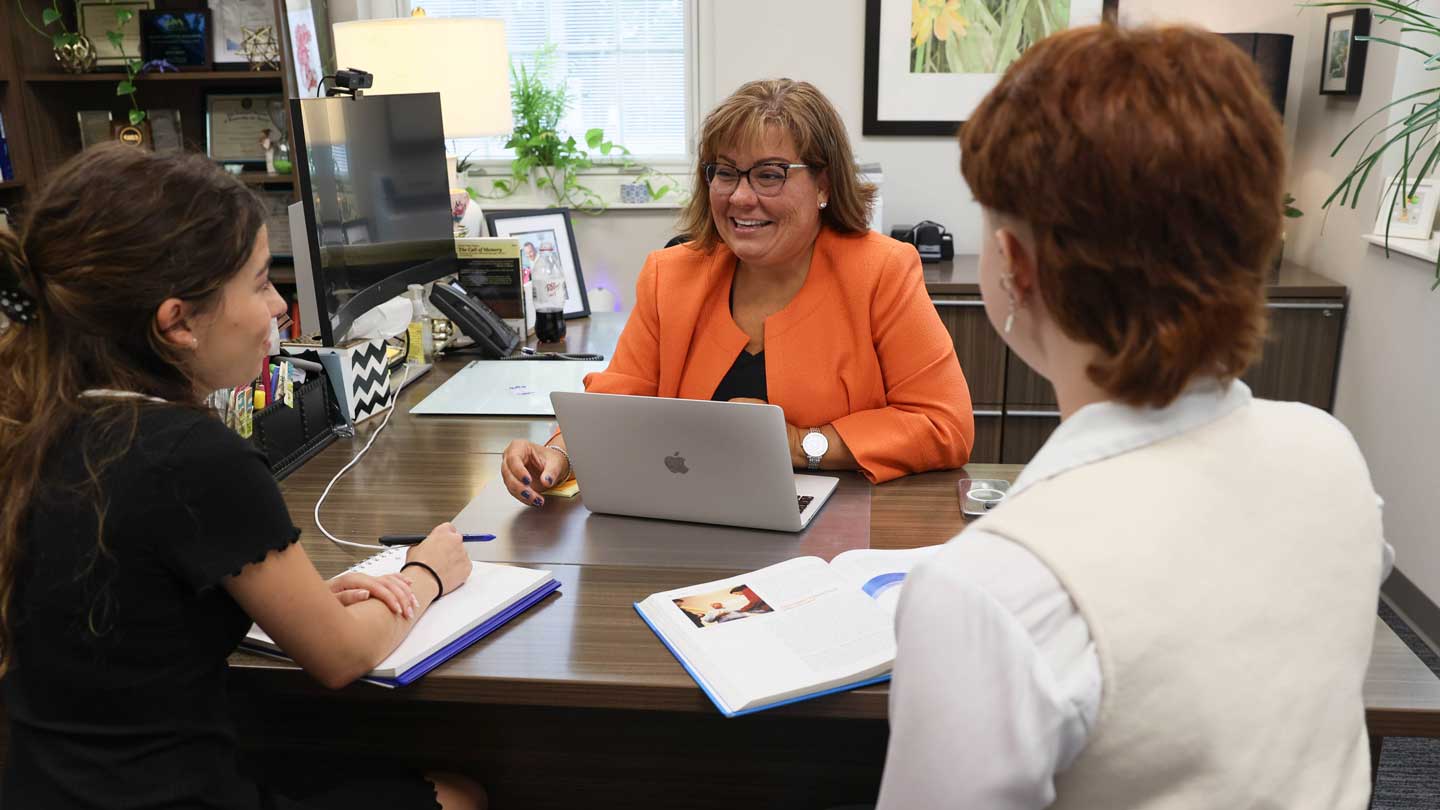
Dean Jodi Price, center, talks with students in her office in Morton Hall on the campus of The University of Alabama in Huntsville (UAH). A longtime psychology professor, department chair, associate dean and interim, Price was named dean of the College of Arts, Humanities, & Social Sciences on Jan. 22, 2026.
Dr. Jodi Price loves to celebrate good news with her students at The University of Alabama in Huntsville (UAH), a part of The University of Alabama System. Since joining the Department of Psychology in 2008, she’s enjoyed congratulating countless students on new jobs, academic advancements and, of course, receiving their degrees.
“I’m still thrilled on graduation days,” Price says. “I know how momentous and important those days were in my life, and so I also recognize how important it is, not only to the student, but to their families, who, in many cases, have sacrificed a great deal to get their student across that stage. There’s something really special about watching them walk across that stage and knowing that they are better off than they were when they entered our doors four years prior in terms of upward mobility and career trajectory.”
Price has had ample opportunities to encourage students on their journeys. Along with her role as psychology professor, she’s served as department chair, associate dean of the College of Arts, Humanities, & Social Sciences (CAHS) and, since June 2025, interim dean. Now, as the new dean of the college, effective Jan. 22, 2026, Price is implementing plans to build on the college’s significant strengths and attract ever more students to its life-changing programs.
“I think our biggest strength is our passion for helping our students,” Price says. “We are all dedicated instructors, and we are united in our desire to see students accomplish their educational and career goals.”
Some students arrive on campus with a clear career vision. Some don’t. And some discover a better fit for their talents and interests once they’ve explored a few options.
In a college with disciplines ranging from history to music performance, painting to sociology and many more, Price places prime importance on assisting students from point A to point B.
“We don’t know what their point B is,” she says. “They have to decide what that is for themselves. But once they identify what their goal or goals are, then we can figure out a game plan.”
To keep the game plan viable, the college offers a proactive advising approach that doesn’t wait for struggling students to seek help.
“This gives us the opportunity to do outreach to all students and to ensure that all students who might need assistance are getting that assistance early and often. These changes at the advising level have meant that students are more likely to stay on track and are more likely to graduate without any unnecessary courses. This has improved students’ experiences.”
Price herself shifted career paths as an undergraduate.
“I began college as a pre-law major, as I had always intended to pursue a law degree. It was after taking a couple of psychology courses that I realized I had found my true passion. These introductory psychology courses exposed me to the breadth of concepts that psychologists study and the many ways that psychologists contribute to our understanding of human behavior and making our lives better. I knew that I wanted to learn more!”
Price earned a B.S. in psychology and an M.S. in experimental psychology from The University of Tennessee in Chattanooga and then a Ph.D. in experimental psychology from The Georgia Institute of Technology.
“I am a cognitive psychologist by training, and my research examines how learning and memory change across the lifespan. My focus is to help students be better students and to help older adults have the best cognitive outcomes as they age.”
Price’s lab examines several factors that contribute to student success:
- How students decide what to study
- How long they should study some material before moving on to study other material
- How they evaluate their understanding of material
- How these decisions change based on time constraints – night before an exam versus two weeks before an exam
- Likelihood of material being on an exam
- Nature of the exam – multiple choice versus essay
It’s all useful preparation for guiding a college of diverse learners.
“As someone who has spent their career studying student learning and the various factors that either facilitate or hinder that process, I draw upon my own research and that of others in how I approach my teaching and research and, most recently, in my role as dean,” Price explains.
“I regularly meet with students to discuss what the literature indicates are ideal versus problematic study methods, and I find it so rewarding when students report that those discussions have allowed them to improve their grades across all of their courses.”
Price’s deeper understanding of the reasons why students choose to enroll in a class, to skip a class or even to drop a class helps her and her team provide valuable support.
“Knowing these factors has allowed me to work with my incredible team to devise and implement processes and outreach to support students at these key decision points – around registration or near the drop-add or withdrawal deadlines – to ensure they have all the necessary information to make the best decision in their case, since each student's situation and needs are different from the next.”
Serving as an advocate, for faculty as well as students, is one of Price’s primary goals.
“Within my first month of being in the interim role, I increased travel funding for our students and faculty, so that they can attend conferences and present their work. I also raised part-time pay – nowhere near where it needs to be, but it’s an improvement. Naturally, we’re always constrained by budgets, but we’re trying to recognize what a critical role our part-timers play in contributing to our students’ success.”
Price is also focused on raising greater awareness in the Huntsville community about the many exciting things happening in CAHS.
“I have challenged our faculty to be more engaged, and I’ve been focused on building relationships with folks in the community. We are doing phenomenal things, and we are producing excellent students with wonderful skill sets. The more people see and appreciate that, the more people benefit.”
Contact
Julie Jansen
256.824.6926
julie.jansen@uah.edu
Ann Marie Martin
(256) 824-5294
annmarie.martin@uah.edu