UAH researchers support Southeast flash drought assessment to improve future drought preparedness
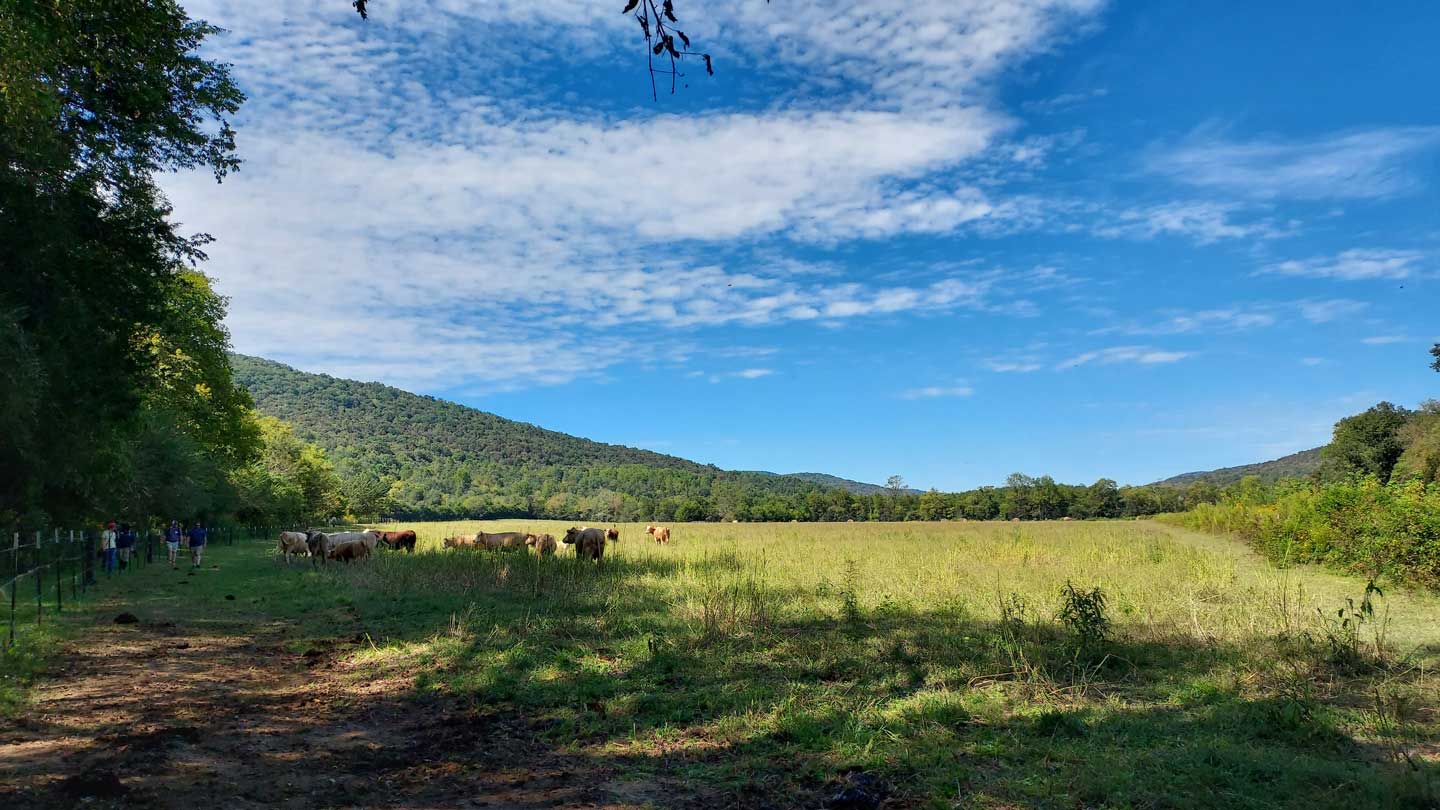
Pasture in Jackson County, Alabama, documented during field visit.
The Earth System Science Center (ESSC) at The University of Alabama in Huntsville (UAH), a part of The University of Alabama System, played a key role in supporting a newly published regional drought assessment that details important lessons learned from the flash fall drought experienced across the Southeast in 2023. The report brings together input from state climate offices and drought practitioners from Alabama, Florida, Georgia, Mississippi, North Carolina, South Carolina, Tennessee and Virginia to provide context and expertise on how rapidly evolving drought conditions affect communities, resources and livelihoods. UAH is home to the Alabama Office of the State Climatologist (AOSC).
Drawing on its ongoing role in drought monitoring and coordination across Alabama and the broader Southeast, the AOSC developed the assessment in collaboration with the National Oceanic and Atmospheric Administration’s (NOAA) National Integrated Drought Information System (NIDIS) and the Southeast Drought Early Warning System (DEWS). Contributors responded to a comprehensive survey reflecting on the 2023 event, including how impacts manifested in their states, how drought conditions were communicated to the public, how agencies coordinated and engaged stakeholders and where gaps remain in drought research, monitoring and communication that are particularly relevant to the Southeast.
Because the Southeast is generally water-rich, there can be the misconception that the region does not experience frequent droughts. The fall 2023 event, however, reinforces the opposite: drought does occur in the Southeast, it can escalate quickly and it can have major economic and operational impacts – especially for sectors like agriculture and forestry.
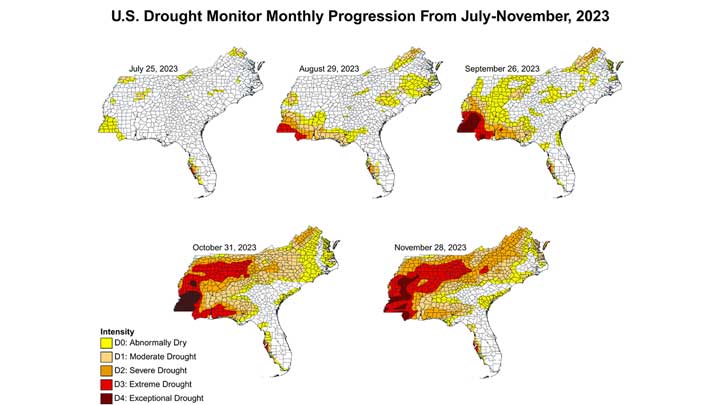
The USDM Monthly Progression shows how rapidly drought worsened across the Southeast from July – Nov. 2023. Mississippi, Alabama and Tennessee were the hardest hit regions.
“The 2023 fall flash drought showed how quickly drought conditions can emerge in the Southeast, challenging how we traditionally think about drought in the region,” says Dr. Lee Ellenburg, Alabama Associate State Climatologist and a research engineer at UAH. “By documenting this event at a regional scale, the assessment helps identify where improved monitoring and coordination are most needed to better prepare for future droughts.”
The AOSC supports a wide range of activities, including climate monitoring, data analysis, stakeholder engagement, applied research and communication. As part of this broader work, the organization provides weekly input to the U.S. Drought Monitor for Alabama, contributing local expertise and data to help identify where drought is occurring in the state and how severe it is. This sustained role in drought monitoring and engagement provides the foundation for the AOSC’s participation in broader, multi-state assessments of drought conditions across the Southeast.
Drawing on this expert input and multiple data sources, the assessment explains how the fall 2023 drought developed across the region, how widespread and severe it became, the impacts observed across key sectors, and the lessons identified to strengthen drought preparedness moving forward.
The report highlights the role of UAH-based researchers in translating regional collaboration and applied science into practical information that supports real-world planning, decision-making and response. While grounded in data and regional expertise, the assessment was intentionally developed as a public-facing resource rather than a traditional academic paper. The goal was to make drought information more accessible, capturing both the physical evolution of the 2023 event and the real-world impacts experienced across the Southeast. By publishing through NIDIS, the report also serves as a formal, citable reference that documents regional challenges, monitoring gaps and priority needs, supporting future research, coordination and preparedness efforts related to flash drought in the Southeast.
“This assessment was designed to bridge the gap between technical drought science and what people actually experience on the ground,” says Brianne Minton, AOSC climate services coordinator and UAH ESSC researcher. “By bringing together regional input in an open, accessible format, the report captures how quickly drought can develop in the Southeast and why our monitoring and communication tools need to reflect those realities.”
