Dr. Karen Frith, retired UAH College of Nursing dean, leaves legacy of excellence, innovation, growth
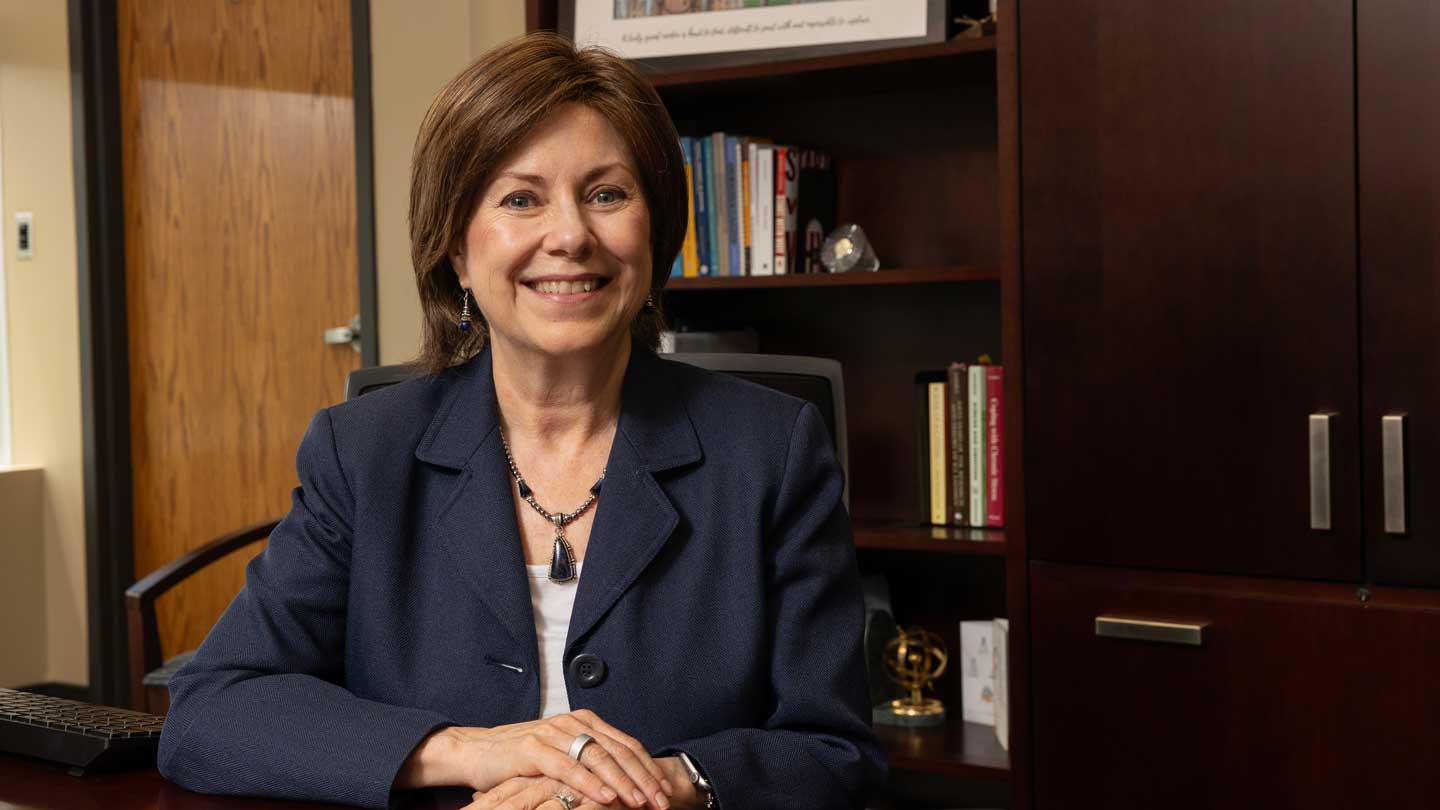
Dr. Karen Frith reflects on her long career as a nurse and nurse educator in her office at the College of Nursing at The University of Alabama in Huntsville (UAH) on June 5, 2026.
Dr. Karen Frith smiles often as she talks about the students mentored, the programs begun and the advancements made during her 19 years in the College of Nursing at The University of Alabama in Huntsville (UAH), a part of The University of Alabama System. But the newly retired dean wears a special smile of satisfaction when she mentions an expected increase in enrollment for fall 2026.
When Frith assumed the deanship in 2021, she faced a world-changing challenge. Amid the COVID-19 pandemic, university enrollment in general was falling, and the College of Nursing’s enrollment dropped because nurses were on the front lines treating patients with the deadly infection. As she led her college to address the issue, her strategies incorporated a significant component of her 42-year career as a nurse and nurse educator.
“I’ve always used technology to try to push healthcare and education,” she says. “I was writing a regular column on emerging technology, and so I was reading deeply and broadly about different kinds of technology. I wanted to keep us at the forefront of technology use and development. At a science and technology university like UAH, that’s important. We’re a very strong nursing program, and we use technology to innovate.”
To boost enrollment, technology produced a new recruiting tool designed to grab teens’ attention.
“We worked with a company to develop our Discover Nursing app – augmented reality that we take into high school classrooms. We’re the only college in the university that has it.”
The app offers a virtual UAH nursing student describing the requirements of a good nurse – “You have to be sharp, steady and compassionate all at once” – as well as the ways UAH helps students achieve that goal through “hands-on training, high-tech simulations and support from professors.” There’s also a panoramic tour of the cutting-edge Simulation & Learning Innovation Center – “our best recruiting feature,” Frith notes.
Finding the right path
Frith, a Decatur native, did not hear her calling to be a nurse in high school. Although her seventh-grade science teacher, Susan Estes, had inspired a fascination for the study of biology, Frith’s love of singing in church choirs and school choruses led to a music major at Jacksonville State University. But as a freshman worried about job prospects, she questioned her dedication to music. Then she looked through a friend’s fundamentals of nursing textbook.
“I had never thought about it at all. I was drawn to biological sciences, and when I saw it applied in nursing, that was my trigger to change my major.”
Frith transferred to Auburn University, graduating in 1984 with a Bachelor of Science in Nursing. Early in the program, she told her advisor that she intended to teach nursing someday. Although Frith didn’t know much about nursing at that time, she had long witnessed a teacher’s drive and dedication in her mother, Ann Harris.
“The person who influenced me the most in my life was my mother. She was a third-grade teacher for many years and ultimately was a principal at one of the magnet schools in Decatur. She was my role model and professional mentor from a very young age.”
Her mother’s best friend, Dr. Myra Ashley, inspired her to pursue her doctoral degree and teach in higher education.
Frith served in clinical and administrative roles as a nurse for eight years while advancing her education. She received a Master of Science in Nursing in nursing administration from the University of North Carolina at Greensboro in 1988.
She began her teaching career in 1992 as assistant professor of nursing at Georgia College & State University. While working as a nurse educator, she earned her Doctor of Philosophy in Nursing Science with an education concentration in 2001. She rose to associate professor and chair of the Department of Healthcare Systems and Informatics in the School of Nursing. When the school added kinesiology and music therapy departments, she simultaneously served as department chair and graduate coordinator for all master’s degrees in the newly formed School of Health Sciences.
In 2007 she returned to North Alabama and joined the UAH faculty as an associate professor of nursing with a focus on teaching and research; she was promoted to full professor in 2012.
Frith resumed an administrative role in 2015 when she became associate dean for undergraduate programs. Her focus included adopting a new curriculum and implementing stronger evaluation processes. When she became associate dean for graduate programs in 2018, she instituted computer-based testing, oversaw the Doctor of Nursing Practice program and served as the college’s first Ph.D. coordinator.
Along with teaching and serving as an administrator, the third major focus of Frith’s career was research. She has produced an extensive publication list that includes explorations of productivity and occupational stress in nursing, fall prevention in older adults and the use of AI in nursing. Research opportunities led to various adjunct faculty appointments, including at Pontifícia Universidade Católica do Rio Grande do Sul in Brazil and the University of Rostock in Germany.
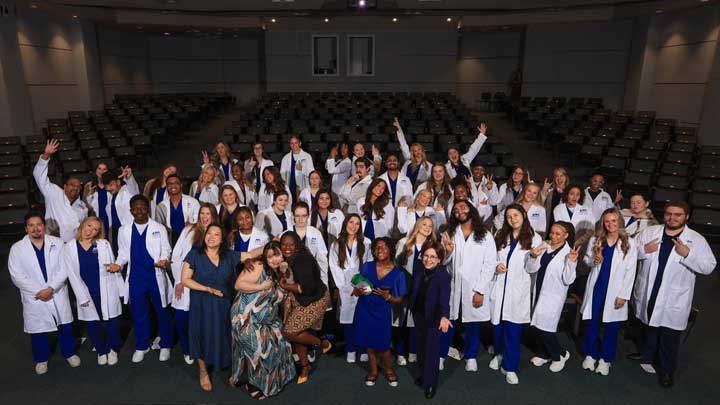
After posing for the serious commemorative photograph for the UAH College of Nursing’s spring White Coat Ceremony on Feb. 20, 2026, students, faculty and staff express their comedic side. This was the last such ceremony for Dean Karen Frith, front row, far right, who retired at the end of June.
New routes to nursing
Ensuring top-quality nursing graduates has always been Frith’s goal. A point of pride for the whole college is its first-time pass rate for the National Council Licensure Examination (NCLEX). In the past 10 years, 90% or more of the graduates hit the mark. In the past five years, the rate has never dipped below 99%, and in two of those years, it was 100%.
This outstanding pass rate helped her develop another long-held goal: an accelerated degree program.
“It’s a fast-track program into nursing,” she explains. “We developed it for people who already had a non-nursing degree but wanted a career change. It’s been a highly successful program. We seated our fourth class in January, and we have a waiting list.”
A key component to success was an apprenticeship option for educating nurses developed by the Alabama Board of Nursing and the Alabama Office of Apprenticeship.
“We were the first in the nation to develop a second-degree program – finish in 11 months, entering in January, finishing in early December – paired with an apprenticeship at a hospital. There were other accelerated programs, but ours was the only one paired with an apprenticeship.”
The program may be fast, but the pass rates are just as high.
Dean Frith also started two different master’s degree tracks: psychiatric mental health nurse practitioner and nursing education.
Expanding healthcare outreach
Along with raising the profile of the UAH College of Nursing and its students, Frith saw her deanship as an opportunity to benefit the larger community.
“Ours is not a preventive healthcare system, but that’s where nurses really shine. In my presentation for this job, I talked about improving our community by engaging nurses in health advocacy, education and outreach to improve health equity.”
In May 2024, the college hosted its first Health Equity Summit with leaders from government, corporate, nonprofit and academic sectors. The Health Equity Symposium followed in October 2024 with a broader community conversation addressing cognitive health, veterans care, and cancer prevention and support.
Then Frith created a new position – the college’s first associate dean for research – and appointed Dr. Azita Amiri.
“Azita talked about how she would like to do this thing called Neighborhood Nursing. And I said, ‘Let’s do it!’ This initiative combines the roles of a nurse – health education, health advocacy and making real changes in people’s lives with preventive care before major illnesses develop.”
They announced UAH Neighborhood Nursing on Oct. 21, 2025, at SHINE 2025 (Spotlighting Health Innovation and Neighborhood Engagement Symposium). The program began in select neighborhoods in January 2026.
“Faculty and students have seen over 500 neighbors,” Frith says, “and they’ve had some really remarkable lifesaving things happen.”
Ongoing passion for service
Frith enters retirement with the same energy and excitement she brought to nursing and teaching. Along with traveling and a return to gardening and other hobbies, she has a volunteer list: mentoring adolescent girls and working with older adults through UAH Neighborhood Nursing.
Before she cleared out her College of Nursing office, the bookcase behind her desk held a one-word sign – Mentor – that figuratively pointed both ways.
“A former student of mine gave me that. It encapsulates what my whole career has been about – mentoring others for success. It reminds me why I’m here. That piece can go into retirement, because mentoring doesn’t stop when a career stops.
“I’ve done a lot of fun things. I’ve had a fantastic career. I’ve gotten to affect the lives of many people through my own direct care or indirectly through the care that our students, and ultimately graduates, have given to patients.
“Now I want to be as passionate about retirement as I’ve been about my career.”
Learn More
Contact
Julie Jansen
256.824.6926
julie.jansen@uah.edu
Ann Marie Martin
(256) 824-5294
annmarie.martin@uah.edu