After 15 years of transformative leadership, Dr. Shankar Mahalingam, dean of the UAH College of Engineering, is set to retire
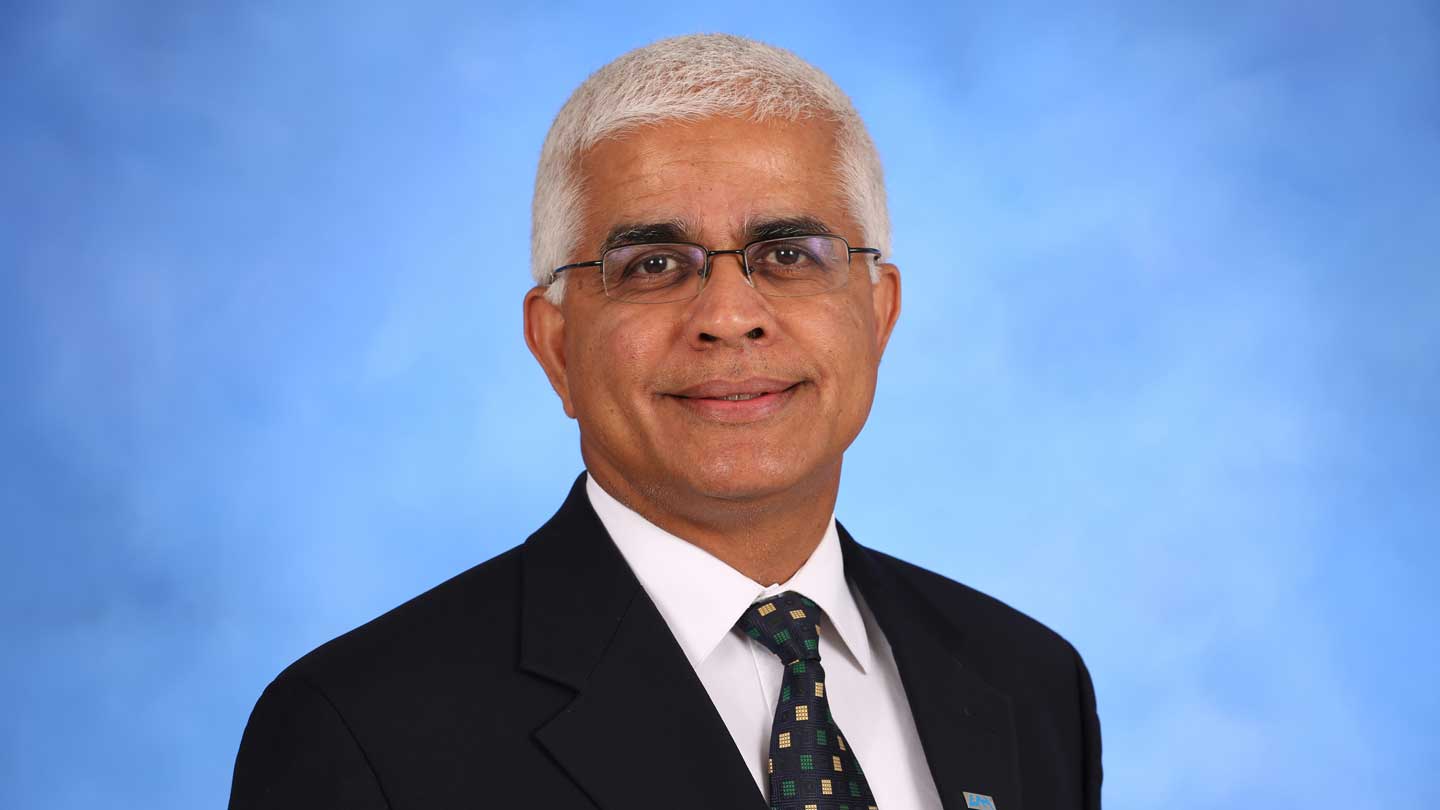
Dr. Shankar Mahalingam, Dean of the UAH College of Engineering and Distinguished Professor of Mechanical and Aerospace Engineering.
Following 15 years of distinguished service as dean of the College of Engineering at The University of Alabama in Huntsville (UAH), Dr. Shankar Mahalingam is retiring, concluding a tenure marked by significant growth, innovation and national impact at the institution. Under his leadership, the College rose to No. 73 in U.S. News & World Report graduate engineering rankings, and UAH achieved a No. 1 ranking in Alabama for federal research expenditures in six categories.
“Dr. Mahalingam's leadership helped transform the College of Engineering into a more research-intensive, student-centered institution with deeper regional impact,” says Dr. David Puleo, UAH provost and executive vice president for academic affairs. “He promoted faculty excellence, expanded student opportunities and elevated the college's national reputation. His contributions to the college and university will endure. Both personally and on behalf of the university, we are grateful for his 15 years of leadership and wish him every success in his well-earned retirement.”
Mahalingam joined UAH, a part of The University of Alabama System, in 2010, bringing a lasting commitment to academic excellence, research advancement and student success. Over the course of his stewardship, the College experienced unprecedented expansion in enrollment, research activity, faculty distinction and regional engagement, leaving an enduring legacy at UAH and across North Alabama.
Under his leadership, research expenditures increased nearly tenfold, and undergraduate enrollment increased by approximately 1,000 students. The College awarded 5,590 bachelor’s degrees, 1,937 master’s and MSE degrees and 287 Ph.D. degrees. The four-year graduation rate doubled to 45%, and the six-year graduation rate increased from 57% in 2018 to 64% in 2025. All engineering programs maintained continuous Accreditation Board for Engineering and Technology (ABET) accreditation.
Under his purview, 11 faculty members earned National Science Foundation CAREER Awards, and numerous faculty also received professional honors, including Fellow status in a number of global professional organizations, including the American Institute of Aeronautics and Astronautics (AIAA), the American Society of Mechanical Engineers (ASME), the Institute of Electrical and Electronics Engineers (IEEE), the International Society for Optics and Photonics (SPIE), ASM International, the American Association for the Advancement of Science (AAAS) and others.
Mahalingam guided the College through significant strategic initiatives as well, including securing nearly $5 million in signed commitments for space and room naming opportunities in the new Raymond B. Jones Engineering Building, set to open in 2026. In 2025, he led the launch of a new undergraduate certificate in Artificial Intelligence in Engineering Applications and spearheaded the adoption of the College’s strategic plan, Flight Plan 2032, focused on student success, research excellence and regional engagement.
A Distinguished Professor of Mechanical and Aerospace Engineering, Mahalingam is leaving an enduring imprint on the institution, the region and his field. He made significant contributions to research in turbulent combustion, wildfire modeling, flame-spread experiments and computational fluid dynamics (CFD). A widely respected researcher and scholar, his work in large-eddy simulation and direct numerical simulation advanced understanding of turbulence–flame interactions, fire behavior and environmental phenomena critical to addressing global climate challenges. His research portfolio also includes studies in acoustic and shear-flow interactions and cardiovascular fluid dynamics, reflecting the breadth of his expertise.
At UAH, Mahalingam has remained actively engaged in teaching and research, offering undergraduate and graduate courses in statics, fluid mechanics and computational fluid dynamics. He served as principal investigator or co-principal investigator on funded projects from NSF, the USDA Forest Service, the Joint Fire Science Program (JFSP), the Strategic Environmental Research and Development Program (SERDP) and the National Institute of Standards and Technology (NIST), and co-advised multiple UAH Ph.D. and master’s students.
A strong advocate for experiential learning, Mahalingam expanded co-op, internship, and undergraduate research opportunities aligned with Huntsville’s aerospace, defense and advanced manufacturing sectors. He played a key role in establishing major scholarships and endowed support, including the Mary Makima and Lester B. Ross Scholarship, the Andrew and Betty Ventre Memorial Scholarship supported by a $3.1 million endowment for graduate students, and the $1 million Ashok K. Singhal Endowed Chair in Mechanical and Aerospace Engineering.
Mahalingam earned a Bachelor of Technology degree from the Indian Institute of Technology, Madras, followed by a Master of Science degree from Stony Brook University and a Ph.D. from Stanford University, all in mechanical engineering. He began his academic career at the University of Colorado Boulder as Assistant and Associate Professor of Mechanical Engineering before joining the University of California, Riverside. There, he served as a professor for 10 years, including six years as Chair of the Department of Mechanical Engineering, during which he helped establish both the M.S. and Ph.D. programs.
Mahalingam has served as Associate Editor of the AIAA Journal, as a Member-at-Large on the Board of the Western States Section of The Combustion Institute, and is an Associate Fellow of AIAA and a Fellow of ASME, AAAS and Sigma Xi.
Beyond campus, Dr. Mahalingam championed STEM outreach throughout North Alabama, strengthening partnerships with K–12 schools, community colleges, industry and regional organizations. His emphasis on the “UAH Charger engineering family” fostered a strong sense of pride while highlighting student and alumni achievements.