The Alabama Office of the State Climatologist provides monthly climate reports that analyze statewide temperature, precipitation, and drought trends. Each report also highlights how that's month’s climate compared to long-term historical normals. A summary of every monthly report is featured on this page, with options to view the full report in PDF format or explore the complete climate report archive.
Alabama Climate Report: August, 2026
Brought to you by the Alabama Office of the State Climatologist
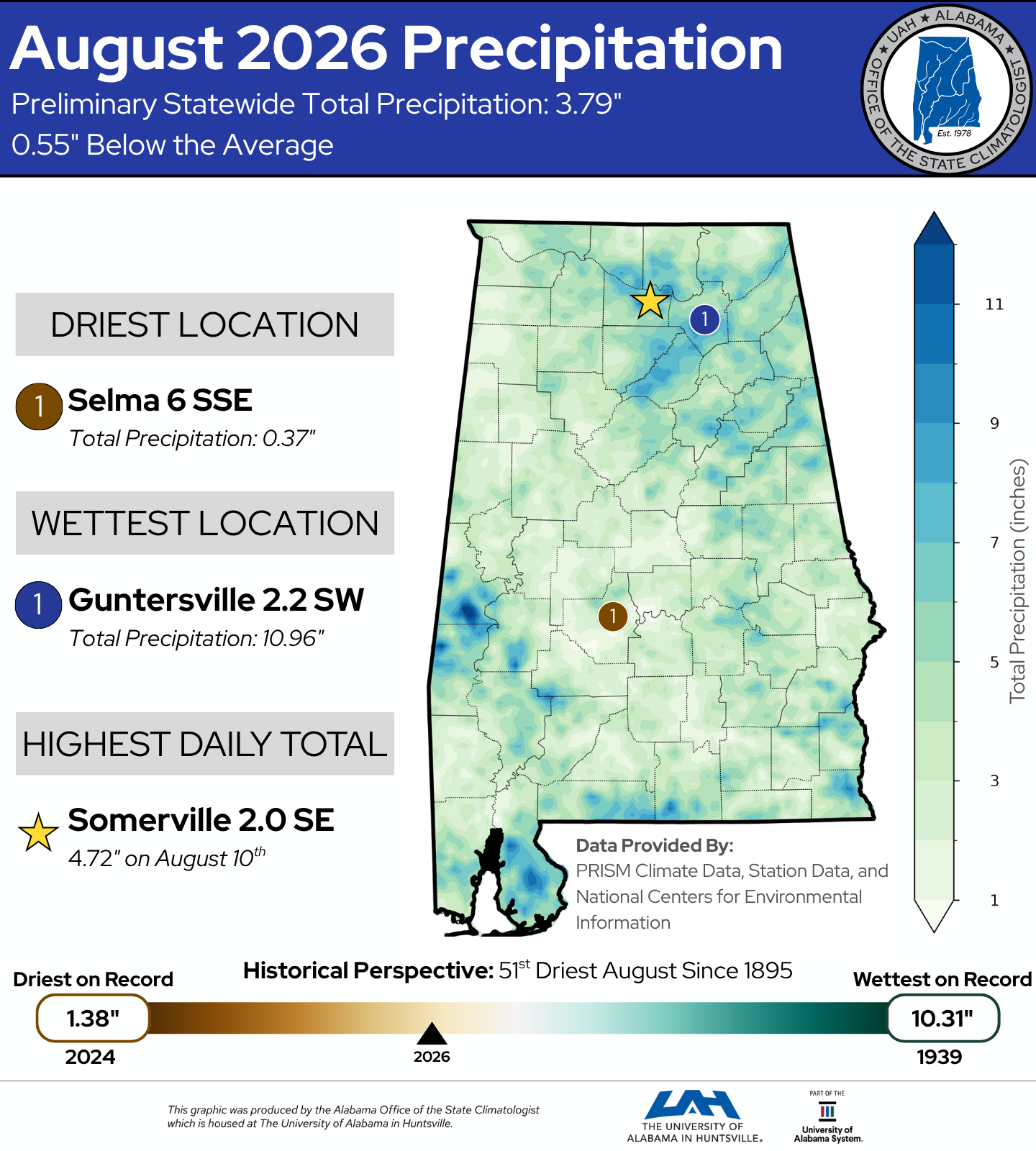
August 2026 precipitation infographic showing statewide rainfall totals, notable observations, and historical ranking. Data Source: NCEP Stage IV Quantitative Precipitation Estimates.
Precipitation Summary (Figure 1)
Statewide, August was the 51st driest August on record, with 3.79 inches of precipitation—0.55 inches below the long-term normal. However, rainfall was highly variable, with the driest areas concentrated in west and central Alabama while the wettest areas were in northeast Alabama.
Precipitation Highlights
- Driest site: Selma 6 SSE – 0.37 inches of rainfall
- Wettest site: Guntersville 2.2 SW– 10.96 inches of rainfall
- Highest Daily Rainfall Total: Somerville 2.0 SE – 4.72 inches on August 10th
- 51st Driest August on record statewide
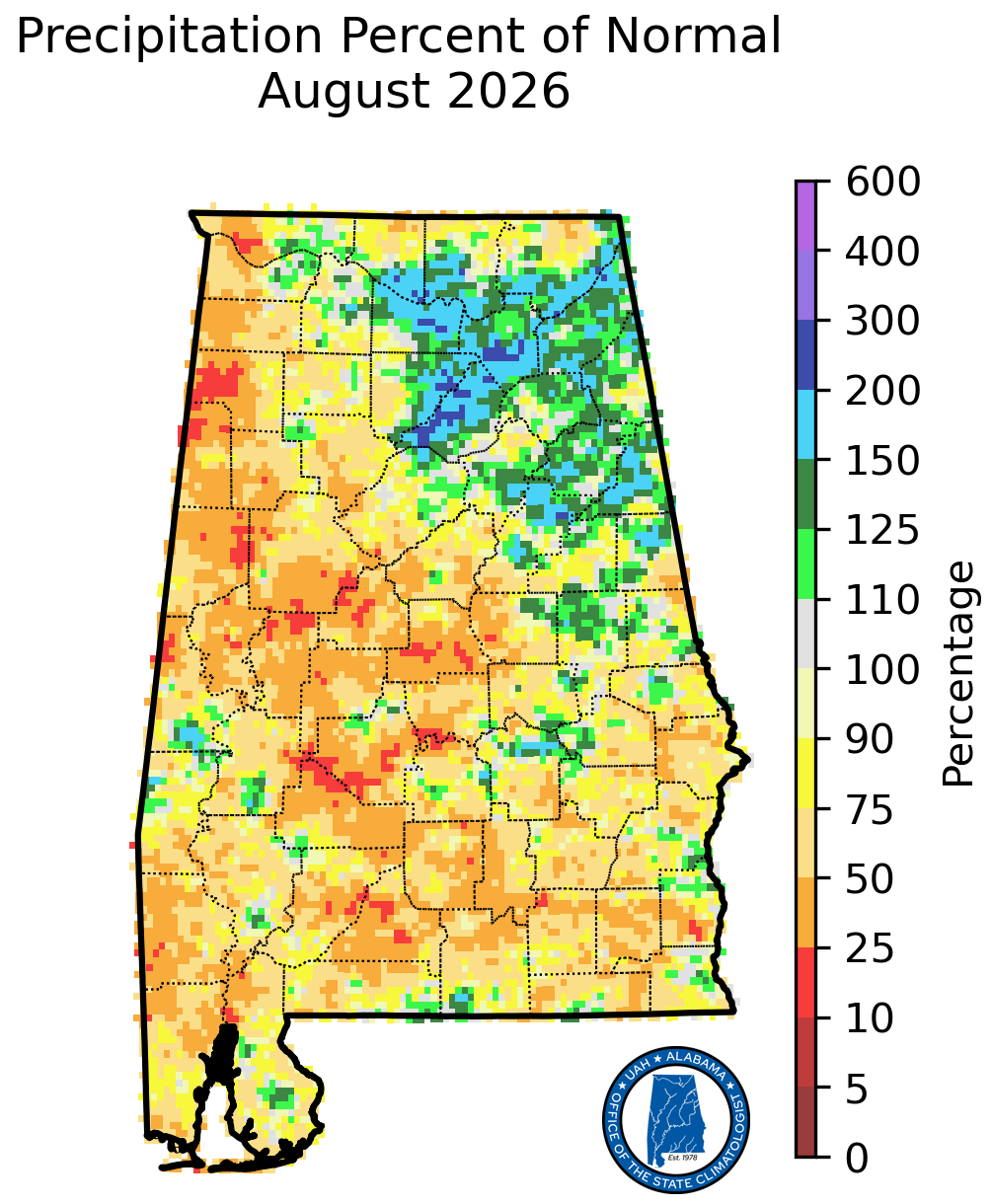
August 2026 precipitation percent of normal across Alabama. Data Source: PRISM.
Precipitation Percent of Normal (Figure 2)
- August precipitation was below normal across much of central, western, and southern Alabama.
- Northern and northeastern Alabama experienced near- to above-normal precipitation, with the highest percentages of normal concentrated across the Guntersville/Sound Mountain area.
- The driest conditions occurred across portions of west-central and southwestern Alabama, where precipitation totals were locally less than half of normal.
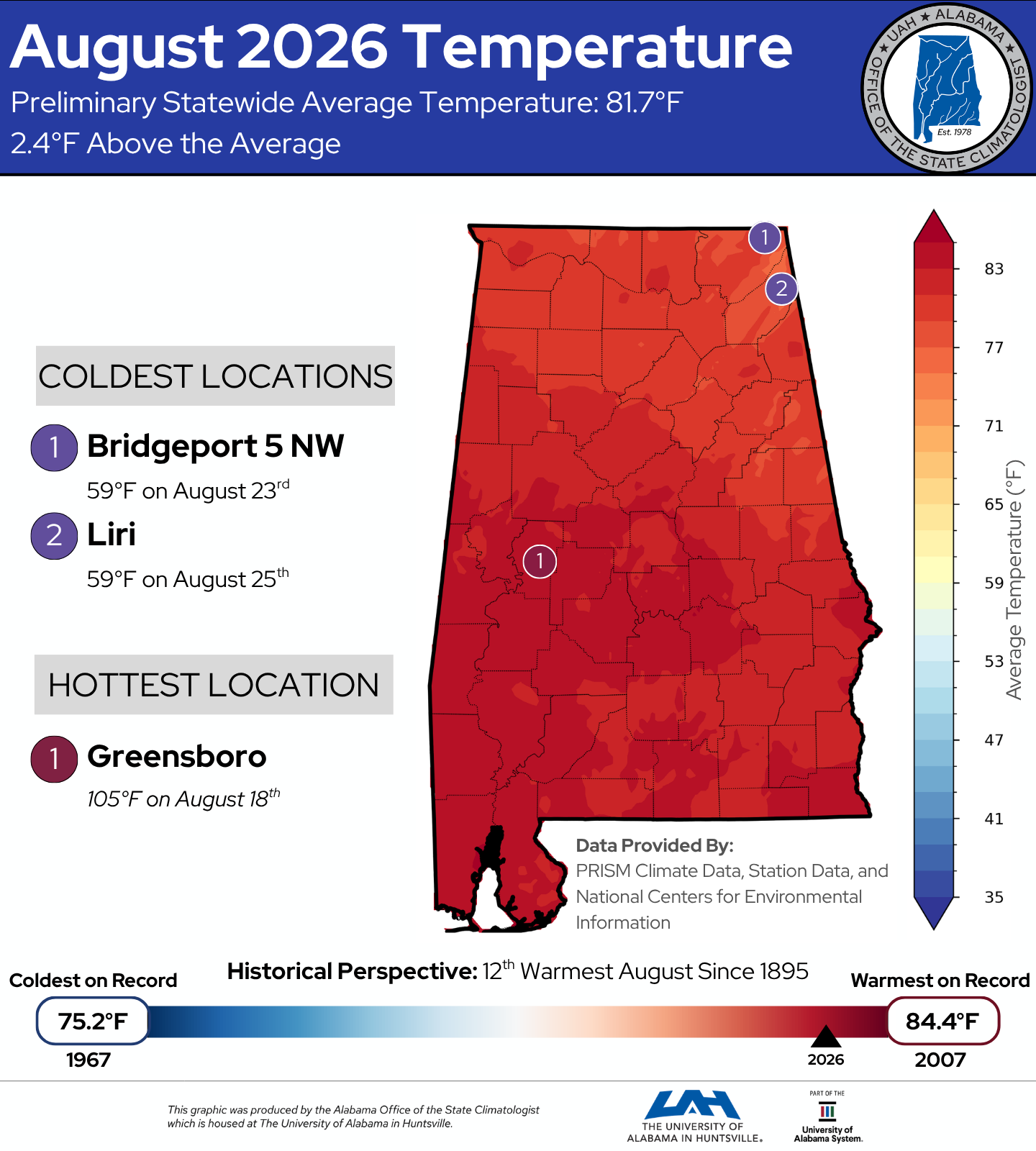
August 2026 temperature infographic showing statewide average temperatures, notable observations, and historical ranking. Data provided by PRISM Climate Data, station data, and National Centers for Environmental Information.
Temperature Summary (Figure 3)
The statewide average temperature for August was 81.7°F (2.4°F above the long-term average). This anomalous warmth was once again driven primarily by the unusually warm overnight temperatures. Average daily low temperatures were 2.9°F above normal, making this the 7th warmest August on record for statewide minimum temperatures. Unsurprisingly to Alabamians, August 2026 was the most humid August on record with an average dewpoint of 72.9°F. Despite the overwhelming humidity, expanding dry conditions allowed temperatures to surge, with 39 stations reaching or exceeding the century mark during the month.
Temperature Highlights
- Coldest sites: Bridgeport 5 NW & Liri – 59°F on August 23rd and 25th
- Hottest site: Greensboro – 105°F on August 18th
- 12th Warmest August on record statewide
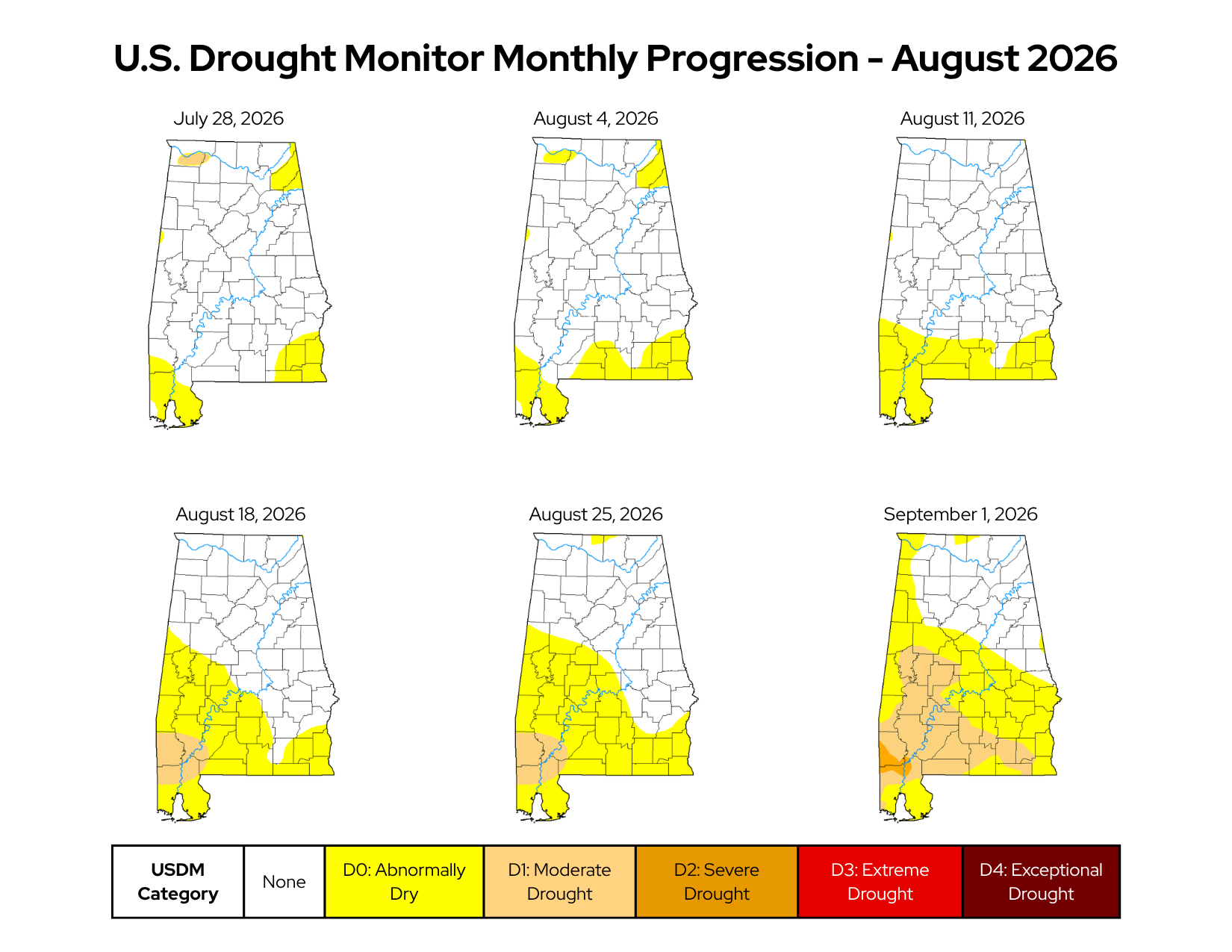
U.S. Drought Monitor maps showing changes in drought conditions across Alabama throughout August 2026. Data Source: U.S. Drought Monitor.
Drought Summary (Figure 4)
Most of Alabama began August with pockets of abnormal dryness (D0) along the northern and eastern borders and across parts of southern Alabama. As the month progressed, abnormal dryness expanded across much of central and southern Alabama, while moderate drought (D1) developed in southwestern Alabama. By the beginning of September, severe drought (D2) had developed across Washington, Mobile, and Baldwin counties, while D1 expanded across portions of southwestern and central Alabama.
Summer 2026 Review
The end of August signals the end of climatological summer (June, July, August). How did the summer of 2026 stack up against other summers in Alabama?
Statewide, the average temperature for the summer was 80.4°F, 1.5°F warmer than normal, ranking as the 20th warmest summer on record. With regard to precipitation, this summer was the 43rd wettest on record with 15.48 inches of precipitation, 1.41 inches wetter than normal. Spatially, however, precipitation was quite variable in summer (Figure 5).
While 41 stations reached or exceeded 100°F (representing 36.6% of the 112 active reporting stations), the defining story was the persistent humidity. June was the 2nd most humid June on record, while July and August both broke all-time monthly humidity records. With mean dew points running +2.0°F to +6.0°F above the 1991-2020 normal statewide, summer 2026 stands as the most humid Alabama summer on record according to PRISM data (Figure 6).
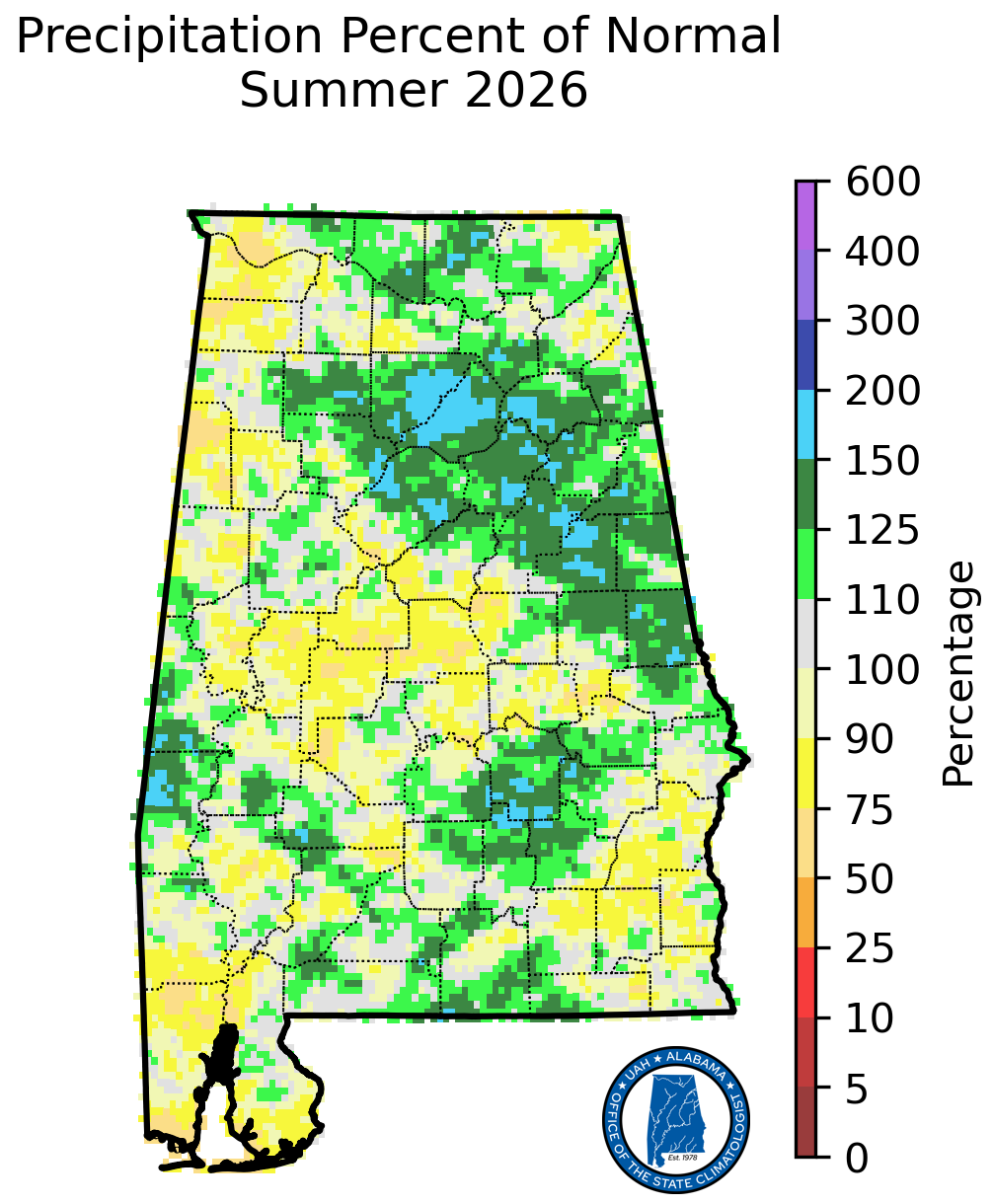
Figure 5. Summer 2026 precipitation percent of normal across Alabama.
Data provided by: PRISM
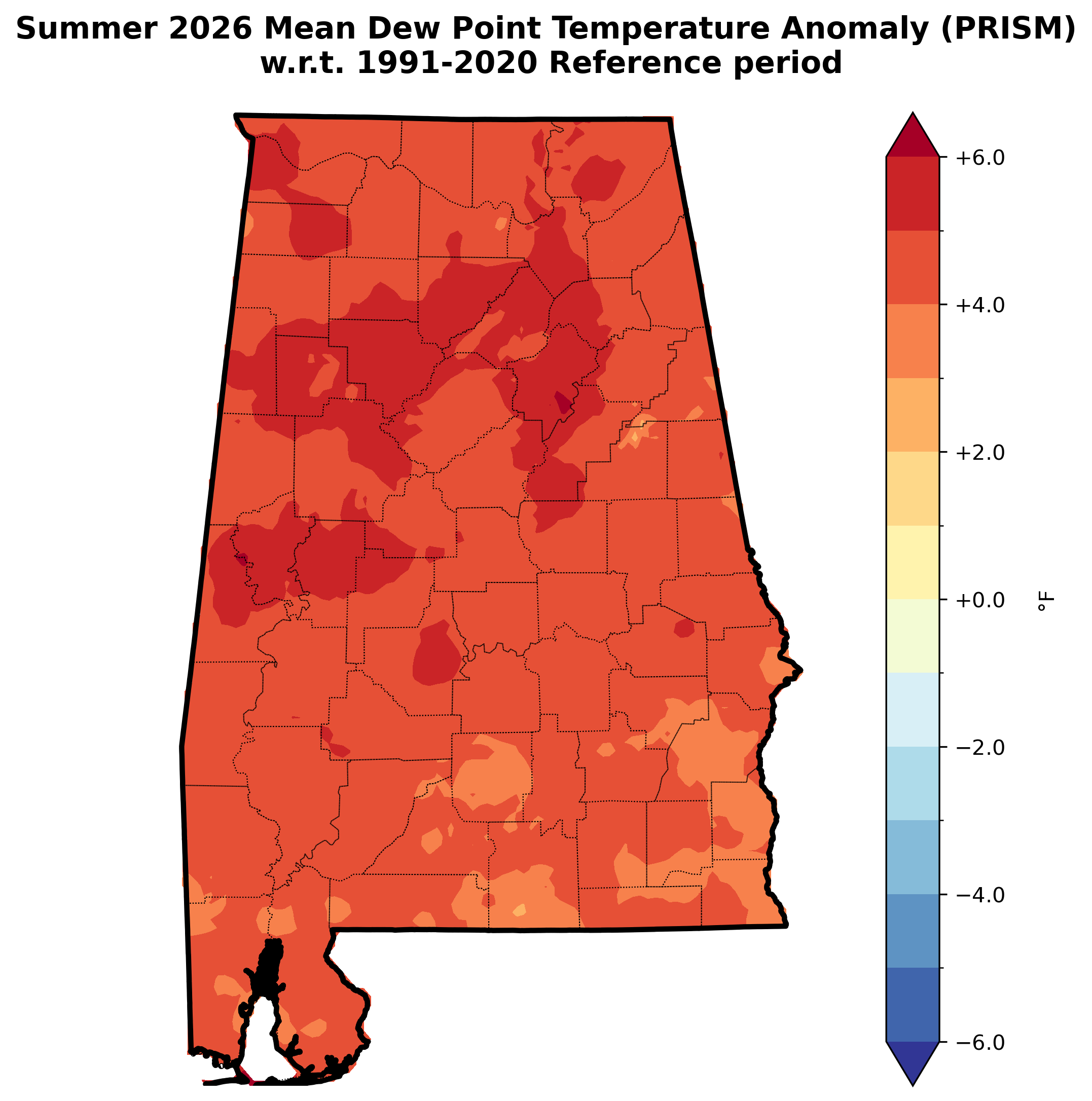
Figure 6. Summer 2026 humidity trends shown via mean dew point temperature anomalies across Alabama.
Data provided by: PRISM
For more information, read the full report .
If you have any questions, please contact aosc@uah.edu.