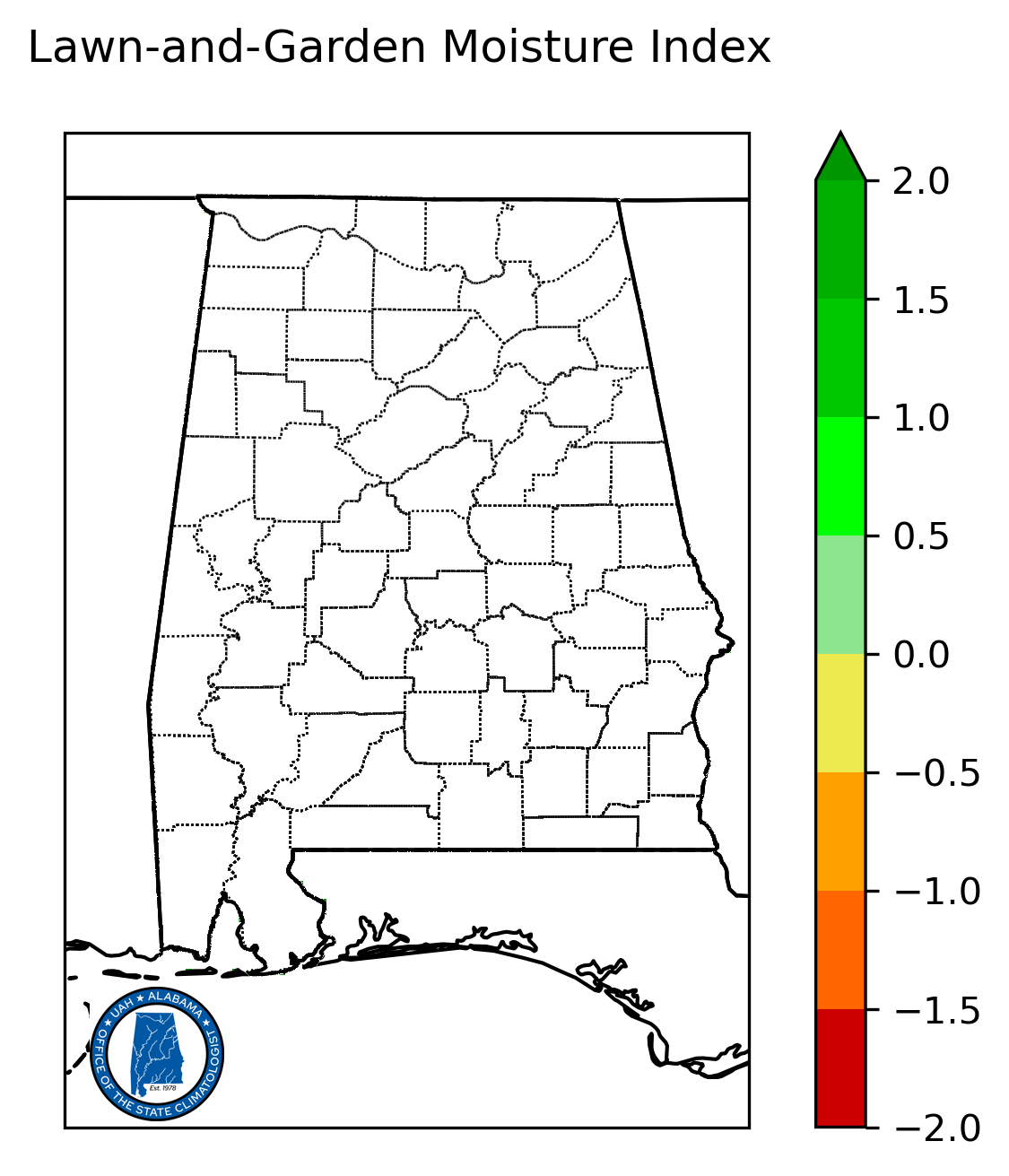
Statewide Condition Summary
View Alabama & Southeast LGI Data Directory
The LGI Is Computed in Two Stages
Stage 1: Estimate how much recent precipitation contributes to current soil moisture.
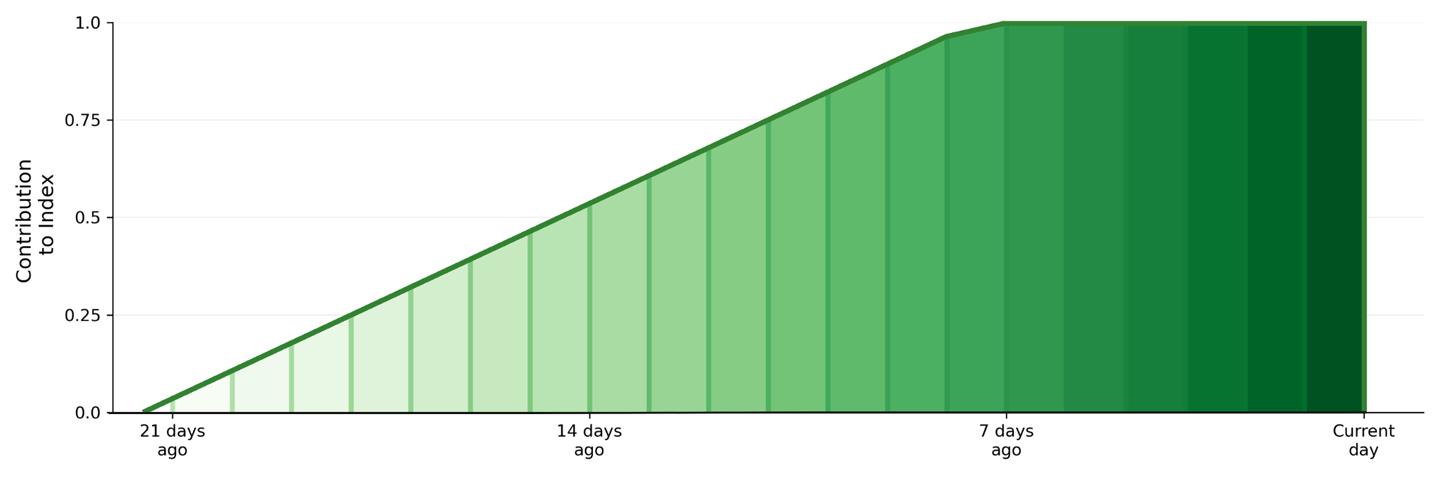
To estimate current soil moisture, we calculate how much recent precipitation still contributes to conditions on the ground. We assume that any precipitation over the past 21 days should be included in the computation. We also assume that more recent precipitation is more significant than the less recent. We consider all precipitation during the previous 7-day period to be equally important, but precipitation before that time is discounted according to the sliding scale shown in Diagram 1. The resulting number is the total effective precipitation during the period. We use precipitation data from NOAA’s Climate Prediction Center, which combines radar estimates with reports from rain gauges.
Stage 2: Compare effective precipitation for a specific day with historic normals.
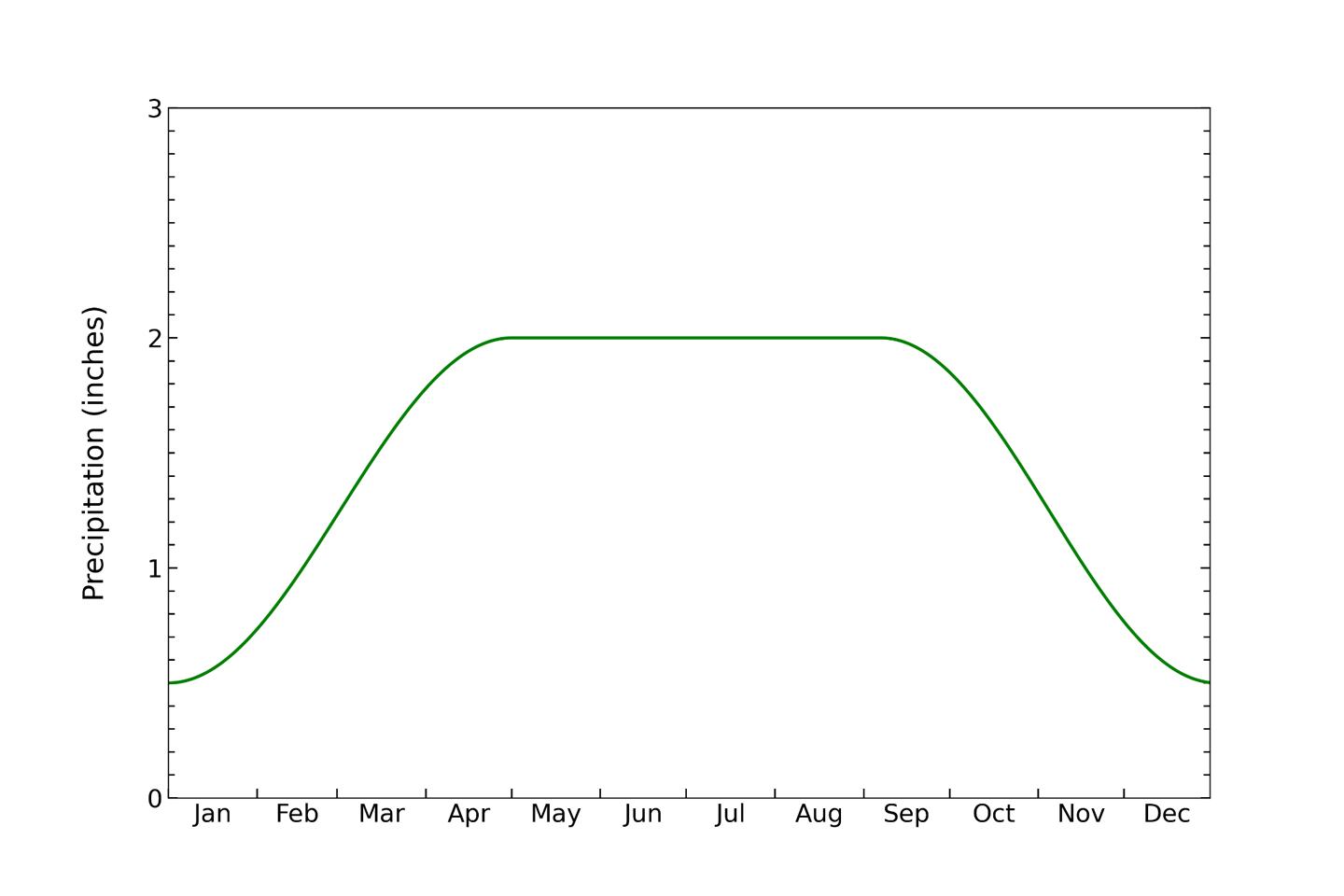
Next, we compare the total effective rainfall for the current day to a "standard" amount considered adequate for that time of year to support healthy lawns and gardens. The difference between these two values is the LGI. Less rainfall is required to sustain healthy vegetation in the winter than in the summer. As shown in Diagram 2, about 0.5 inch is sufficient in the coldest months, while up to 2 inches may be needed in the hottest. For example, 1 inch of rain on January 1 would result in an LGI of +0.5 inch, while the same amount on July 1 would yield -0.5 inch. These values are based on typical conditions across Alabama. Positive LGI values indicate surface moisture is adequate to sustain healthy lawns and gardens and may also reflect surplus moisture. Negative values signal a moisture deficit and can serve as a proxy for stress or decline in short-rooted vegetation.
The curve shown in Diagram 2 does not apply equally well across all parts of the state. Some areas have loose, fast-draining soils, while others retain moisture for longer periods.Different grasses, flowers, shrubs, and garden crops also have varying water needs. Despite these differences, the curve provides a useful general estimate of which areas are receiving enough precipitation to support healthy lawns and productive gardens and which are not.