Alabama is located in the southeastern United States and spans approximately 52,423 square miles, including 1,673 square miles of water. It stretches from the southern Appalachian foothills to the Gulf of Mexico, with Cheaha Mountain standing as its highest point at 2,407 feet above sea level. Its southern boundary is shaped by the Gulf Coast, offering access to rich marine and coastal environments.
Alabama experiences a humid subtropical climate, characterized by long, hot summers and mild winters. The state receives generous rainfall throughout the year, though precipitation levels can vary significantly from year to year and between regions. Weather patterns are influenced by both the Gulf of Mexico and seasonal air masses, which contribute to occasional extreme events such as tropical storms, tornadoes, and periods of drought.
Precipitation
Alabama is one of the wettest states in the Southeast, receiving an average of 56.88 inches of rainfall per year based on 30-year averages (1991–2020). The wettest conditions tend to occur along the Gulf Coast and in parts of northeastern Alabama near the Paint Rock Valley, where annual totals often exceed 60 inches. In contrast, portions of the Black Belt are relatively drier, with average annual rainfall closer to 52–54 inches.
While these averages describe typical conditions, they do not capture how much Alabama’s rainfall fluctuates from year to year. This variability is evident in the long-term record of annual precipitation dating back to 1895. Annual totals frequently fluctuate above and below the 30-year average, with prolonged dry periods occurring during the 1930s Dust Bowl era, a sharp decline in the 1950s, and additional drought episodes in the early 2000s. These dry intervals are punctuated by years of well above-average rainfall, reinforcing that Alabama’s precipitation is driven by strong year-to-year variability rather than a consistent long-term trend.
Alabama Annual Total Precipitation with Anomalies
Base Period: 1991-2020
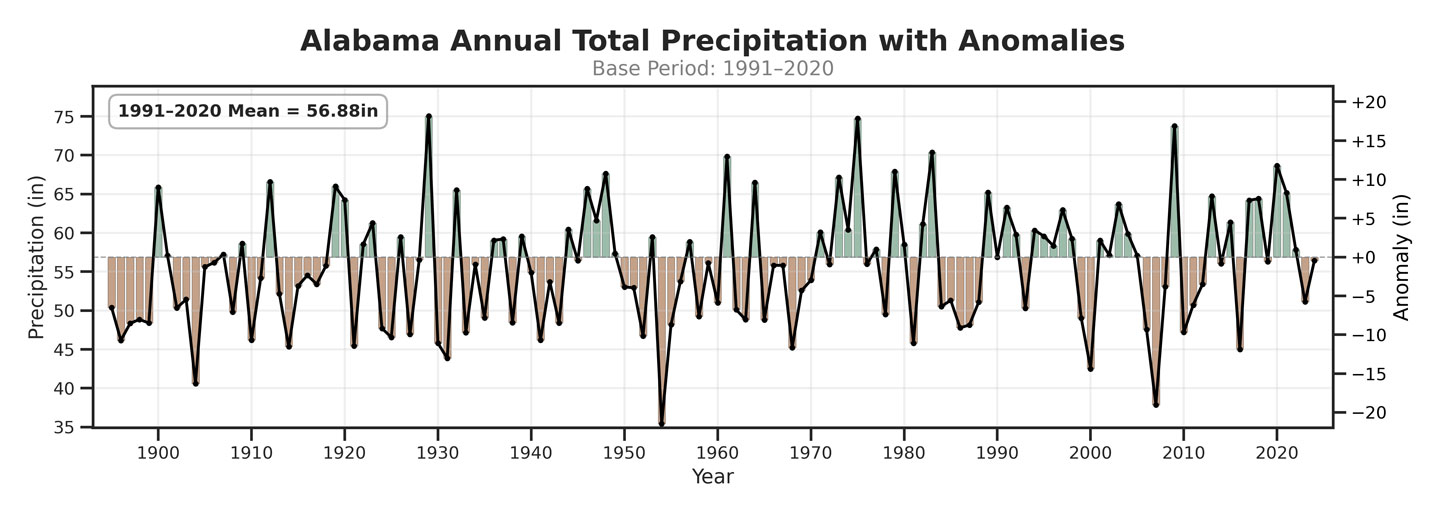
Rainfall totals in Alabama are highly variable, and the state’s ecosystems have adapted to receive roughly 55–65 inches of rain per year. While this amount is greater than in many other states, even modest departures below this range can have significant impacts on ecosystems, water resources, agriculture, and the broader economy. The defining characteristic of Alabama’s rainfall is not its abundance, but its variability, which becomes more apparent when examined at monthly and seasonal scales.
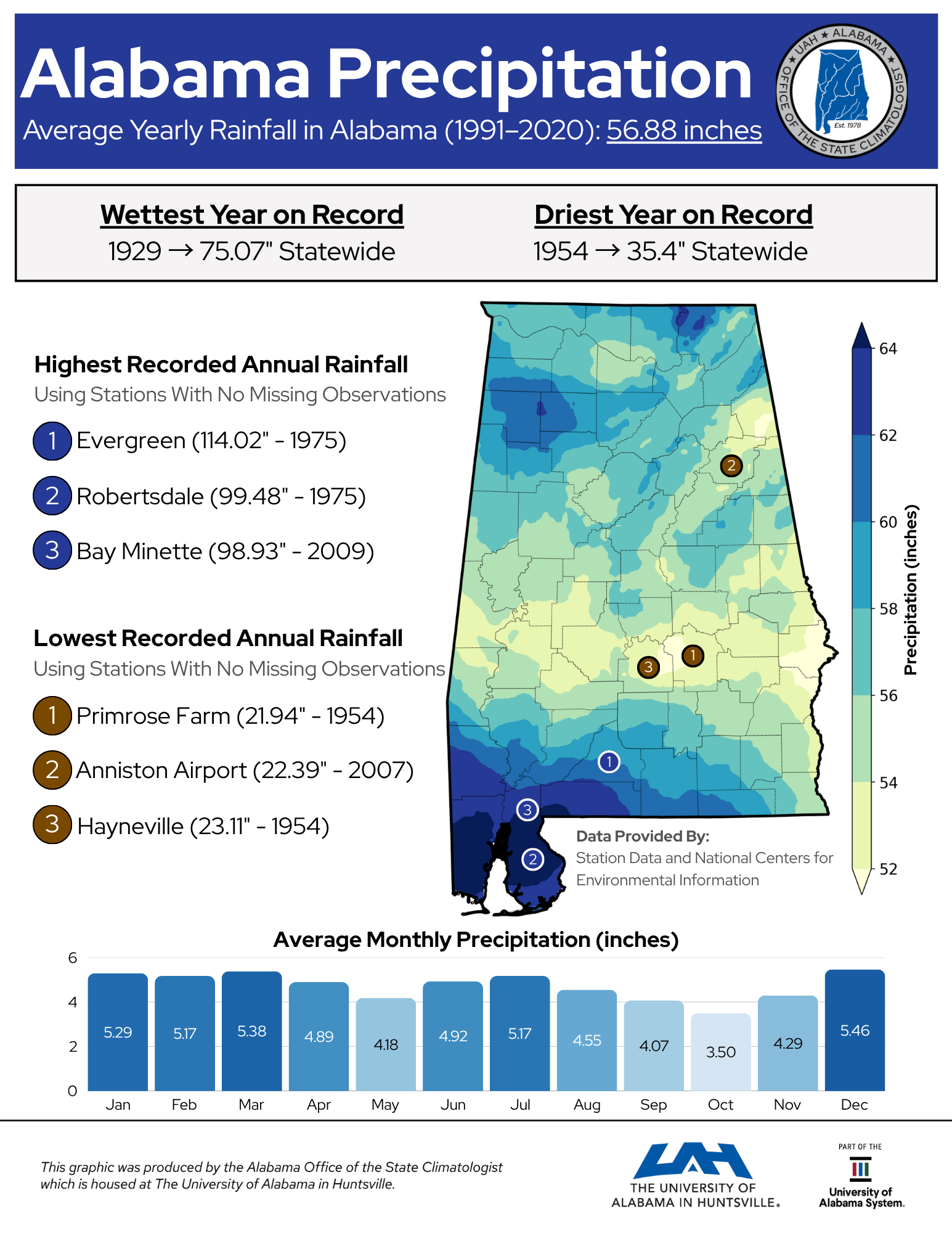
Overview of Alabama’s average annual and monthly precipitation based on the 1991–2020 climate normals, including statewide records and spatial patterns in average annual rainfall.
Seasonal Patterns
- Winter and spring bring widespread rainfall from frontal systems and occasional severe weather.
- Summer rainfall is dominated by frequent thunderstorms.
- Fall precipitation is more variable and often influenced by tropical systems and hurricanes.
Wettest & Driest Months
- Wettest months: January (5.29 inches) and December (5.46 inches).
- Driest months: October (3.50 inches) and May (4.18 inches).
Notable Rainfall Extremes
- Wettest year on record: 1929 (75.07 inches statewide).
- Driest year on record: 1954 (35.4 inches statewide).
- Highest weather station total: Evergreen in 1975 (114.02 inches).
- Lowest weather station total: Primrose Farm in 1954 (21.94 inches).
View County Specific Precipitation Data
Temperature
Alabama averages 63.6°F each year based on 30-year averages (1991–2020), though temperatures vary across the state. The warmest annual average temperatures occur along the Gulf Coast and across southern Alabama, where values often exceed 66°F. Cooler conditions are typically found in northern Alabama and higher-elevation areas, where average annual temperatures are generally closer to 60–62°F.
The long-term record of annual average temperature dating back to 1895 shows considerable variability, with no consistent pattern from one year to the next. Cold years are not necessarily followed by warm years, and departures from average conditions can persist for long periods of time. This is especially evident during the latter part of the 20th century, when temperatures remained below normal for several decades. In contrast, more recent years have featured annual temperatures that are more often above average.
Although individual years continue to fluctuate above and below the long-term mean, changes in temperature patterns have important implications for Alabama’s climate system. Variations in temperature influence evapotranspiration rates, growing season length, water demand, and the occurrence of heat extremes. As with precipitation, understanding how temperature varies at annual, seasonal, and monthly scales is essential for assessing impacts to ecosystems, agriculture, infrastructure, and public health.
Alabama Annual Average Temperature with Anomalies
Base Period: 1991-2020
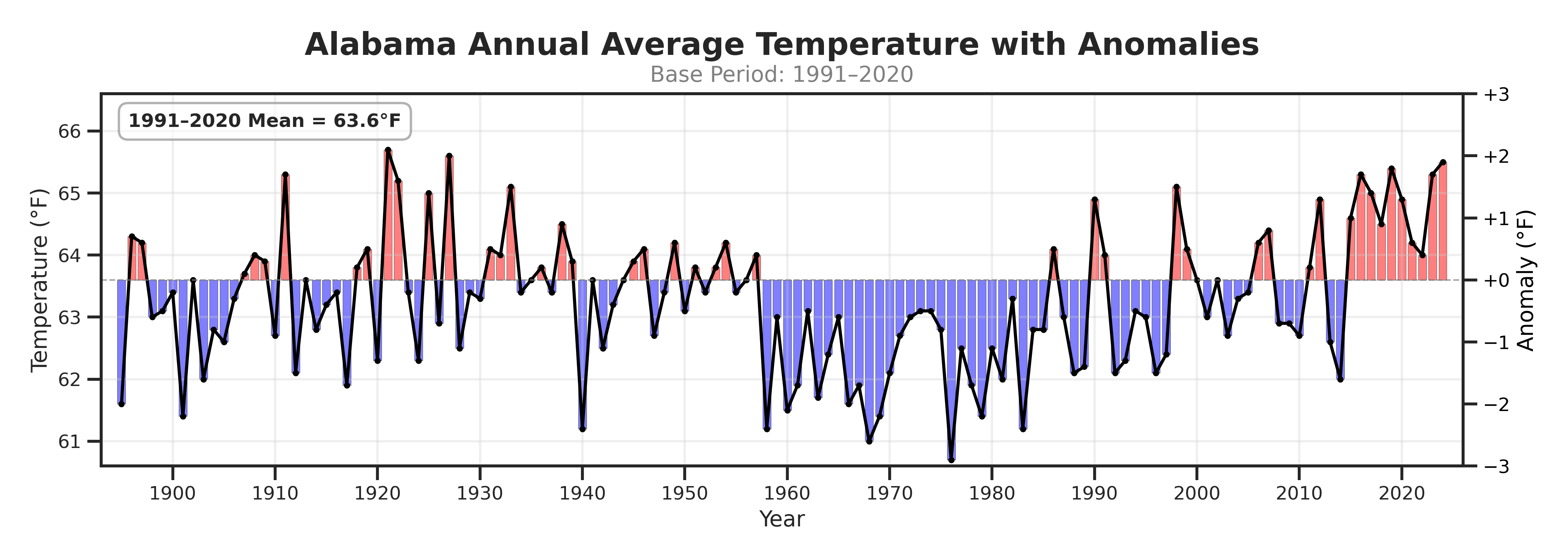
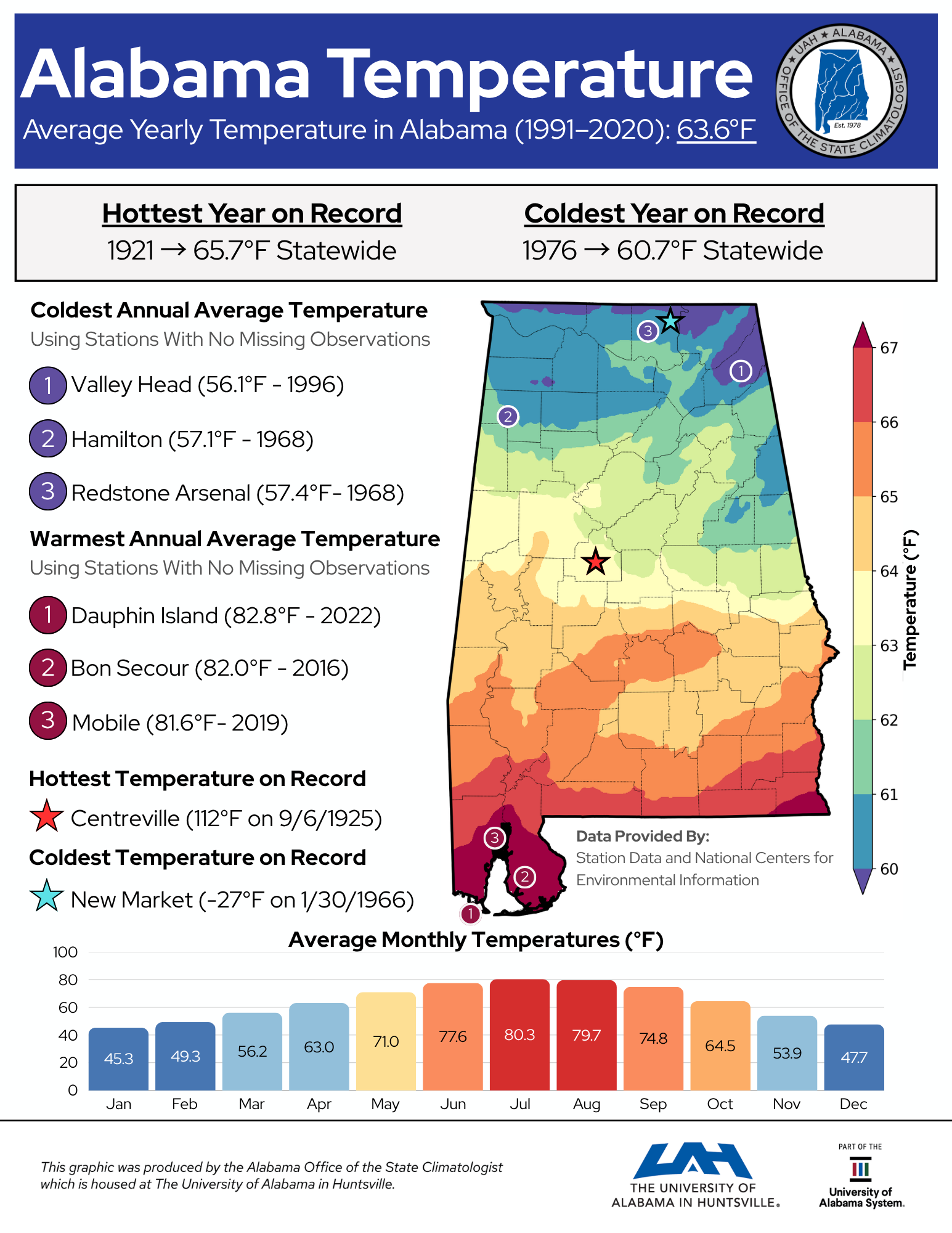
Overview of Alabama’s average annual and monthly temperatures based on the 1991–2020 climate normals, highlighting statewide records, temperature extremes, and spatial temperature patterns.
Seasonal Patterns
- Winter temperatures are generally mild but can drop sharply during outbreaks of Arctic air.
- Spring features a rapid warm-up and increased variability, with occasional late-season cold snaps.
- Summer is consistently hot and humid statewide, with the highest average temperatures of the year.
- Fall brings gradual cooling, though early fall often remains quite warm.
Coldest & Warmest Months
- Coldest month: January (45.3°F).
- Warmest month: July (80.3°F).
Notable Temperature Extremes
- Hottest year on record: 1921 (65.7°F statewide).
- Coldest year on record: 1976 (60.7°F statewide).
- Hottest temperature on record: 112°F at Centreville on September 6, 1925.
- Coldest temperature on record: −27°F at New Market on January 30, 1966.
View County Specific Temperature Data
Frost/Freeze
Cold temperature events are an important part of Alabama’s climate and can affect agriculture, gardening, and natural ecosystems across the state. Two commonly tracked cold events are frosts and freezes, which occur when temperatures near the ground fall to freezing conditions.
A freeze occurs when the air temperature reaches 32°F or colder at the standard measurement height (about 2 meters above the ground). Freezes typically occur when a cold air mass moves into the region and lowers temperatures across a wide area. A frost, on the other hand, forms when water vapor in the air turns directly into ice crystals on surfaces that are at or below freezing (i.e., when the surface of the plant itself is at or below freezing). Frost can occur even when air temperatures measured several feet above the ground remain slightly above 32°F because colder air often settles close to the ground on calm, clear nights. While frost events are usually more localized than freezes, both can damage flowers, vegetables, fruit trees, and other cold-sensitive plants.
Last Frost/Freeze
The last frost and last freeze dates mark the final occurrence of freezing conditions during the late winter or spring season. These dates are based on long-term climate records and help indicate when the risk of damaging cold temperatures typically decreases. While they provide useful planning guidance for planting and agricultural activities, these dates are guidelines rather than guarantees, since cold events can still occur after the typical final date in some years.
Read our full blog on last freeze & last frost in Alabama!
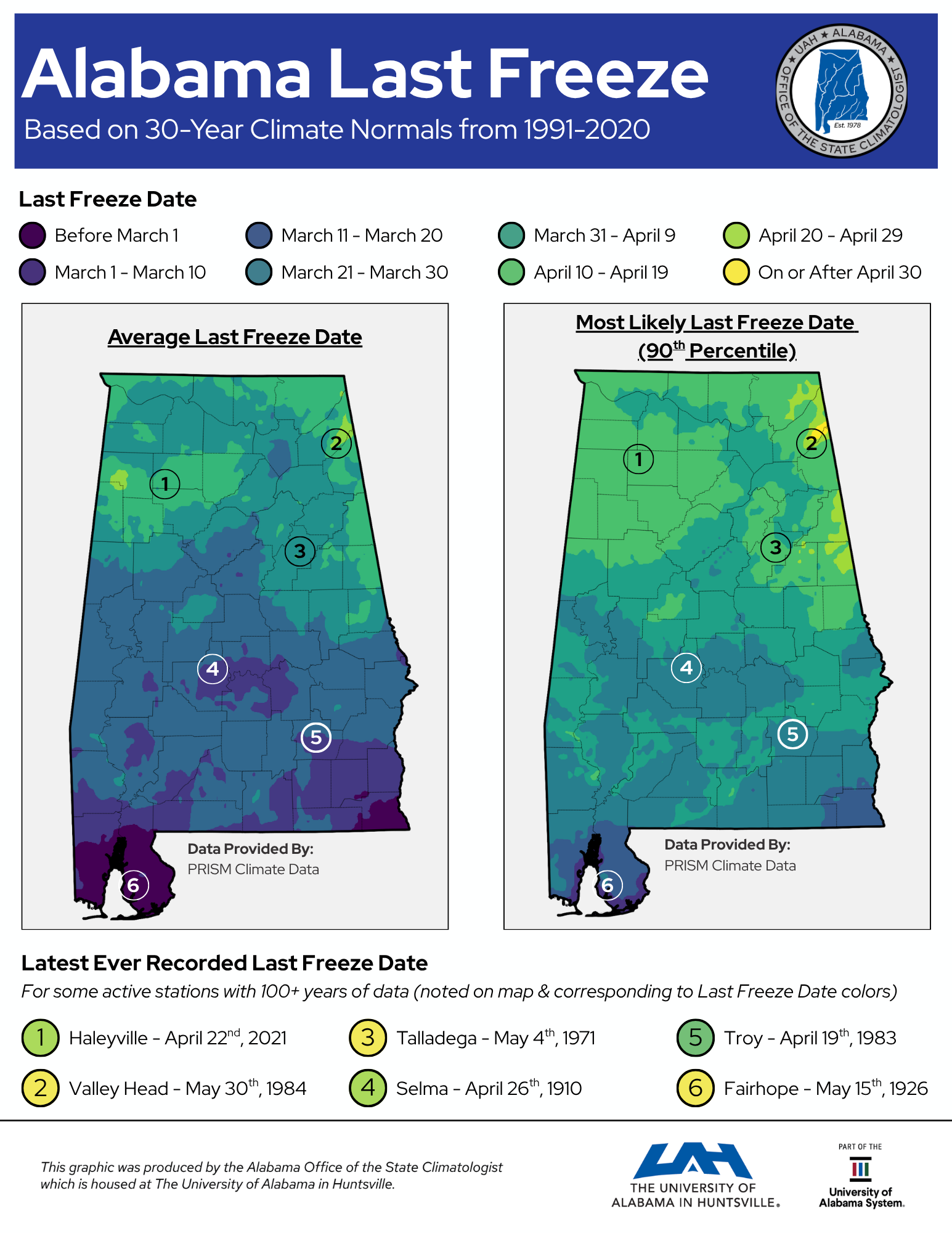
Average and 90th percentile last freeze dates across Alabama based on 1991–2020 climate normals.
Last Freeze Patterns
- South Alabama: The earliest last freezes typically occur along the Gulf Coast, most often in late February to early March.
- Central Alabama: Last freezes generally occur in mid-March as temperatures warm moving northward across the state.
- North Alabama: Cooler temperatures and higher elevations allow freezes to persist longer, with average last freezes often occurring in late March to early April.
- 90th percentile: A more conservative estimate showing that freezes have historically occurred later in some years, extending into April in parts of North Alabama.
Latest Ever Recorded Last Freeze Date
- Valley Head: May 30, 1984.
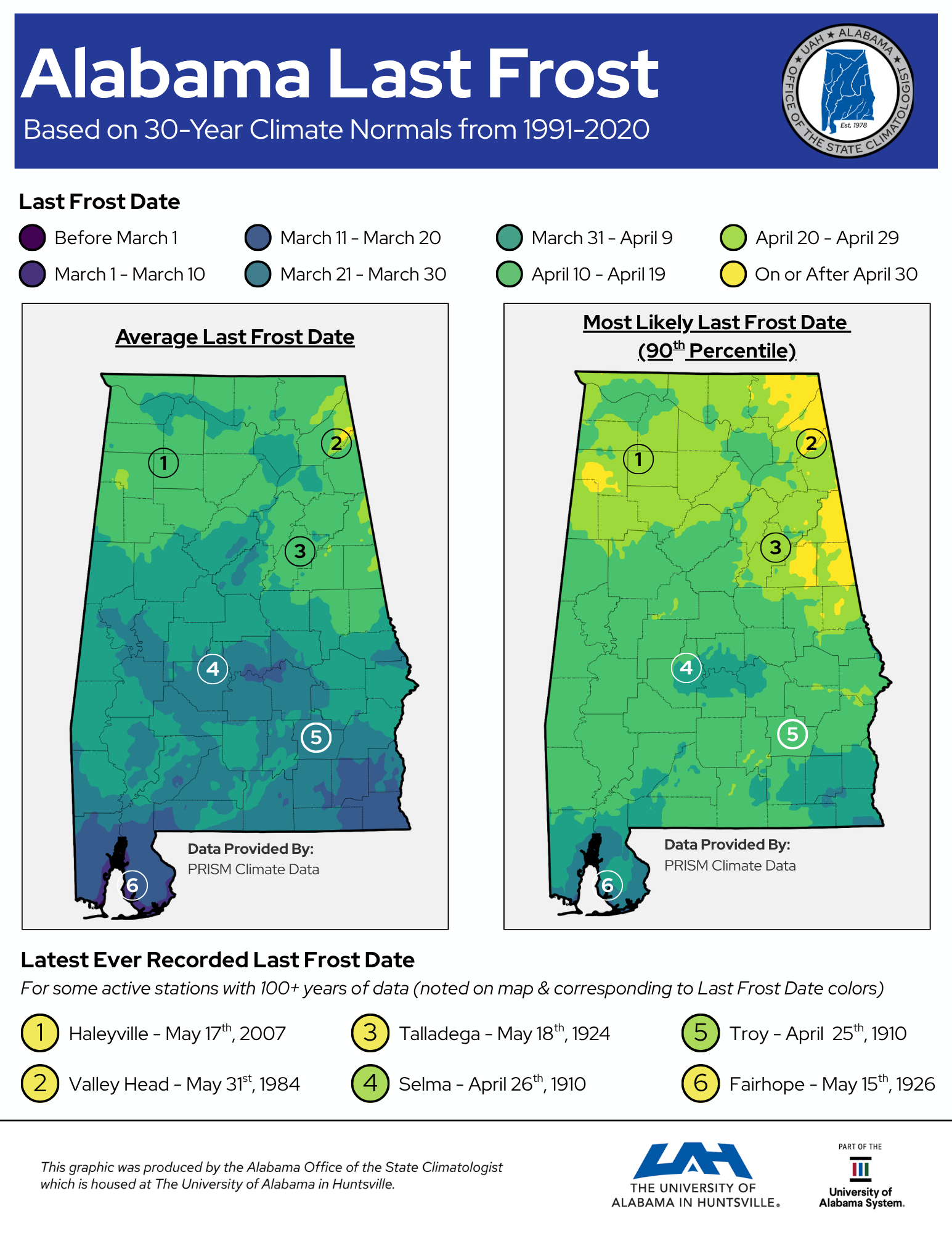
Average and 90th percentile last frost dates across Alabama based on 1991–2020 climate normals.
Last Frost Patterns
- South Alabama: The earliest last frosts typically occur along the Gulf Coast, generally in early March.
- Central Alabama: Frost risk usually ends in late March as spring temperatures continue to warm.
- North Alabama: Frost can persist into early to mid-April, especially in higher elevation areas.
- 90th percentile: Frost risk can extend into mid- to late April across much of the state and occasionally later in northern locations.
Latest Ever Recorded Last Frost Date
- Russellville: June 4, 1969.
Severe Weather
Alabama is no stranger to severe weather, including tornadoes, hurricanes, damaging winds, and flooding rains. While these events can have devastating impacts on communities, infrastructure, and agriculture, they also play an important role in Alabama’s climate by providing much of the rainfall that supports the state’s forests, rivers, farms, and water resources. Read on to learn more about severe weather patterns and long-term trends across the state.
Tornadoes
Tornadoes are a defining part of Alabama’s severe weather climatology and can occur during any month of the year. Most tornadoes develop from severe thunderstorms when warm, humid air from the Gulf of Mexico interacts with cooler, drier air and strong winds higher in the atmosphere. While tornado activity typically peaks during the spring, Alabama also experiences a secondary severe weather season during the fall. Tornadoes in Alabama can be especially dangerous because they often occur at night and may be obscured by heavy rainfall, reducing visibility and limiting reaction time. Alabama’s combination of geography, Gulf moisture, and frequent storm systems creates an environment where severe weather preparedness remains important year-round.
Read our full blog on tornado trends in Alabama!
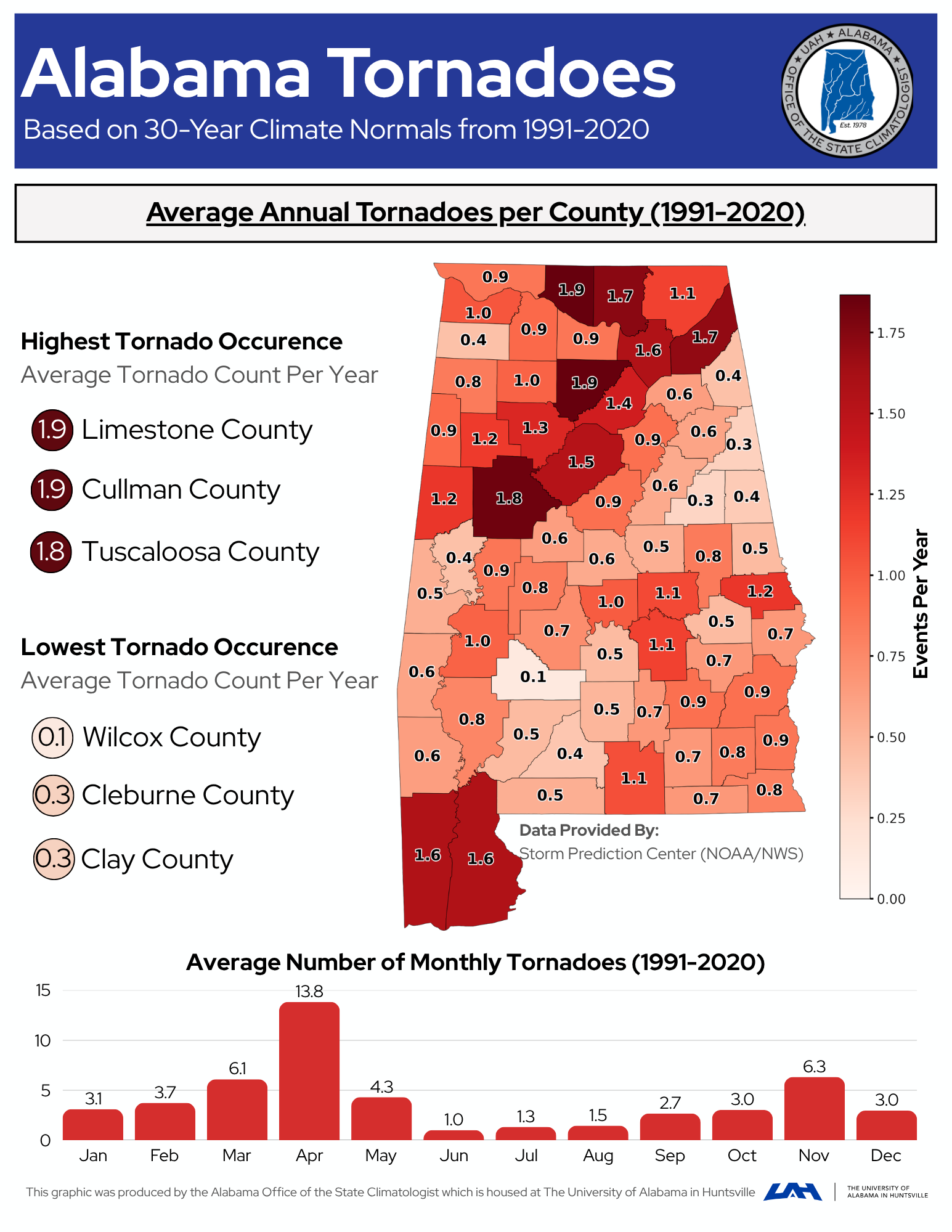
Overview of Alabama tornado trends based on 1991-2020 climate normals.
Tornado Patterns
- North and West Alabama generally experience the highest average annual tornado occurrence, with counties such as Limestone, Cullman, and Tuscaloosa averaging nearly 2 tornadoes per year.
- April is historically the most active month for tornadoes in Alabama, averaging nearly 14 tornadoes statewide.
- A secondary peak in tornado activity typically occurs during November.
- Tornado activity is generally lowest during the summer months, especially June through August.
Climate Extremes
| Variable | Value | Date | Location | Station ID |
|---|---|---|---|---|
| TEMPERATURE | ||||
| Maximum Temperature | 112°F | September 6, 1925 | Centerville (Bibb County) | 011520 |
| Minimum Temperature | -27°F | January 30, 1966 | New Market (Madison County) | 015867 |
| PRECIPITATION | ||||
| 24-hour Precipitation | 32.52 in. | July 19 - 20, 1997 | Dauphin Island Sea Lab (Mobile County) | 012172 |
| 24-hour Snowfall | 20 in. | March 13, 1993 | Walnut Grove (Etowah County) | 018648 |
| Snow Depth | 22 in. | January 24, 1940 | Reform (Pickens County) | 016847 |
| HAIL | ||||
| Weight | 9.8 oz. | March 19, 2018 | Walter (Cullman County) | N/A |
| Circumference | 13.75 in. | March 19, 2018 | Walter (Cullman County) | N/A |
| Diameter | 5.38 in. | March 19, 2018 | Walter (Cullman County) | N/A |
| Volume | 19.8 cu. in. | March 19, 2018 | Walter (Cullman County) | N/A |
**Additional Datasets Coming Soon