Three incoming UAH students win NSF EGFP grants highlighting student success; research opportunities still available for top STEM graduates
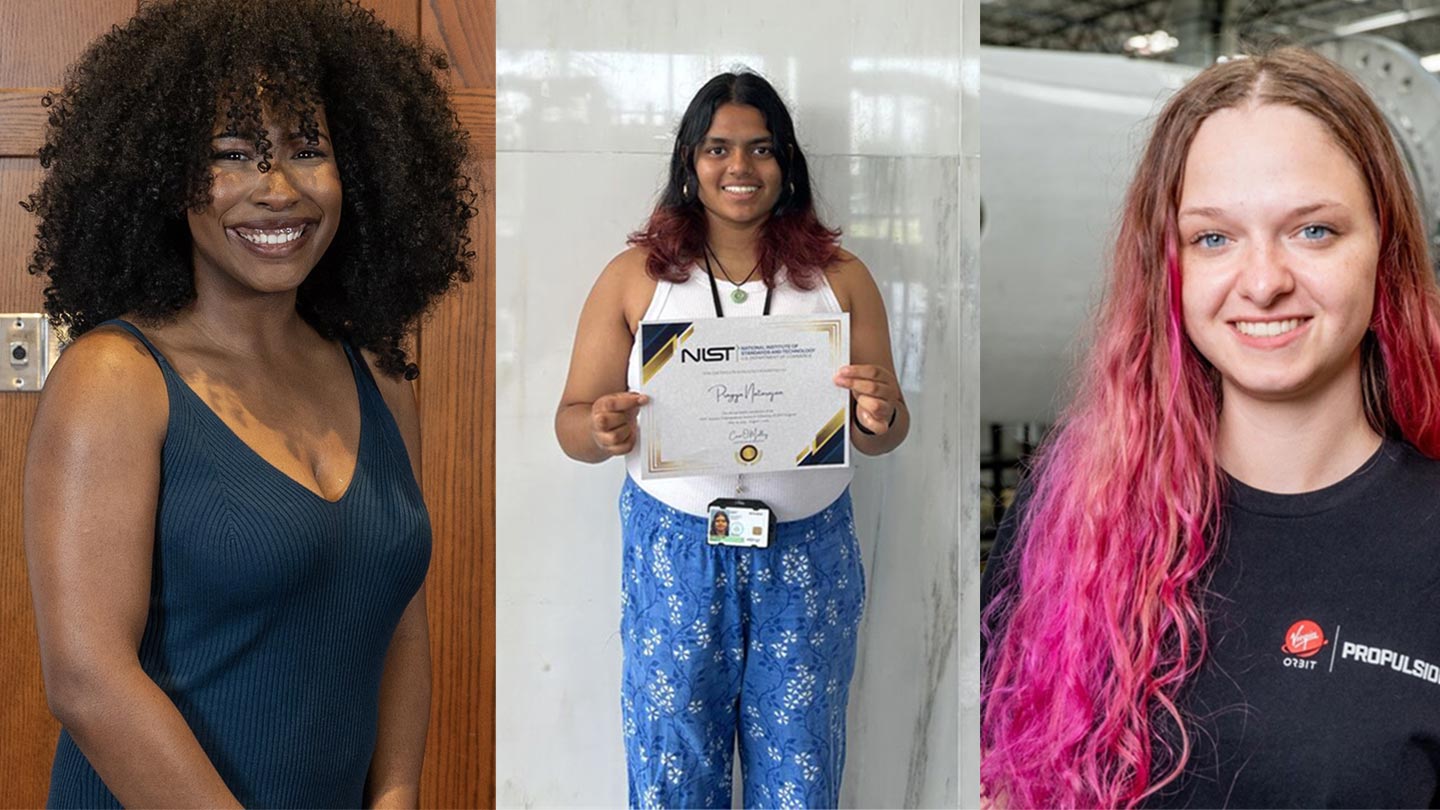
(L-R) Savaria Parrish, Pragya Natarajan and Stephanie Manasterski, the first three UAH graduate students to receive fellowships in the National Science Foundation’s (NSF) Established Program to Stimulate Competitive Research (EPSCoR) Graduate Fellowship Program (EGFP).
The University of Alabama in Huntsville (UAH), a part of The University of Alabama System, is welcoming three graduate students who won research fellowships through the National Science Foundation’s (NSF) Established Program to Stimulate Competitive Research (EPSCoR) Graduate Fellowship Program (EGFP). Savaria Parrish, Pragya Natarajan and Stephanie Manasterski are among the first fellows supported through UAH’s EGFP program, an award of $2.39 million that seeks to support up to 15 doctoral fellows in six signature STEM areas: astronomy and astrophysics; heliophysics and low-temperature plasmas; atmospheric sciences; mechanics of materials and structures for aerospace systems; engineering design and systems engineering; and computing and artificial intelligence. The award runs through June 2028.
The fellowship is designed for graduate students who received an Honorable Mention from the NSF Graduate Research Fellowship Program within the previous three years. At UAH, EGFP fellows receive three years of support through a $37,000 annual stipend and a $16,000 annual cost-of-education allowance. Fellows have up to five years to use the support. The student research reflects the breadth of advanced STEM work conducted at UAH and the university’s close connections to Huntsville’s aerospace, space science and technology community.
Research that reaches from dark matter to deep space
Savaria Parrish, who earned a bachelor’s degree in geosciences from Virginia Tech with minors in physics and astronomy, will work with Dr. Sukanya Chakrabarti, a UAH professor of physics and astronomy, on extreme-precision radial velocity observations. Parrish has received a number of awards, including the American Astronomical Society (AAS) Chambliss Student Award, as well as Virginia Tech's Aspire! Award and Outstanding Undergraduate Service Award, and she is an American Physical Society (APS) Team Up Together Scholar.
“Savaria will be working with me on our galactic-scale extreme-precision radial velocity observation campaign to measure dark matter directly,” Chakrabarti explains. “These observations can also be used to characterize exoplanets and the internal structure of stars very precisely. I'm thrilled to have her join our team!”
Pragya Natarajan, an EGFP fellow joining the UAH Department of Space Science, will focus on the Marshall Grazing Incidence X-ray Spectrometer (MaGIXS) sounding rocket experiment and its Soft X-ray telescope, combining advanced instrumentation, simulations, calibration and flight-data analysis.
“We are thrilled to welcome Pragya Natarajan as the newest graduate student joining our team in the Department of Space Science at UAH,” says Dr. Subramania Athiray Panchapakesan, an assistant professor in the UAH Center for Space Plasma and Aeronomic Research (CSPAR). “Her research will bridge the gap between space science and advanced X-ray instrumentation, focusing specifically on the Soft X-ray telescope for the MaGIXS sounding rocket experiment. She will work directly with grazing incidence X-ray mirrors and gratings, conducting critical ray-trace simulations supported by ground-based calibration experiments. Pragya will also play a key role in analyzing flight data from the MaGIXS rocket missions, applying her findings to deepen our understanding of the complex physical properties of the solar corona.”
Stephanie Manasterski, a graduate student in mechanical and aerospace engineering (MAE), is slated to investigate technology with potential applications in fusion propulsion and future deep-space missions.
“Stephanie will be conducting vital research using ‘Sparky,’ our 60-kilojoule pulsed power machine, to study how pulsed magnetic nozzles can control and direct high-energy fusion plasma,” notes Dr. Jason Cassibry, a professor of MAE affiliated with the UAH Propulsion Research Center. “This technology is a critical piece of the puzzle for fusion propulsion, which holds the potential to drastically shorten transit times for deep-space missions. Ultimately, her work could help pave the way for rapid, practical interplanetary travel throughout our solar system.”
Twelve fellowship opportunities remain
UAH currently has 12 EGFP fellowship slots remaining open, providing additional opportunities for other high-achieving graduate students who have received an NSF GRFP Honorable Mention to pursue doctoral research at the university. Eligible students may apply through the NSF Education and Training Application (ETAP) system through June 2028.
To learn more about these programs, review the NSF EPSCoR Graduate Fellowship Program requirements and visit UAH graduate fellowships and application information.