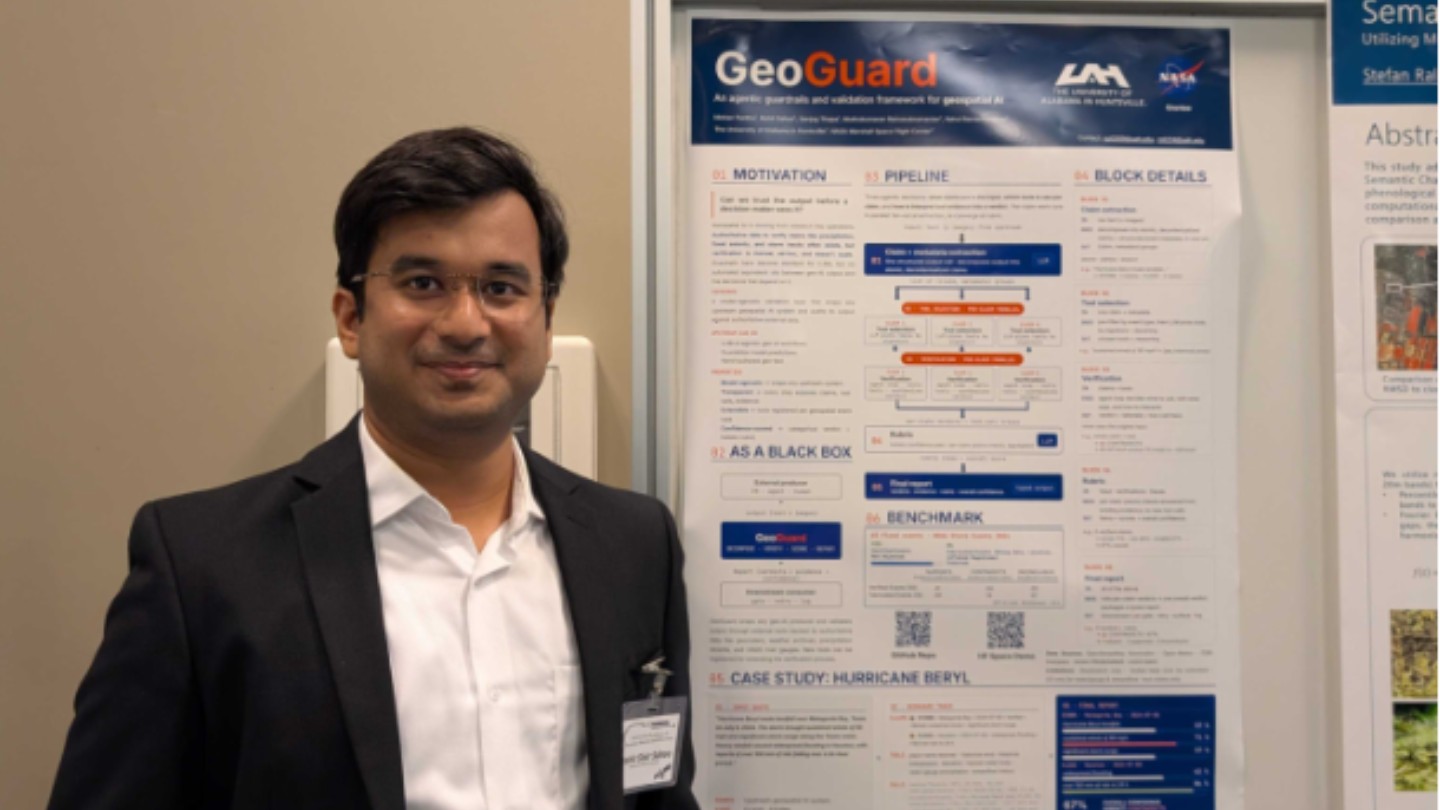
UAH Lab for Applied Science computer scientist Rohit Sahoo with his poster at the 2026 ESA-NASA Workshop on AI Foundation Models for Earth Observation.
Research and computer scientists at The University of Alabama in Huntsville’s (UAH) Laboratory for Applied Science played a prominent role in the second annual ESA-NASA Workshop on AI Foundation Models for Earth Observation. Held in May at the Jackson Center in Huntsville, the event featured many UAH representatives including research scientists Nikolaos Dionelis and Nidhi Jha, along with computer scientists Iksha Gurung, Nishan Pantha, Gaurab Panthee, Muthukumaran Ramasubramanian, Sujit Roy, Rohit Sahoo, and Sanjog Thapa. Members of this group served as session moderators, poster presenters, and workshop facilitators, highlighting artificial intelligence (AI) projects spearheaded by NASA’s Office of Data Science and Informatics (ODSI) at Marshall Space Flight Center.
The international workshop gathered more than 900 in-person and virtual participants, bringing together experts from NASA and the European Space Agency (ESA), academia, and industry. Attendees focused on applying AI foundation models (FMs) to Earth science applications while promoting open data sharing and rigorous model benchmarking. Beyond highlighting state-of-the-art developments, participants engaged in identifying current knowledge gaps and operational challenges to establish a research roadmap with priority themes for the future of Earth system science.
UAH scientists held central roles in guiding the workshop's technical agenda. Roy moderated a session titled “Latest Advances in AI Foundation Models,” while Jha led a session on “Agentic AI for Earth Observation and its Integration with Foundation Models.” During each of these sessions, scientists and developers from across the globe presented their research and ideas on these topics.
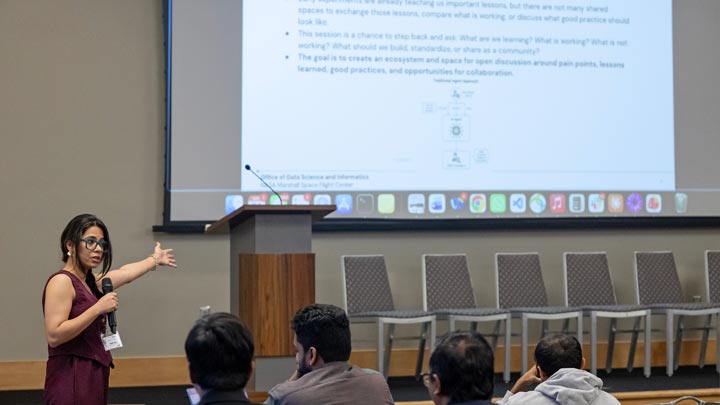
UAH Lab for Applied Science research scientist Nidhi Jha leading a collaborative discussion at the 2026 ESA-NASA Workshop on AI Foundation Models for Earth Observation.
Jha and Ramasubramanian also led a discussion on building a community around trustworthy AI agents for science, where co-design, accountability, and development best practices emerged as central themes. In the discussion, Jha showcased Accelerated Knowledge Discovery (AKD), an initiative currently under development by NASA’s ODSI. AKD aims to transform AI into a full cognitive research partner integrated directly into scientific workflows. To advance AKD, Lab for Applied Science researchers work with NASA leadership, IBM Research, Development Seed, and the Universities Space Research Association to co-develop agents, share tools, and implement safety guardrails.
Jha also presented Collaborative Agent Reasoning Engineering (CARE), a stage-gated methodology that unifies domain experts, developers, and large language model-based helper agents. Instead of relying on ad hoc prompt tweaks, CARE uses reusable artifacts to systematically ground and verify reliable AI agents. “There is high alignment on the daily work we do with AKD and the workshop’s focus on AI,” Jha said. “The AKD team has been nurturing a space for designing and building AI agents for science, and this correlates with the main themes of the workshop.”
Several UAH researchers also shared their work in technical poster sessions and interactive tutorials. Posters presented by UAH computer scientists Pantha, Panthee, Sahoo, Thapa and Ramasubramanian detailed the design-to-implementation pipeline for scientific AI agents, focusing on their user interfaces and guardrails for geospatial FMs. Pantha, Panthee, and Ramasubramanian presented research on science-based evaluation frameworks and benchmarking for geospatial FMs.
UAH researchers, including Roy and Dionelis, are actively involved in developing and evaluating these models, which are pretrained on massive unlabeled datasets to reduce the need for custom, narrowly targeted machine learning tools. Pantha explains, “Foundation models are one step forward toward building a generalist world model, and they could be a part of a larger model space where we build systems that can broadly understand domain knowledge. UAH has been significantly involved in building these foundation models and will continue to push the frontier in these endeavors.” This work relies on strong cross-sector collaboration, with UAH researchers developing foundation models in partnership with NASA, IBM Research and key academic partners.
On the final day of the workshop, researchers Gurung, Jha, Pantha, Ramasubramanian, and Sahoo also coordinated and led a hands-on tutorial session on building agentic foundation models tailored for Earth observation. Over 60 workshop attendees participated and gained insight into practical steps for building and using AI agents.
Reflecting on the collaborative environment, Jha emphasized the value in bringing multidisciplinary perspectives together. “Participating in the workshop was an enriching experience because it brought together diverse perspectives on how scientific knowledge is created, shared, and operationalized,” Jha said. “Scientists, data experts, AI developers, and domain specialists often approach problems differently, and creating a shared understanding is essential.”