Researcher wins $600K NSF CAREER Award to unlock greater efficiency from renewable fuels
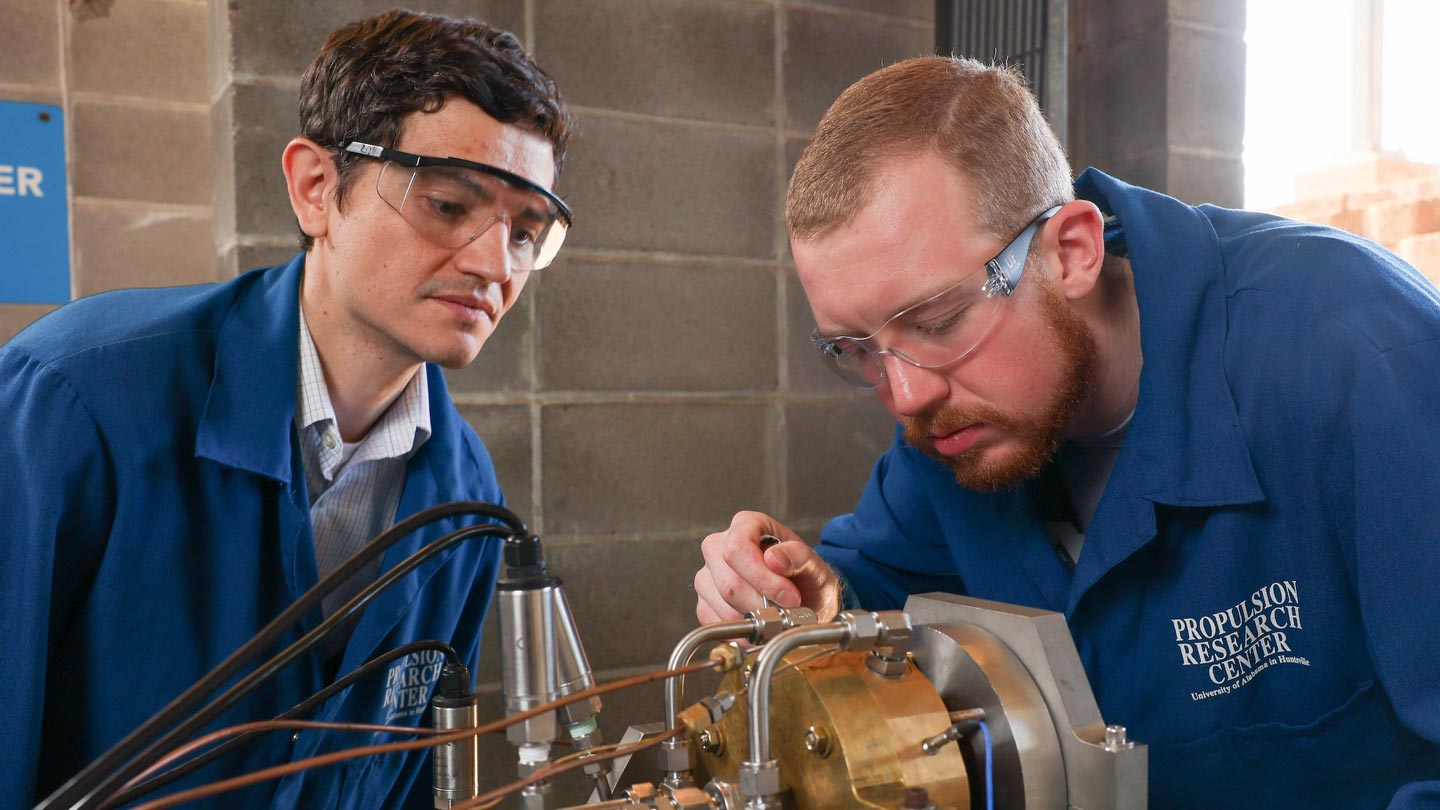
(L – R) Dr. John Bennewitz works with graduate student Noah Hudson in the Johnson Research Center.
The fuels of tomorrow could burn faster, cleaner and more efficiently, thanks to research at The University of Alabama in Huntsville (UAH), a part of The University of Alabama System. Dr. John Bennewitz, an assistant professor in the Department of Mechanical and Aerospace Engineering at UAH, has received a $599,927 National Science Foundation (NSF) Faculty Early Career Development (CAREER) Award to investigate how ammonia-based additives can improve the combustion performance of renewable fuels. The five-year project will explore whether adding ammonia borane to renewable fuels, such as ethanol and methanol, can enhance their performance in detonation-based combustion systems.
The research could ultimately have applications across a broad range of combustion systems, including stationary power generation, aviation and advanced propulsion technologies, as well as other transportation applications where improved fuel efficiency and energy density are critical.
“I am very honored to be awarded this NSF CAREER research grant,” Bennewitz says. “My long-term research aim is to expand the fundamental understanding required to produce high performance multiphase detonation systems using renewable fuels to aid the creation of a diverse energy future, and this project helps provide a strong foundation towards this goal.”
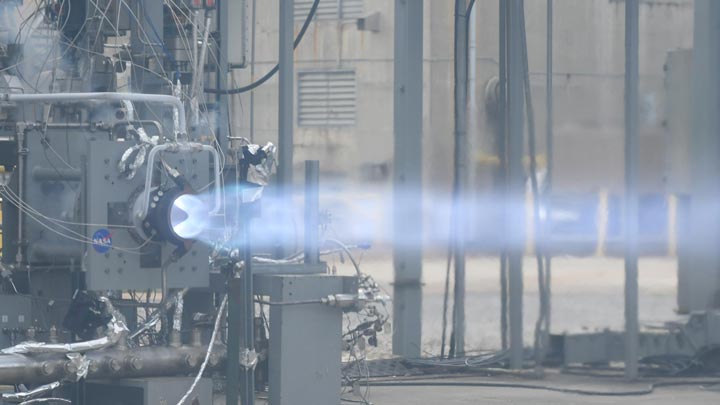
Engineers at NASA’s Marshall Space Flight Center conduct a successful 251-second hot fire test of a full-scale Rotating Detonation Rocket Engine combustor.
The NSF CAREER program is one of the foundation's most prestigious awards for early-career faculty, recognizing teacher-scholars whose research and educational activities have the potential to make significant contributions to their fields.
“The project will create a new research direction for the Advanced Propulsion, Energy and Combustion Science Laboratory (APECSLab) that will explore the use of detonation to increase the thermodynamic efficiency of combustion cycles with renewable fuels,” Bennewitz explains. “The project has the potential to positively impact the energy landscape of renewable fuels.”
The researcher heads APECSLab, which is housed within the UAH Propulsion Research Center. The lab focuses on detonation, combustion and propulsion. Bennewitz’s work builds on his studies of fuel droplets, energetic additives and multiphase-detonation physics.
“Ethanol with ammonia borane has shown the ability to produce micro-droplet shedding and augment vaporization for enhanced burning due to hydrogen gas generation,” Bennewitz says. “The ability of ammonia borane addition to affect both secondary atomization and vaporization makes it a strong detonation modifier candidate for renewable fuels, including ethanol and methanol.”
Exploring a new path for renewable fuels
Renewable fuels can broaden the nation's domestic energy portfolio, but their lower volumetric energy density compared with traditional fossil fuels presents challenges for power generation and transportation.
Bennewitz's research will examine detonation, a supersonic combustion process, as an alternative to conventional subsonic deflagration. Subsonic deflagration is a type of combustion where a flame front moves through a fuel-and-oxidizer mixture at a rate slower than the speed of sound. The new project instead focuses on supersonic combustion to investigate the physics governing how fuel droplets interact with a traveling detonation wave, with particular attention to secondary atomization and vaporization, processes that can influence combustion performance.
“In 2023, we participated in a collaborative project with the Air Force Research Laboratory (AFRL) and Argonne National Laboratory (ANL) to investigate droplet-detonation interactions for pure liquid fuel and water using high-speed diagnostics,” Bennewitz says. “Our group performed remote testing at ANL’s Advanced Photon Source, where we successfully implemented MHz-rate x-ray image capturing of droplet-detonation interaction events for water and rocket grade kerosene RP-2.”
To support the study, the research team will employ advanced high-speed diagnostics, including X-ray imaging, chemiluminescence and Schlieren visualization – an optical method that lets researchers see changes in gas density. Combined, these diagnostics will capture the complex interactions between droplets and detonation waves. The experiments will help determine how ammonia borane changes droplet breakup, vaporization, energy release and ultimately detonation propagation. The goal is to develop a stronger fundamental understanding that could inform future approaches to controlling detonation in renewable-fuel systems.
Research meets STEM education
The NSF award extends beyond the laboratory as well. “Additionally, I have long-term educational goals to promote STEM to K-12 groups and to cultivate scientific interest to the broader community regarding the ongoing combustion work APECSLab is pursuing at UAH,” the researcher notes. “The planned academic activities detailed under this project are intended to fulfill these overarching objectives with the goal of fostering accessibility for both the general understanding of the relevant science, as well as a path forward for these students to pursue STEM careers.”
The research team also will collaborate with the U.S. Space & Rocket Center in Huntsville to provide STEM educational opportunities for the public.