Leah Johnson will receive UAH’s 1st doctorate in chemistry at commencement ceremonies May 4
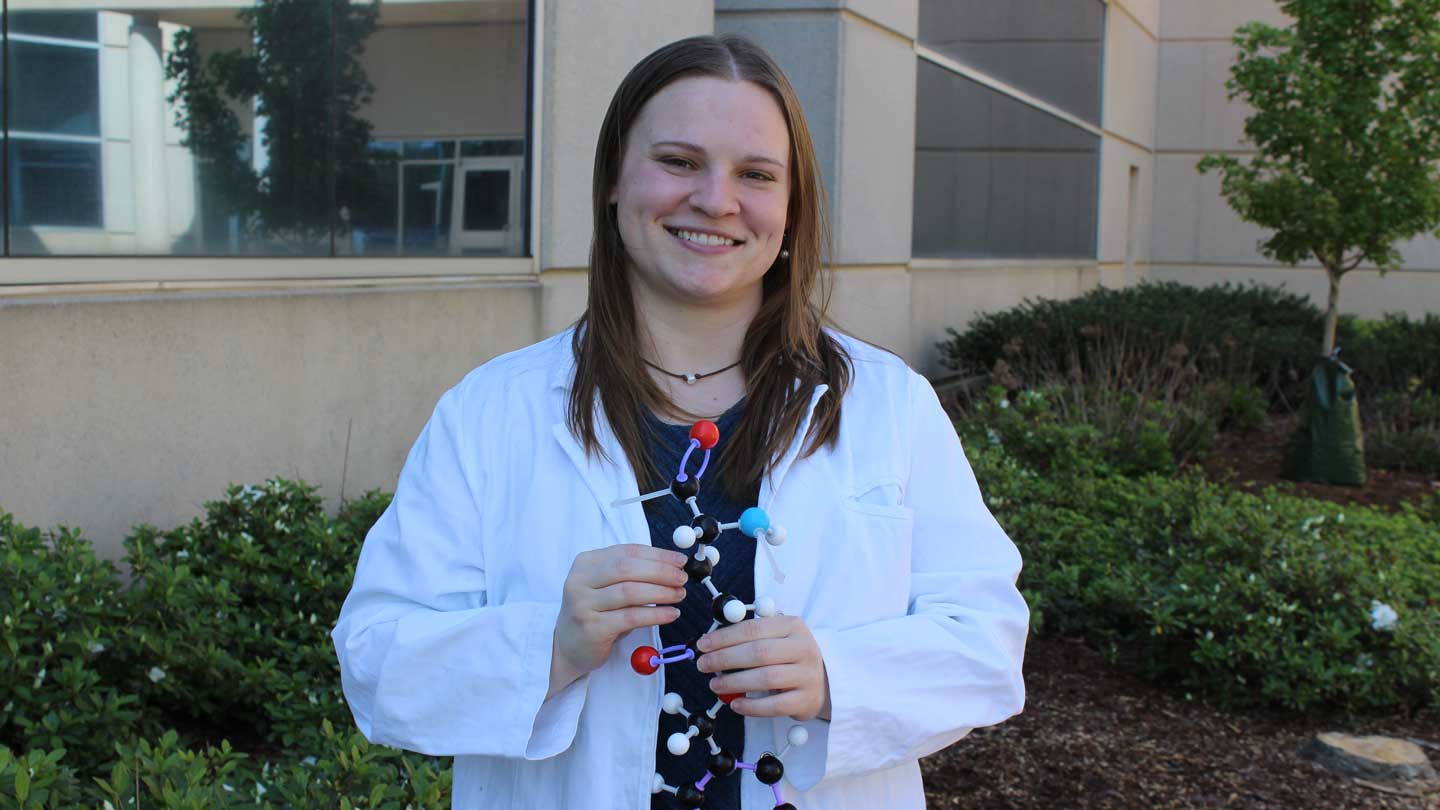
Leah Johnson, the first student to earn a doctorate in chemistry at The University of Alabama in Huntsville (UAH), stands outside the UAH Materials Science Building on April 7, 2026, with her “chemist LEGO” model of the molecule she studied for her dissertation. Johnson will receive her Ph.D. in chemistry from UAH on May 4, 2026, during commencement ceremonies at the Von Braun Center Propst Arena.
When Leah Johnson is awarded her Ph.D. in chemistry from The University of Alabama in Huntsville (UAH) on May 4, the event will mark a milestone for the student and the university: Johnson is the first graduate of the chemistry doctoral program UAH implemented in fall 2023.
UAH will honor the accomplishments of Johnson and approximately 1,145 other spring 2026 graduates during two commencement ceremonies at the Von Braun Center Propst Arena. UAH is a part of The University of Alabama System.
Johnson was pursuing her master’s in chemistry at UAH when the doctoral program began. Her primary research professor, Dr. Carmen Scholz, professor of chemistry in the College of Science, urged her to expand her education to a Ph.D.
“She said, ‘You are capable of this,’” Johnson recalled. “‘You are the caliber of student that needs to strongly consider a Ph.D.’ I will never forget that. It really stuck with me because I was on the fence.”
Johnson had listed the positives: “Yes, this would be a good opportunity. Do I like my research? Do I like the research group? Do I think I can stick it out for another three years? All of that was there.”
But Scholz’s words confirmed Johnson’s choice.
“Her encouragement is really what helped me decide that this is something I need to do and that I ended up wanting to do.”
Johnson’s doctoral dissertation, “Synthesis and Characterization of Poly(gamma-L-benzyl-glutamate) by Infrared Adsorption and Diffusion-Ordered NMR Spectroscopy,” is one reflection of her longtime goal to make the world a better place through chemistry – in research and teaching.
“Polymer chemistry is a very practical discipline because we use polymers every day. I work with a polymer that is used in biomedical research, mainly for drug delivery. Say we have this drug that does not dissolve in water. It would be unsafe for us to have it freely in our bodies because it’s not compatible.”
Enter polymers made from natural building blocks.
“People who are smarter than me have created polymers of these materials (amino acids) and have made sort of a little shuttle with the capsule that the drug goes into. It’s like a housing unit that goes around the body. Then when the housing is processed by the body, it’s a healthy way, relatively speaking, to deliver drugs that would otherwise be very toxic.”
The polymer Johnson studied is one piece used to build the capsule, officially termed as a micelle.
“Instead of actually making the micelles and the delivery systems, I just looked at this polymer. And this is what I tell people: I stuck it into a bunch of instruments, looked at what it gave me and then made interpretations based on that spectra.”
The molecular weight of the string of molecules (i.e., the polymer chain) can affect its properties, she said.
As Johnson described her work, she snapped various black, red, blue, white and purple plastic shapes – “chemist LEGO” pieces – together to form a model of the molecule in question.
“You can’t hold a molecule and look at it. The model kit helps me visualize it. And I’m very visual.”
That model kit was another piece of good professorial advice. She received the tip while working on her bachelor’s in chemistry at The University of North Alabama.
“My professors in undergrad would tell me that this is the best way to visualize. You learn about molecules on a whiteboard or on paper, but the molecules are not two dimensional, they’re three dimensional. This has all the correct angles and everything. It helps students visualize better, so they can determine different things. And they can actually hold it. You can’t hold everything in chemistry.”
Johnson plans to take the kit and her passion for chemistry into the teaching field. This summer she’ll be an adjunct at Snead State Junior College.
“I’ve always said I enjoy teaching chemistry more than doing chemistry. It’s not that I don’t enjoy working in labs and figuring stuff out in that way, but there’s a different type of joy when I’m showing someone how to work a chemistry problem and seeing that light bulb moment: Yes, you get it!”
An industrial path remains a possibility, but teaching has the strongest pull for now.
Johnson’s love of teaching came as naturally as her love of science. Her mother spent more years than she’d like to count as a third-grade teacher in Lawrence County. Her father and brother are both physicists, and her brother’s also a professor at The University of West Alabama. And Johnson has always loved teaching the youth in her church.
From her mother’s experience, as well as her own as a student in small, rural Alabama schools, Johnson understands and appreciates dedicated teachers and promising students.
“Growing up in that environment with some amazing teachers and seeing how education changes the trajectory of lives, I want to give students that opportunity: You are smart and capable and more than you probably realize. You just need someone to tell you that and to give you that start.”
Contact
Julie Jansen
256.824.6926
julie.jansen@uah.edu
Ann Marie Martin
(256) 824-5294
annmarie.martin@uah.edu