UAH researcher wins $1.18 million NSF award to advance cold-plasma technologies to help farmers grow more food with fewer resources
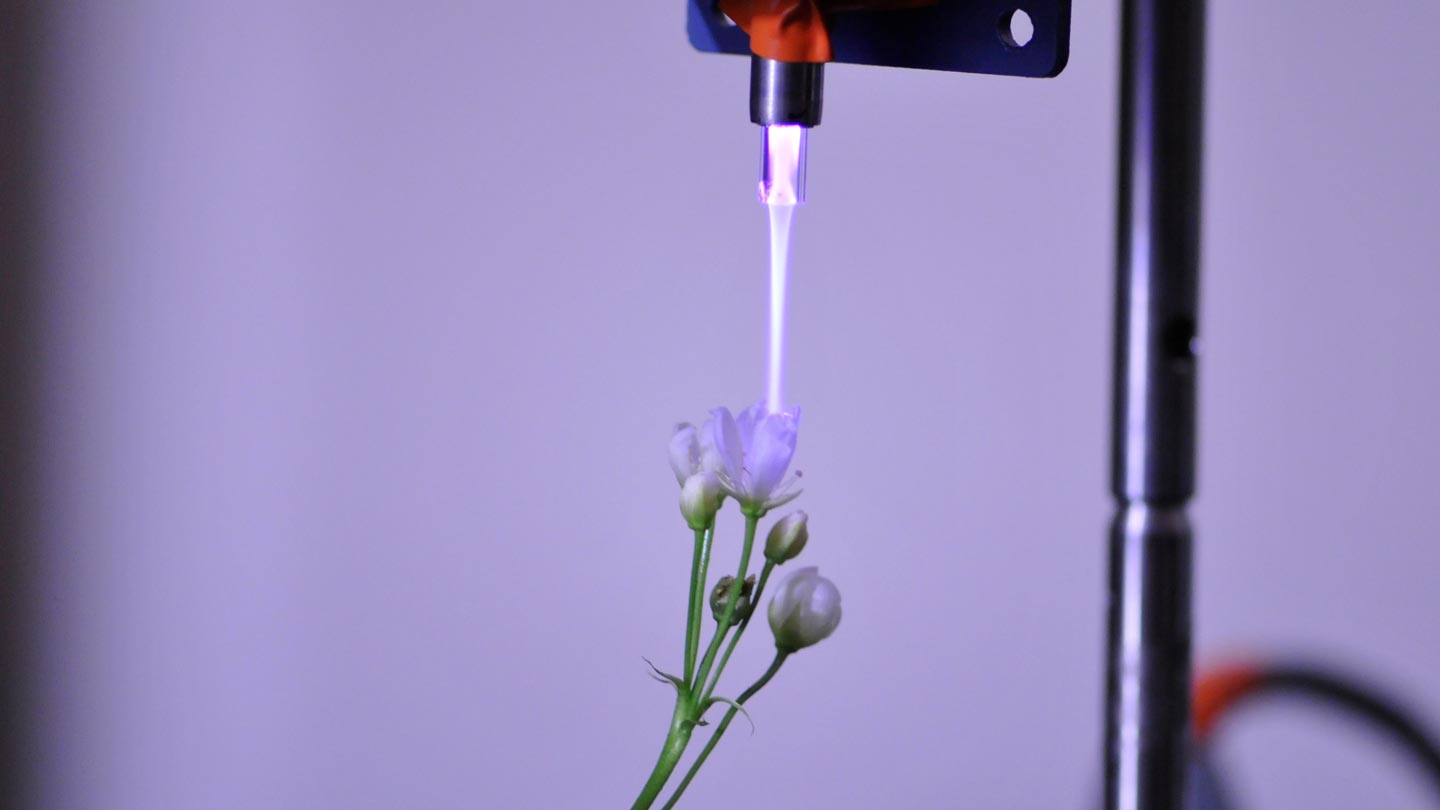
Cold plasma is an electrically energized gas that can be generated at room temperature and atmospheric pressure.
What if a single treatment before planting could help crops grow stronger, withstand drought and produce more usable food, without adding chemicals or genetically modifying the plants? A researcher at The University of Alabama in Huntsville (UAH), is working to bring that possibility closer to reality through a new project aimed at moving cold-plasma agricultural technology from the laboratory to commercial use. Dr. Gabe Xu, a UAH professor of Mechanical and Aerospace Engineering and principal investigator on the project, has received a National Science Foundation (NSF) award totaling $1,184,600 to advance cold-plasma agriculture treatment technology toward larger-scale systems for commercial use. UAH is a part of The University of Alabama System.
The work brings together researchers from UAH, Alabama A&M University and Auburn University, along with industry and agricultural partners, to translate laboratory-developed technology into systems that could help farmers increase crop productivity, improve food safety and reduce spoilage while using fewer resources.
“Our partners and collaborators are critical to translating the lab science and technology to real world application,” Xu says. “I can tell you how to make a plasma source and measure the plasma properties, but I have little idea of what crops would be good to treat, or where in the poultry processing pipeline the technology could help the most. We have to work together to find the best path forward that balances the science, engineering, food safety, regulations and profitability for the end user.”

Dr. Gabe Xu, UAH professor of Mechanical and Aerospace Engineering.
Cold plasma is an electrically energized gas that can be generated at room temperature and atmospheric pressure. Using electricity and commonly available gases, the technology produces reactive chemical species, charged particles and electric fields that can interact with living materials, including seeds, roots, leaves and food products. Unlike conventional approaches that rely on additional chemical treatments or genetic modification, cold-plasma treatment offers a potential way to improve agricultural outcomes through a targeted, single treatment.
UAH's project will focus on scaling up plasma sources and their power supplies while testing treatments for plants and food. The goal is to develop commercially useful systems that can integrate into agricultural and food-production operations. The technology has demonstrated promising results in plant growth and resilience.
“In the ideal end stage, cold plasma can reduce or remove the use of chemical fertilizers that are currently used to increase the yield of crops,” Xu explains. “We have shown that plasma treatment can increase the germination, growth rate and final usable yield of various plants. All with a one-time treatment prior to planting. We have also found that plasma treatment can improve drought tolerance, meaning less water could be used as well, or crops can better survive adverse weather.”
The technology also helps address food waste and food safety concerns by reducing microorganisms associated with spoilage and extending the shelf life of agricultural and food products.
“For food spoilage, the plasma can sanitize spoilage organisms and increase shelf life, thus reducing food waste and food-borne illness,” the researcher notes. “The lack of synthetic chemicals or genetic modification is thus not only good for the crops and the animals and people who eat them, but also for the soil, water and environment.”
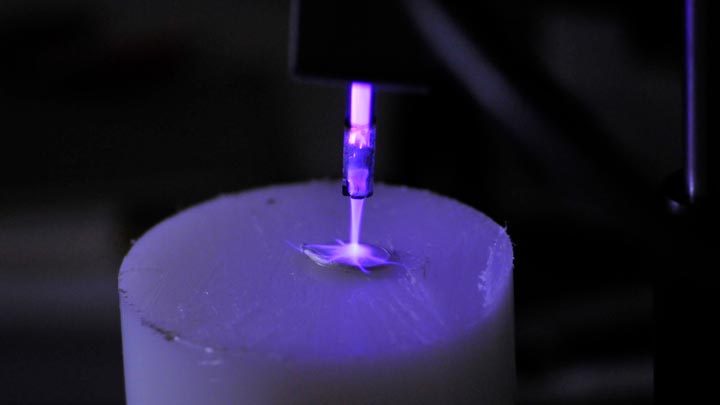
In honor of Halloween, experimenting with atmospheric pressure plasmas on pumpkin seeds in collaboration with the UAH Department of Biological Sciences.
Feeding a hungry world
The team is pursuing these applications at a time when agricultural producers face growing pressure to increase food production while managing limited land and water resources, changing weather patterns and the economic demands of running farms. The NSF project is designed to move beyond laboratory demonstrations by addressing the engineering, performance and practical considerations necessary for adoption by farmers and the food industry.
Xu emphasizes that translating the technology into agricultural use is particularly important as global food demand rises.
“I believe bringing research like this to real-world agricultural and food applications will be critical in the coming years and decades. The human population is projected to reach 10 billion people by 2050, for which we will need an estimated 60-70% more food production. At the same time, farmland is shrinking year to year, adverse weather patterns are increasing, soil and water are continually stressed by synthetic fertilizers and more family farms close every year.
“The pressure to feed the world with increased food production while balancing profitability and sustainability is one of the most critical problems facing humanity as a species. I don't know if cold plasma is the answer, but I think it can have a role to play in the future of agriculture and food production.”
EPSCoR support provides the foundation
The agricultural award builds on nearly a decade of Alabama research in plasma science and engineering supported by the NSF Established Program to Stimulate Competitive Research (EPSCoR). The statewide initiative, known as Future Technologies and Enabling Plasma Processes (FTPP), is supported by a separate $20 million NSF award, with UAH administering the project in collaboration with universities and other partners across Alabama. FTPP develops foundational plasma research and strengthens collaborations among scientists and engineers working in fields that include agriculture, food safety, materials science and space science.
“The EPSCoR project provided both the funds to allows us to build the first plasma sources and study the physics, but perhaps more importantly the project connected me, the plasma scientist/engineer, with researchers in agriculture, food science, microbiology and chemistry,” Xu says. “It was only through these cross-field collaborations that we were able to bring our mutual knowledge together and discover these novel applications of plasma for agriculture, food and microbiology.”
The agricultural project is funded through the NSF Translation to Practice program which supports efforts to move research discoveries toward real-world deployment and adoption. UAH and its collaborators will work with its corporate partners to evaluate the technology's potential applications and help guide its development toward commercial use.
“I think this project is a great example of what the EPSCoR program aims to accomplish: developing new research capabilities and directions that can be self-sustaining to improve the research and economic output of a state for the long term,” Xu concludes.