UAH researcher earns NSF award to investigate how cloud droplets become raindrops, with implications for both Earth and other planets

Interactions between tiny droplets affect their chances of colliding and growing.
Before a cloud can send rain to Earth, microscopic droplets must make a remarkable leap in size, and a University of Alabama in Huntsville (UAH) researcher is working to uncover the physics behind it. Dr. Sarma Rani, a professor in UAH’s Department of Mechanical and Aerospace Engineering, is the principal investigator for the three-year collaborative research project, a National Science Foundation (NSF) award to support research into how water droplets grow inside warm cumulus clouds. The study is funded through NSF’s Division of Chemical, Bioengineering, Environmental and Transport Systems, and is scheduled to run through Jan. 2029. UAH is a part of The University of Alabama System.
Warm, rain-bearing clouds play an important role in Earth’s water and energy balances and influence the weather. Yet scientists continue to face challenges in accurately predicting how droplets grow into raindrops. Rani’s research will focus on a critical portion of that process known as the “size gap.”
“A key unknown is the physics driving droplet growth in the 15 - 40 micron radius range, where growth by condensation and sedimentation-driven collisions is ineffective,” Rani explains. “The goal of our research is to elucidate the microphysics responsible for droplets bridging the size gap by focusing on two fundamental mechanisms that have either been neglected or modeled incorrectly.”
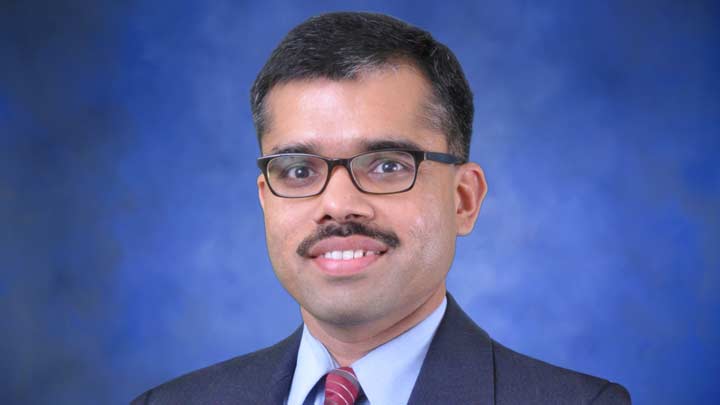
Dr. Sarma Rani, a professor in UAH’s Department of Mechanical and Aerospace Engineering.
The research will examine two mechanisms that could help explain how droplets bridge this gap: the effects of continuum and non-continuum hydrodynamic interactions on droplet collision rates and the potential role of intense turbulent fluctuations in local moisture content as droplets move through clouds. These processes refer to how interactions between tiny droplets affect their chances of colliding and growing, and how turbulence and changes in moisture inside clouds may help droplets grow larger.
The NSF project will combine large-eddy simulations of cloud dynamics with theoretical models of droplet-scale hydrodynamics. Researchers will investigate how large-scale turbulent processes interact with small-scale forces and processes affecting individual droplets.
“Particle-laden turbulent flows are found in numerous engineering applications, as well as in nature,” Rani notes. “In our research group, we have done extensive computational and theoretical work to gain fundamental insights into how particles interact with flows, especially turbulent flows.”
Those engineering studies provided a foundation for applying the group’s expertise to fundamental questions in cloud physics. The project has implications beyond understanding rainfall as well. More accurate descriptions of droplet growth could help improve the representation of warm clouds in models used to study weather and Earth’s climate system, while the effort is also positioned to advance cloud physics research on Earth and other planets.
For Rani, the award represents an opportunity to pursue questions that have persisted in cloud physics for decades. “Winning this award was both gratifying and relieving,” the researcher says. “We hope to go a long way in answering some of the most persistent and longstanding questions relating to droplet growth in clouds.”
In addition to advancing fundamental research, the project will provide interdisciplinary research training for undergraduate and graduate students and will include outreach activities for high school and undergraduate students.