UAH Propulsion Research Center celebrates 35 Years of groundbreaking technologies, advancing the future of space exploration
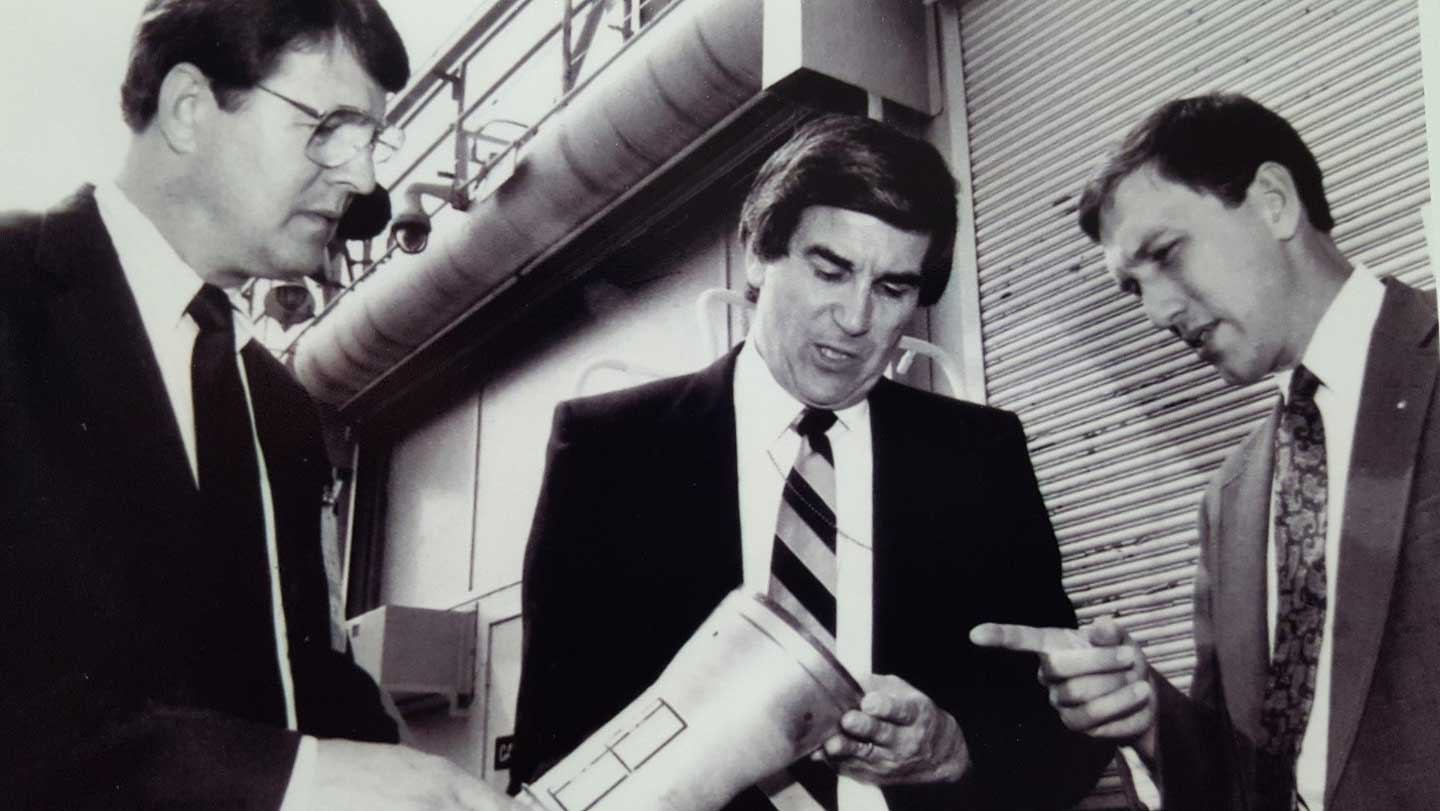
(L – R) Dr. Hugh Coleman, Dr. Clark Hawk and Dr. Robert Frederick, PRC founding members in 1991.
The journey to the farthest reaches of space begins with a challenge close to home: developing the propulsion technologies that will make tomorrow’s missions possible. This fall, the Propulsion Research Center (PRC) at The University of Alabama in Huntsville (UAH) has officially been pursuing that dream for 35 years, bringing together students, faculty, government researchers and industry partners all focused on advancing propulsion science and preparing the next generation of aerospace leaders. UAH is a part of The University of Alabama System
“For 35 years, the Propulsion Research Center has exemplified the kind of forward-thinking research and collaboration that makes UAH such an important part of the nation's aerospace community,” says Dr. Robert Lindquist, vice president for research and economic development at UAH. “What began as a vision to bring together talented faculty, students and research partners has grown into a center with a remarkable legacy of discovery, innovation and workforce development. The PRC is well positioned to continue addressing some of the most challenging problems in propulsion and space exploration while preparing the engineers and researchers who will help shape the future of the field. I’m excited to see what the future brings.”
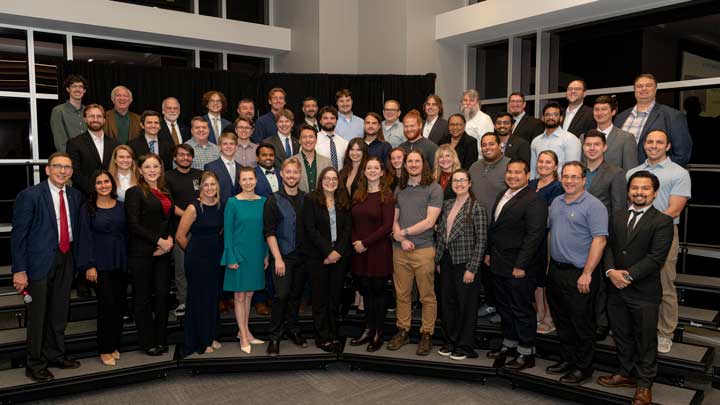
The PRC marked this milestone with a banquet recognizing alumni and the research community that have shaped its history. The event highlighted the paths UAH alumni have taken into industry and government research, and the two-day program concluded with a propulsion symposium at UAH’s Charger Union Theater, bringing together university researchers, industry and government experts to discuss launch vehicles, detonation physics and space nuclear propulsion, all underscoring the center’s longstanding connections among academia and the broader aerospace community.
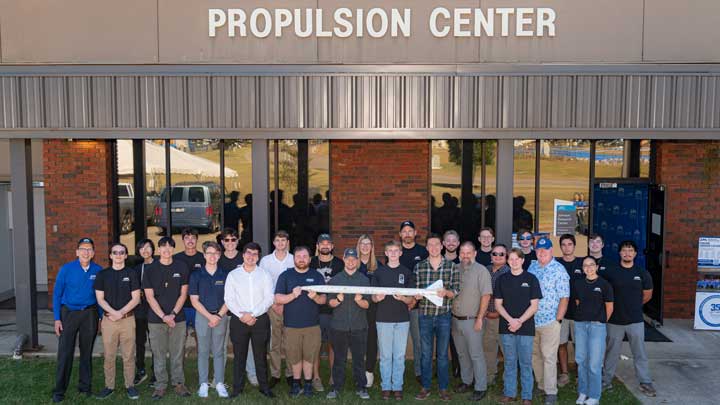
UAH PRC team gathers in front of Johnson Research Center during the 35th anniversary celebration.
“The PRC demonstrates how research and education reinforce one another at UAH,” says Dr. Robert Frederick, the PRC director and one of its earliest faculty members. “Students learn through difficult technical problems, and their work contributes to discoveries, publications and capabilities that matter to external partners.”
Established Feb. 1, 1991, the PRC has grown from a small team of faculty members and student researchers into an interdisciplinary community addressing some of aerospace engineering’s most demanding problems.
The PRC founding brought together a group of academics possessing complementary strengths. The founding Director, Dr. Clark W. Hawk, was instrumental in establishing the center and shaping its mission, contributing extensive Air Force propulsion experience, while Dr. Hugh Coleman, the first Eminent Scholar in Propulsion, brought research expertise and an understanding of academic programs. Frederick, then a new assistant professor, contributed industrial experience in experimental solid rocket combustion.
“A dedicated center gave UAH a continuing structure for connecting faculty expertise with the needs of government and industry,” Frederick explains. “Propulsion problems cross academic disciplines, and solving them requires coordinated research teams, specialized facilities and sustained relationships with sponsors."
A visionary educational model
The team’s founding aim extended beyond establishing a research facility as well. “Dr. Hawk believed that the center’s reputation would depend largely on the students we prepared,” Frederick says. “His vision was to connect the academic and propulsion communities through meaningful research, with students actively involved in the work.”
The main thrust of the newly-minted PRC was for academic departments to provide degree programs, while the center itself generated opportunities for students to contribute directly to projects aimed at solving real-world engineering challenges.
“Our research simply wouldn't happen without the bright, hardworking graduate and undergraduate students who participate in it,” says Dr. Jason Cassibry, a professor in the Department of Mechanical and Aerospace Engineering, and a UAH alumnus himself. “One of the most valuable things students learn at the PRC is how to approach problems that don't already have answers. In the classroom, we typically teach students how to solve problems using established methods. In research, they have to figure out what the problem really is, develop their own approaches and sometimes discover that the assumptions they started with were wrong."
By the end of 2026, the center will have supported 500 advanced degrees, including 106 doctorates, 270 thesis master's degrees and 124 non-thesis master's degrees. The lasting significance of those numbers is what those alumni contribute throughout their careers. “Their research, leadership and mentorship continue the center’s influence long after graduation,” Frederick says.
One prominent example is Dr. John Blevins, a UAH alumnus who earned his master's degree in 1993 and doctorate in 1998 before becoming NASA's Space Launch System chief engineer.
“You remember that person as a student learning to design an experiment, work through an unexpected result or explain a difficult technical problem,” Frederick says. “Later, you see that person leading a team or helping guide an important program. That is Dr. Hawk’s vision becoming visible over time. We helped prepare someone whose influence now reaches well beyond UAH.”
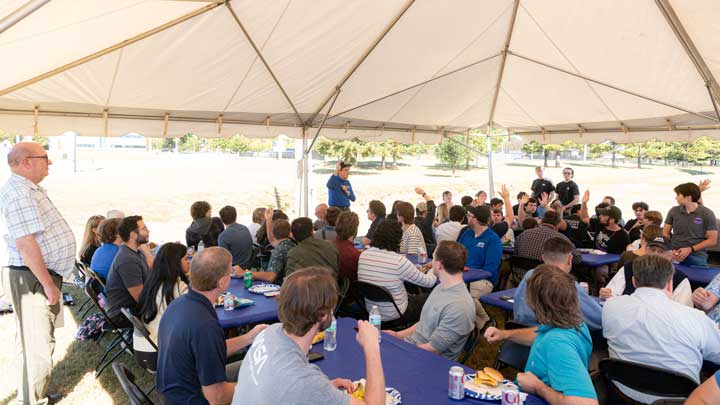
That emphasis on student involvement was on display as well as the UAH University Student Launch Initiative (USLI) marked its 25th anniversary with a picnic and reunion at the Johnson Research Center as part of the celebration, bringing together alumni from across the program’s history and current student team members. The gathering highlighted a quarter-century of hands-on aerospace education, demonstrating how the nationally recognized program has equipped generations of UAH students with practical experience in rocket design, engineering, problem-solving and teamwork.
A home-grown advantage
The PRC's development has been closely connected to Huntsville's aerospace and defense community. NASA’s Marshall Space Flight Center, Redstone Arsenal and regional aerospace companies have each provided opportunities for collaboration, research sponsorship and workforce development, while industry support has helped establish the Eminent Scholar in Propulsion endowment, with contributions from Aerojet, Lockheed Missiles and Space Company, Martin-Marietta, Rocketdyne and Thiokol.
Cassibry, a PRC researcher whose work includes advanced propulsion and fusion concepts, says the university's interdisciplinary environment and proximity to NASA and Cummings Research Park offer distinctive advantages.
“UAH has given me the opportunity to teach a wide variety of courses, which has helped me develop the multidisciplinary expertise essential to advanced propulsion research,” the researcher notes. “Our proximity to Marshall Space Flight Center has been equally important, allowing us to build lasting collaborations and gain access to state-of-the-art experimental facilities that would be difficult to replicate elsewhere. When it comes to advanced propulsion, people know who we are, what we can do and that they can come to us with challenging problems.”
These partnerships also create opportunities for former students to become collaborators and leaders within the aerospace community.
“There's something especially gratifying about seeing the next generation of engineers become the colleagues and leaders we turn to for expertise,” Cassibry says. “It speaks to the strength of the relationship between UAH and NASA Marshall and how that relationship continues to grow across generations.”
Advancing the future of space exploration
The PRC's research portfolio encompasses solid, liquid, hybrid, electric and air-breathing propulsion, along with hypersonics, plasma systems, nuclear thermal propulsion and fusion propulsion.
Among its most ambitious areas is fusion propulsion, which could eventually make deep-space travel faster and expand opportunities for human and robotic exploration.
"We've seen tremendous progress in fusion research over the past decade, driven largely by private investment and renewed NASA interest in fusion propulsion," Cassibry says. “I'm optimistic that we'll see a fusion propulsion demonstration in space within the next 10 to 15 years. In fact, we're working today on some of the very technologies that could make that possible."
The potential implications are substantial. Faster propulsion could reduce astronaut exposure to radiation and prolonged microgravity during lengthy missions while enabling robotic spacecraft to reach destinations that remain difficult to explore with existing systems.
“Fusion propulsion could potentially reduce the journey to Mars to as little as three months, dramatically improving astronaut safety and making human exploration of Mars a much more routine undertaking," Cassibry says.
He also sees possibilities for robotic sample-return missions to Uranus and Neptune and, farther into the future, spacecraft traveling to an area of deep space know as the Sun's “gravitational lensing region.”
“At these enormous distances, the Sun itself acts as a gravitational telescope, potentially allowing us to resolve surface features, perhaps even continents, on Earth-like planets orbiting other stars,” Cassibry says. “Imagine being able to actually see the geography of a world in another solar system!”
Realizing those possibilities will require overcoming substantial scientific and engineering challenges – including achieving repeatable fusion ignition – directing the resulting energy into thrust and developing systems capable of reliable operation.
“We've been working on these challenges for many years at UAH, and we've made substantial progress in understanding the underlying physics. There's still plenty of work to be done, but that's what makes this such an exciting field of research,” Cassibry says.
Looking toward year 50
As the PRC looks toward its 50th anniversary in 2041, Frederick knows the center will continue generating talent and innovative solutions in propulsion and energy technologies.
“By 2041, I hope another generation of graduates will be leading important programs, making discoveries and preparing people who follow them,” the current PRC Director concludes. “New technologies and research accomplishments will matter, but the strongest measure of success will remain the people we help develop and the contributions they make throughout their lives.”
Cassibry shares that emphasis on people over any single technological achievement. “Rather than focus on a particular technological breakthrough, I'd like to see the PRC recognized for something even more enduring: a consistent record of developing outstanding engineers and researchers who go on to make important contributions throughout their careers.”
For Frederick, that commitment is ultimately reflected in the people who make the center's mission possible. “The mission is carried on by the passion of our faculty and staff who invest countless hours of their lives to making UAH and our students successful.”