UAH Director of CSPAR, Dr. Gary Zank, receives international COSPAR Space Science Award; minor planet named in his honor
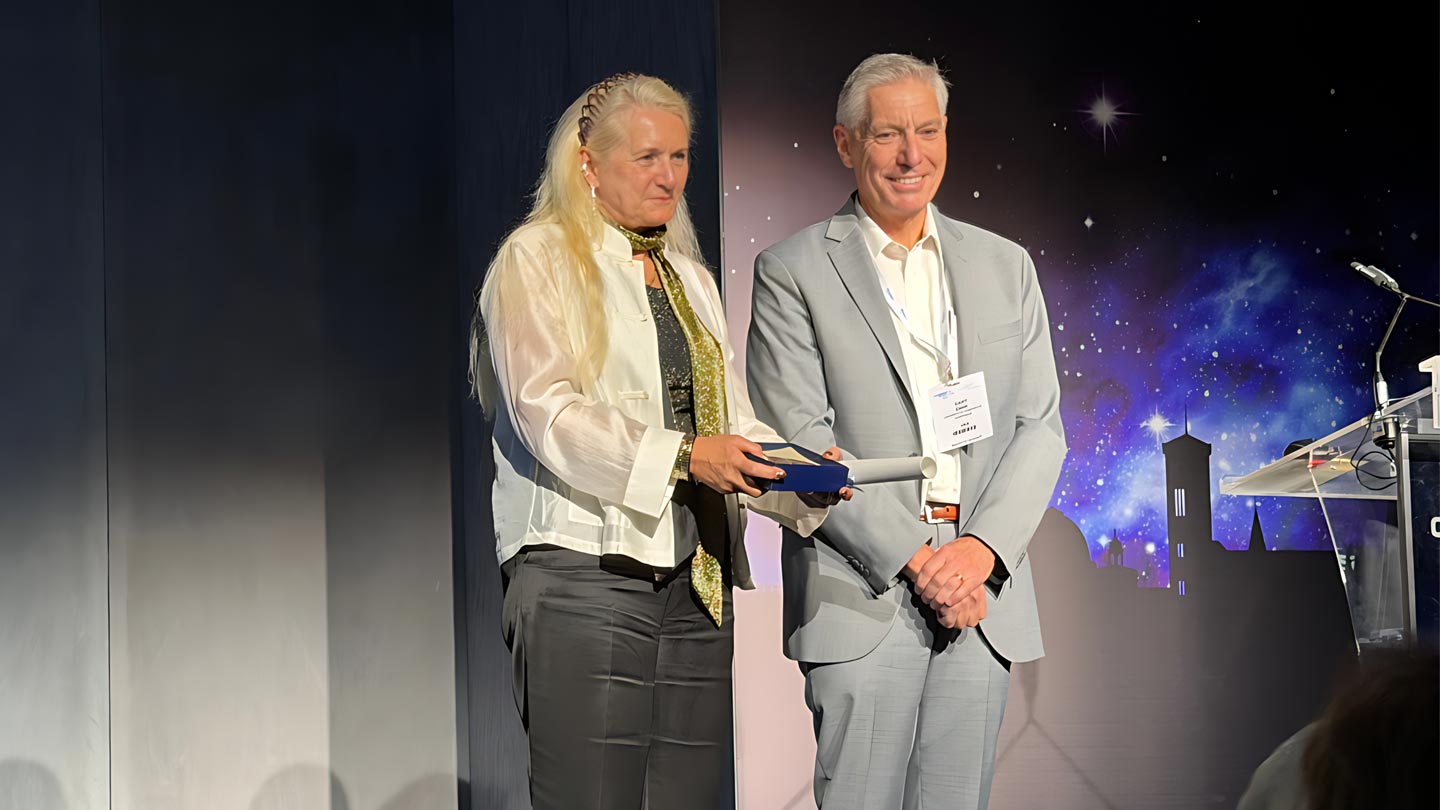
(L – R) Professor Pascale Ehrenfreund, COSPAR council president, presents Dr. Gary Zank, director of the UAH Center for Space Plasma and Aeronomic Research (CSPAR), with the 2026 Committee on Space Research (COSPAR) Space Science Award in Florence, Italy.
A lifetime of probing the invisible forces that shape our solar system has earned a University of Alabama in Huntsville (UAH) researcher one of the highest honors in international space science, as well as an enduring place among the stars. Dr. Gary Zank, director of the Center for Space Plasma and Aeronomic Research (CSPAR) and a faculty member and former chair of the Department of Space at UAH, a part of The University of Alabama System, has received the 2026 Committee on Space Research (COSPAR) Space Science Award. The award was presented during the 46th COSPAR Scientific Assembly in Florence, Italy, an event that brings together researchers from around the world to share advances across space science, including heliophysics, astrophysics, planetary science, space weather and other disciplines.
The Aerojet-Rocketdyne Chair in Space Science at UAH, as well as University of Alabama Board of Trustees Trustee Professor, Zank is also principal investigator for a five-year $20 million National Science Foundation EPSCoR Track-1 award, Future Technologies & enabling Plasma Processes (FTPP). The researcher joins an elite group of scientists recognized by COSPAR, an international organization established in 1958 to promote scientific research in space and foster international cooperation.
“It was a wonderful surprise, as I had not realized that I had been nominated,” Zank says. “Since it covers the awardee's entire career, receiving this medal was very humbling given the great work that so many people have done over their careers. The citation draws extensively on the many results I have been privileged to discover or uncover. I am deeply conscious of how much I owe to my students, postdocs and research colleagues over the past 40 years. Science is truly a collective endeavor, and I am extraordinarily grateful to these wonderful colleagues, friends and of course my wife Adele and my family that have made such a richly rewarding career possible.”
Among Zank’s influential contributions are modern models of the large-scale interaction between the solar wind and local interstellar medium. His work included predicting the existence of a “hydrogen wall,” a region where neutral hydrogen becomes compressed ahead of the heliosphere as the solar wind pushes against interstellar space.
The researcher also developed influential theories of turbulence, particle acceleration and energetic-particle transport throughout the heliosphere. His models of solar-wind turbulence proposed that it consists primarily of two interacting components: two-dimensional fluctuations relative to the average magnetic field and slab-like fluctuations aligned with it. Zank’s early work on the acceleration and transport of solar energetic particles (SEPs) in the early 2000’s has had an enormous impact on current models of SEPs and their role in the modern field of space weather.
The researcher’s work further led to the notion that reflected interstellar pickup ions influence the structure and dissipation of the heliospheric termination shock, a prediction that was supported more than a decade later by observations from NASA’s Voyager 2 spacecraft.
For Zank, the award represents more than an individual career achievement. “COSPAR exemplifies the idea of international cooperation and collaboration,” he notes. “During the Cold War, they were a critical, yet quiet, conduit for bringing together people from around the world under the umbrella of space science to advance the field first of all, and to make everyone recognize the fundamental humanity writ large of all people, regardless of origin or creed, doing science.”
The recognition also comes with a singular distinction that reaches far beyond the scientific community: Minor Planet 21039 has been officially designated 21039 Zank in his honor. The 2.4-kilometer-wide stony asteroid is located in the inner region of the main asteroid belt between Mars and Jupiter.
“It's fun and amusing to know that a minor planet will forever have my name attached to it – at least forever in any meaningful human sense,” Zank says. “I need to find a friend with a good telescope to ask them to kindly photograph it for me so that I can display it!”