Hiding in plain sight: UAH researchers discover new ‘Demon Cavefish’ in North Alabama cave
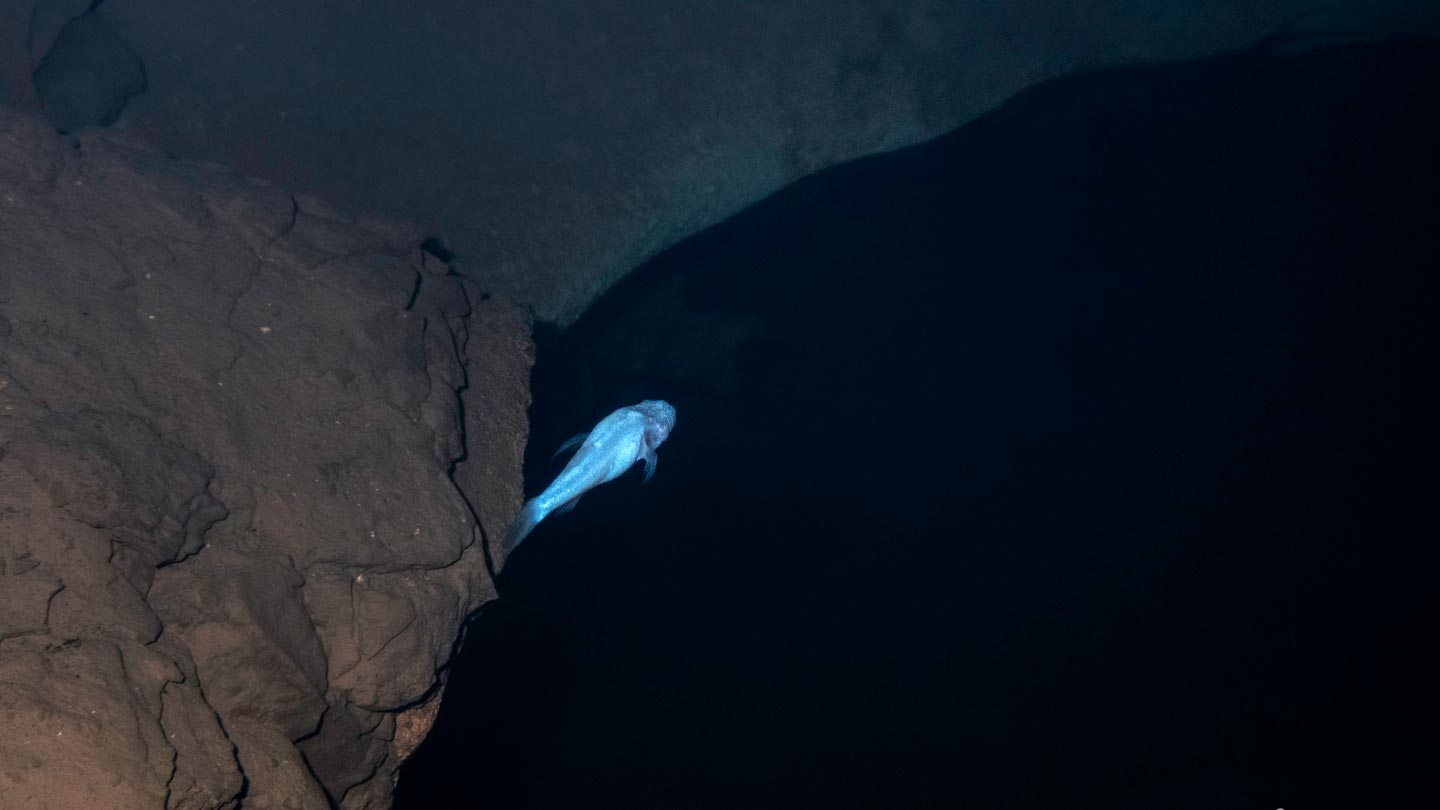
Newly discovered Demon Cavefish swimming in a pool in Bobcat Cave beneath Redstone Arsenal.
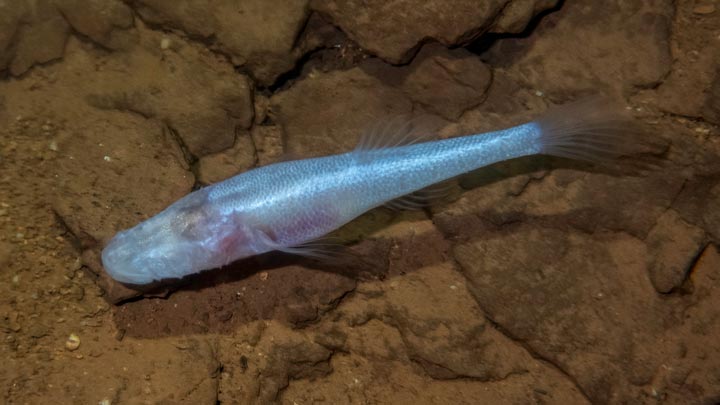
Researchers at The University of Alabama in Huntsville (UAH), a part of The University of Alabama System, have helped uncover a new genus of blind cavefish hiding in one of the most studied cave systems in the southeastern United States, a discovery that is reshaping scientists' understanding of evolution, biodiversity and conservation in subterranean ecosystems. The newly described Demon Cavefish (Demogorgonichthys arcanus) is completely eyeless, colorless and faintly electric blue in life. The discovery, published in Scientific Reports, reveals that one of Alabama's most intensively studied cave systems can still hold extraordinary biological secrets.
The study’s lead author was Dr. Matthew L. Niemiller, associate professor of biological sciences and director of the Cave Bio Lab at UAH, in collaboration with researchers from three other regional universities, including Drs. Jonathan Armbruster of Auburn University, Pamela Hart at The University of Alabama and Dr. Michael Sandel at Mississippi State University, as well as Redstone Environmental and students in the Cave Bio Lab.
“This is one of the last places we'd have bet on it,” Niemiller says. “Finding an entirely unknown, new genus of freshwater fish in eastern North America today is a little like finding a new kind of big cat. The group is so well known, we thought the big surprises were behind us. To have one turn up in a cave we've watched for three decades is a real reminder to stay curious. It was genuinely surprising.”

Dr. Matthew L. Niemiller, associate professor of biological sciences and director of the Cave Bio Lab at UAH.
One of the biggest revelations proved to be the location of the discovery, Bobcat Cave, situated only about eight miles from the UAH campus as the crow flies, beneath the U.S. Army’s Redstone Arsenal.
“This a site that has been monitored at least quarterly for more than 30 years. Cavefishes in this family have been a model system for cave biology since the 1800s,” the researcher notes. “The group is comparatively well-studied, and most of us assumed that a discovery at the genus level was increasingly unlikely. To find one – not in some remote, unexplored cave, but in Bobcat Cave – was humbling.”
The Demon Cavefish escaped detection because it closely resembles another blind species already known from the cave, the Southern Cavefish (Typhlichthys subterraneus). Detailed anatomical studies, CT imaging and genetic analyses ultimately revealed the new fish to be something entirely different.
“It's distinct on every line of evidence we examined," Niemiller explains. "A new genus is warranted when an animal simply doesn't fit within any existing one, and this fish met that bar in its anatomy, its CT imaging and its DNA all at once."
Like ships that pass in the night
The discovery carries implications far beyond the identification of a new species. Researchers found that the Demon Cavefish and the Southern Cavefish occupy the very same pools inside Bobcat Cave, yet they are not close relatives. Instead, the two lineages independently evolved the classic characteristics of cave life – including the loss of eyes and pigmentation – millions of years apart.
“This is the part I find most remarkable,” Niemiller says. “The Demon Cavefish shares its cave, and the very same pools, with the Southern Cavefish, yet the two aren't close relatives. Each found its own separate way into the underground world and lost its eyes and pigment independently, millions of years apart. It's a vivid case of convergent evolution. The cave environment sculpts very similar-looking animals, i.e., blind, pale, with heightened non-visual senses, out of completely distinct lineages.
“At the same time, it shows that caves can preserve deep evolutionary independence, keeping two lineages genetically worlds apart even as they live side by side,” the researcher says. “Underground ecosystems are both powerful sculptors of form and long-term refuges that preserve distinct histories."
The genus name, Demogorgonichthys, references the mythological Demogorgon, an underworld figure familiar to modern audiences through the game Dungeons & Dragons and the television series Stranger Things. Combined with the species name arcanus, meaning “hidden” or “secret,” the scientific name reflects both the fish's subterranean habitat and its decades-long concealment in one of Alabama's best-known cave systems.
The find also highlights the extraordinary biodiversity beneath North Alabama, pointing to the distinct likelihood of other new creatures just waiting to be uncovered.
"Almost certainly, yes,” Niemiller says on considering the possibility. “North Alabama sits atop one of the richest cave landscapes in the country, and the life in its groundwater is remarkable and still incompletely cataloged. Many cave and groundwater animals are easy to overlook. They are small, hard to study, and look-alike species get lumped together. So time and again, modern genetic tools reveal hidden diversity right where we thought we already knew the fauna. The Demon Cavefish is a reminder that our inventories are far from finished, even in well-explored places."
Because the Demon Cavefish is currently known from only a single cave and its connected aquifer, researchers believe it is highly vulnerable to changes in groundwater quality and hydrology. While the restricted access of Redstone Arsenal helps protect the cave from direct disturbance, the species remains susceptible to threats originating at the surface, including contaminants, sediment and changing water conditions.
"Being known from a single cave and its aquifer makes it inherently vulnerable," Niemiller said. "The central challenge is that the threats come from outside the cave. Groundwater quickly links the surface to the cave, so contaminants, sediment and fluctuations in water level from the surrounding recharge area can all reach the fish. What protects it is protecting the water, including safeguarding groundwater quality and the recharge basin, not just the cave passage, along with continued monitoring that reliably tells this species apart from its look-alike neighbor."
For Niemiller and his collaborators, the discovery serves as a reminder that scientific exploration often begins by looking more closely at places that seem familiar. For now, that search goes on with renewed vigor.
“The fact that these two cavefish occupy the same subterranean habitat but followed different evolutionary journeys gives us a unique opportunity to better understand how life adapts to some of Earth's most extreme environments,” he concludes.