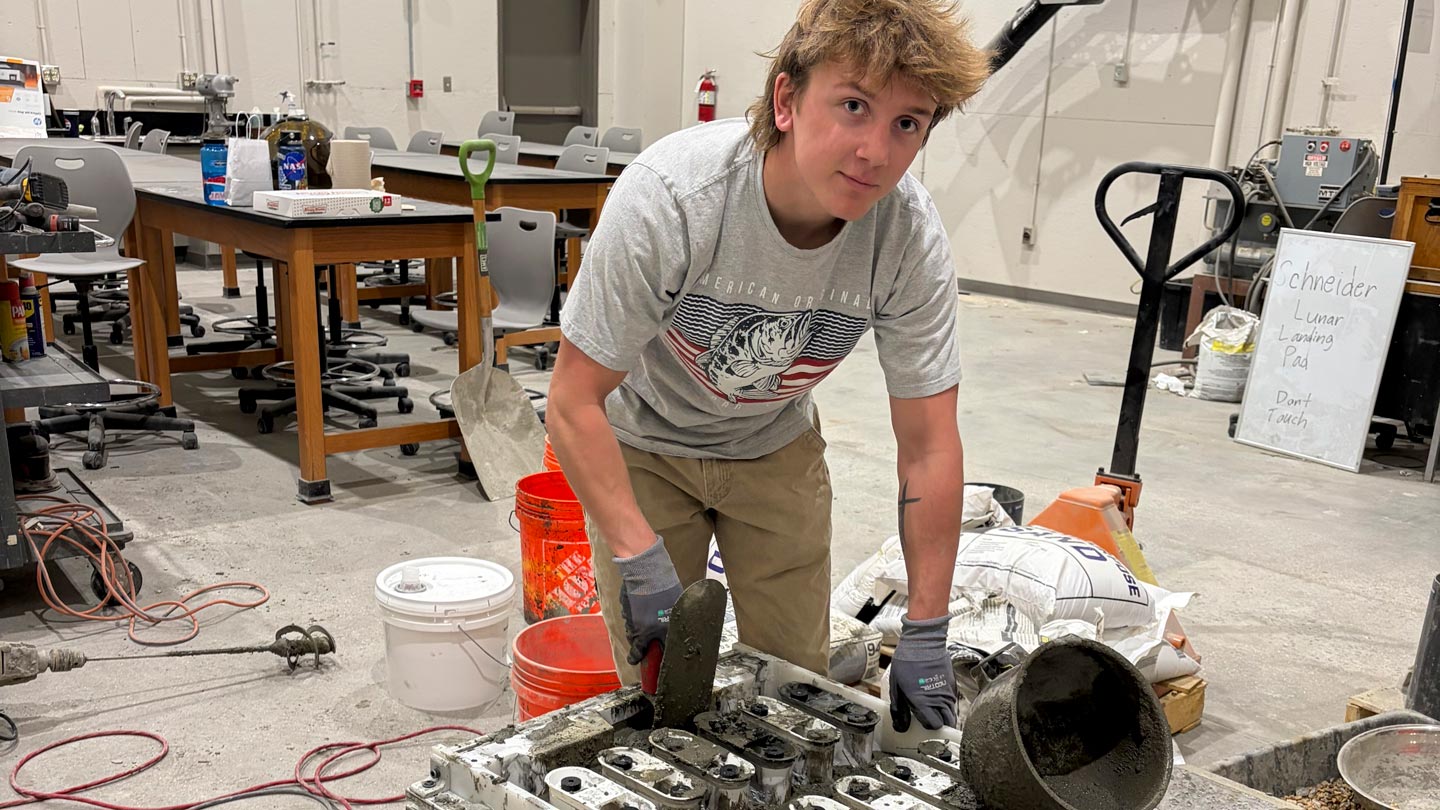
Built to take the blast: UAH students test prototype landing pad to make Moon landings safer
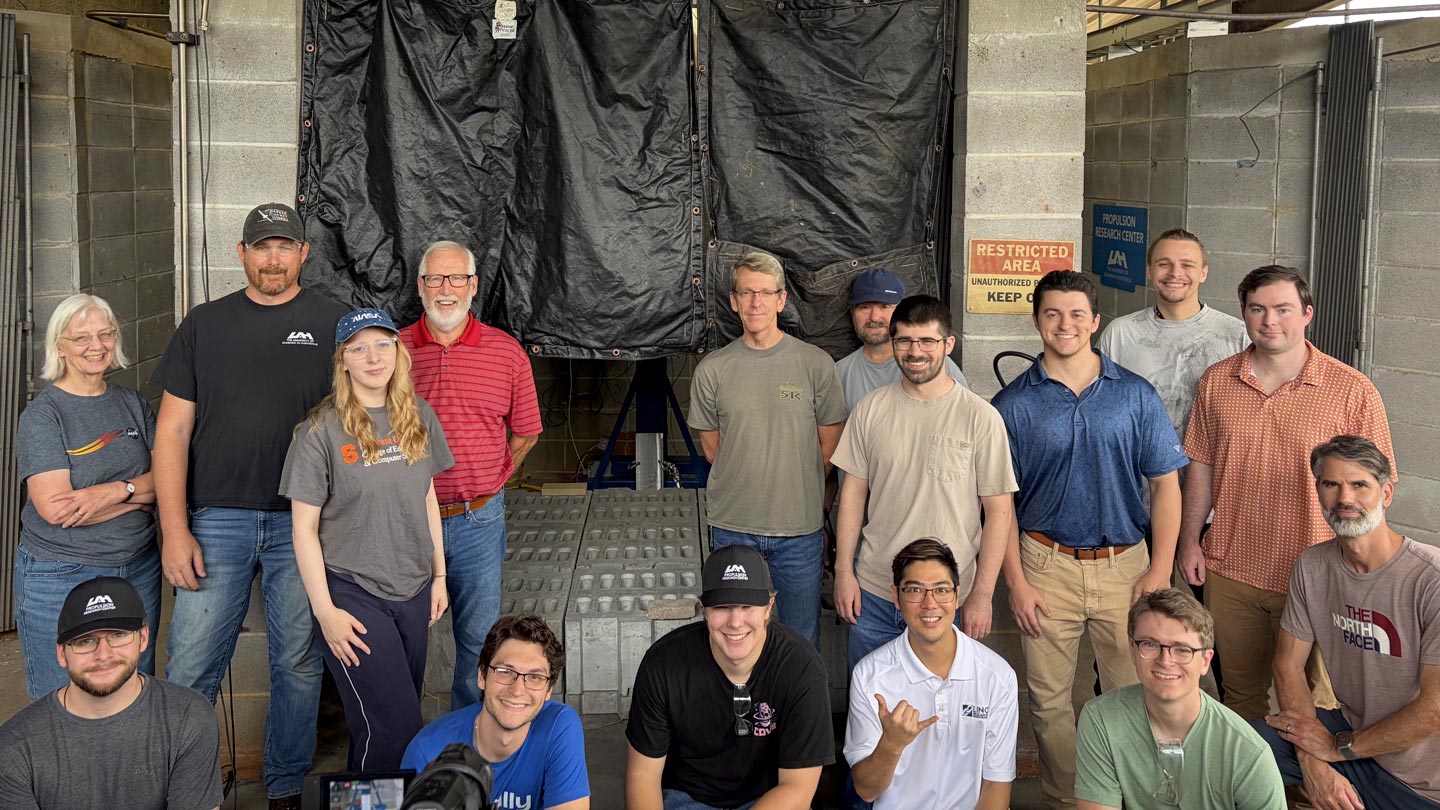
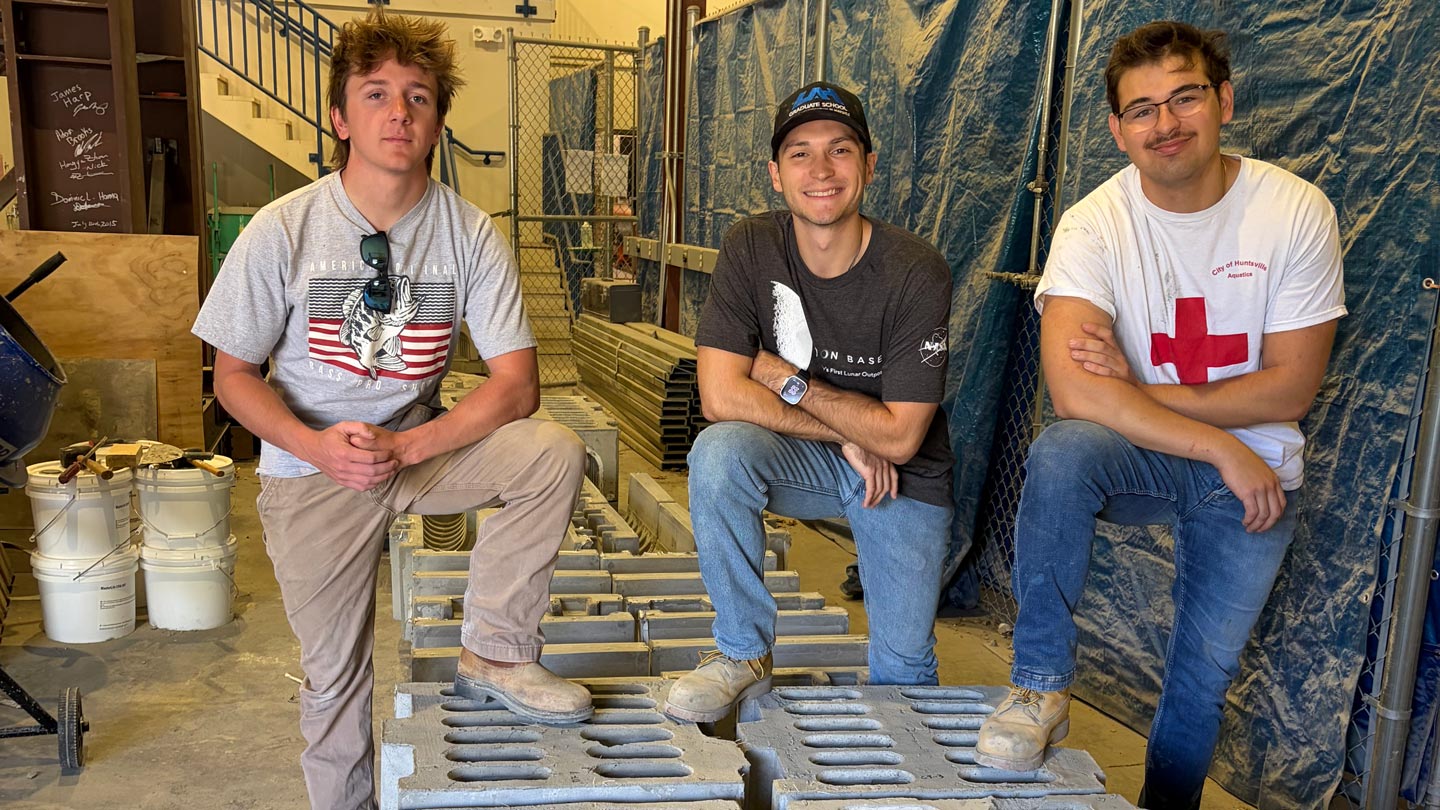
UAH Propulsion Research Center, UAH prototype team and Linc Research, Inc. personnel in front of prototype lunar landing pad.
As NASA works toward a sustained human presence on the Moon, researchers at The University of Alabama in Huntsville (UAH), a part of The University of Alabama System, are helping solve one of the most pressing challenges facing future lunar missions: how to land spacecraft safely without damaging the landing vehicle or nearby infrastructures.
This summer, a team of UAH students and researchers successfully conducted three rocket-motor firing tests on a prototype lunar landing pad at the university’s Propulsion Research Center. The tests demonstrated the prototype’s ability to capture and redirect rocket exhaust through an integrated vent system, marking an important milestone in the development of landing infrastructure for future Moon base operations.
The student research team led by Dr. Judy Schneider, a professor in UAH’s Department of Mechanical and Aerospace Engineering, is part of a multiyear partnership with Linc Research Inc., a certified HUBZone company, supported by NASA Small Business Technology Transfer (STTR) funding. The research focuses on developing a modular, vented landing pad that would help protect spacecraft and surrounding infrastructure from the intense heat and force generated during lunar landings.
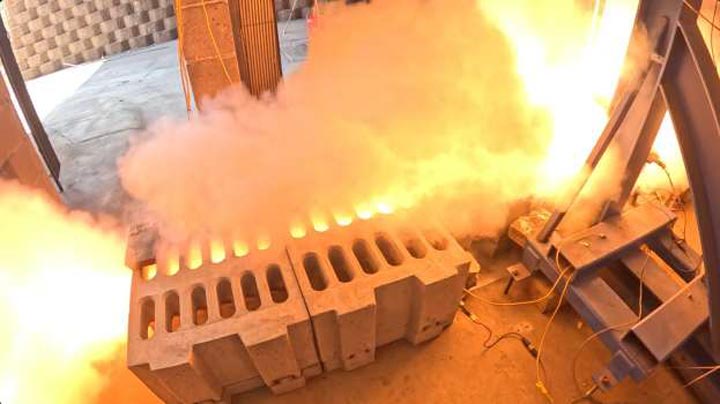
Rocket-motor firing tests on a prototype lunar landing pad at the UAH Propulsion Research Center.
“On Earth, we use water-cooled flame buckets to redirect rocket exhaust,” Schneider explains. “But we won't have those resources on the lunar surface, where water will be in limited supply. Our goal is to redirect the rocket plume so it doesn't damage the landing vehicle or any surrounding structures.”
Unlike Earth, the Moon offers no readily available atmosphere, allowing rocket exhaust plumes to expand freely and interact directly with the lunar surface. The powerful blast from a landing spacecraft can propel dust and debris at high speeds, potentially damaging spacecraft, equipment and nearby habitats. As lunar exploration moves toward longer missions and permanent infrastructure, mitigating these hazards will be increasingly important.
The team's solution is an interlocking landing pad with integrated vents designed to capture and redirect rocket exhaust away from the landing area. Rather than relying on a solid structure to withstand the full force and heat of a rocket plume, the vented design channels the exhaust through the pad, helping reduce thermal damage and protect the structure.
“The hot-fire tests demonstrated that we could redirect the rocket plume,” Schneider says. “By using an internally vented structure, we were able to prevent the heat from damaging the pad as it could in a solid structure.”
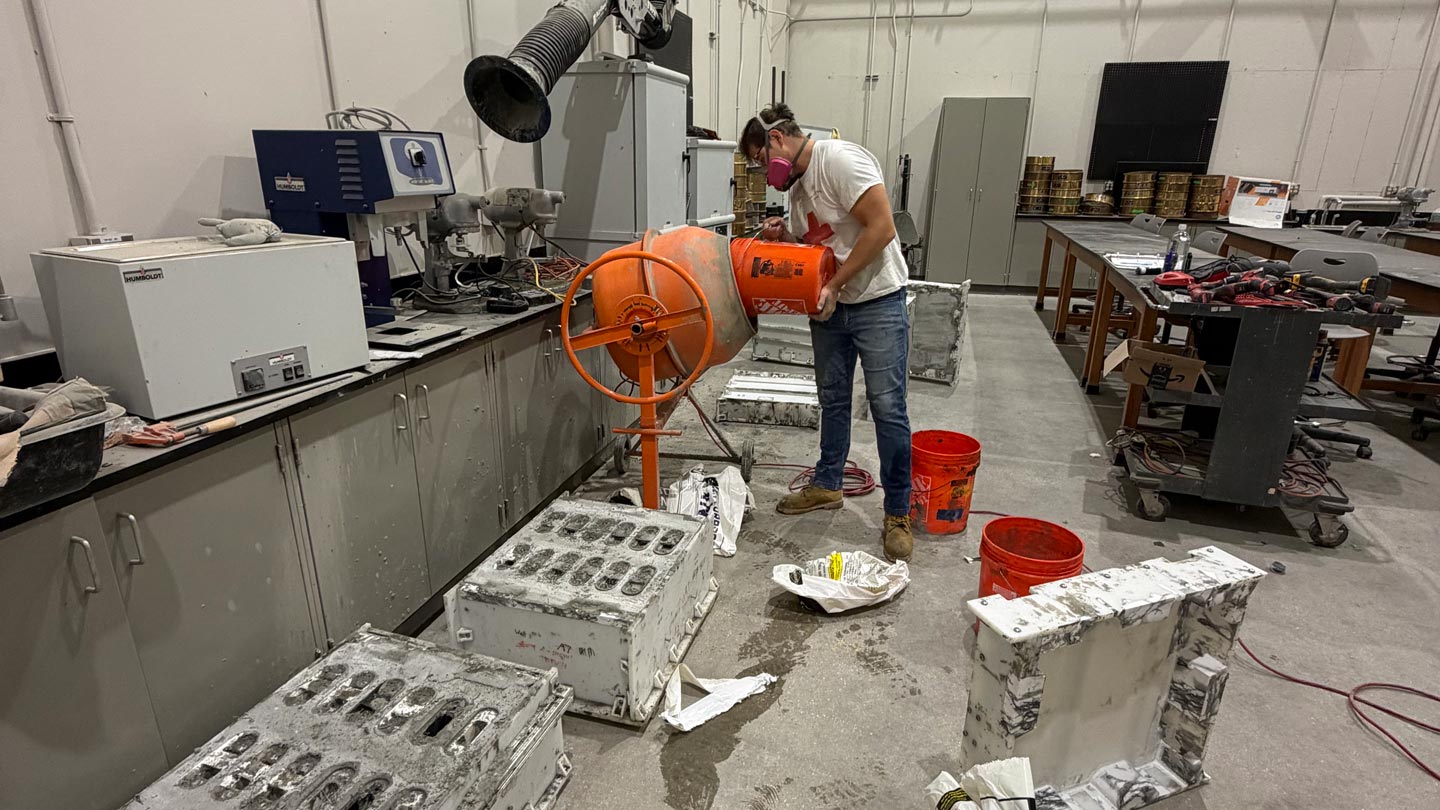
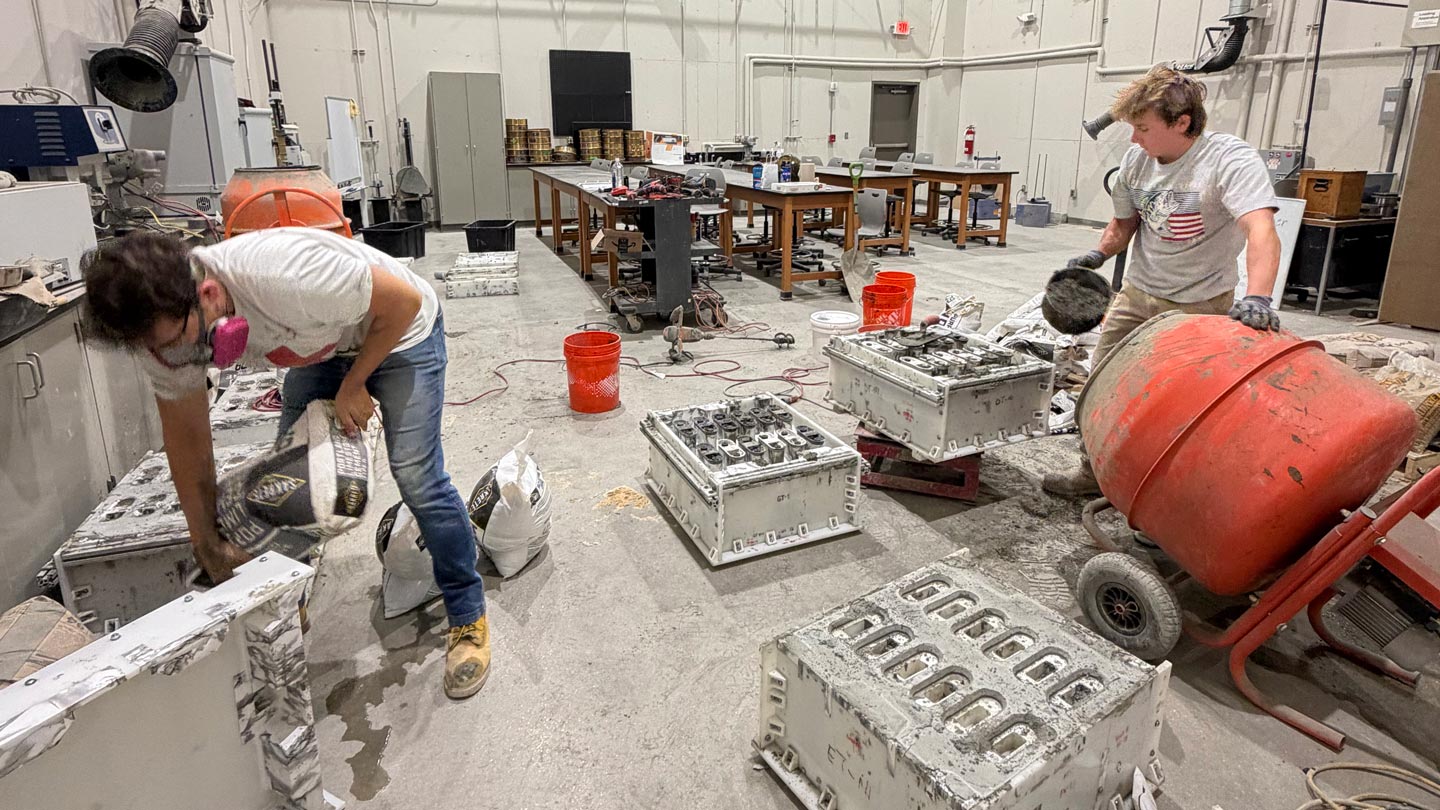
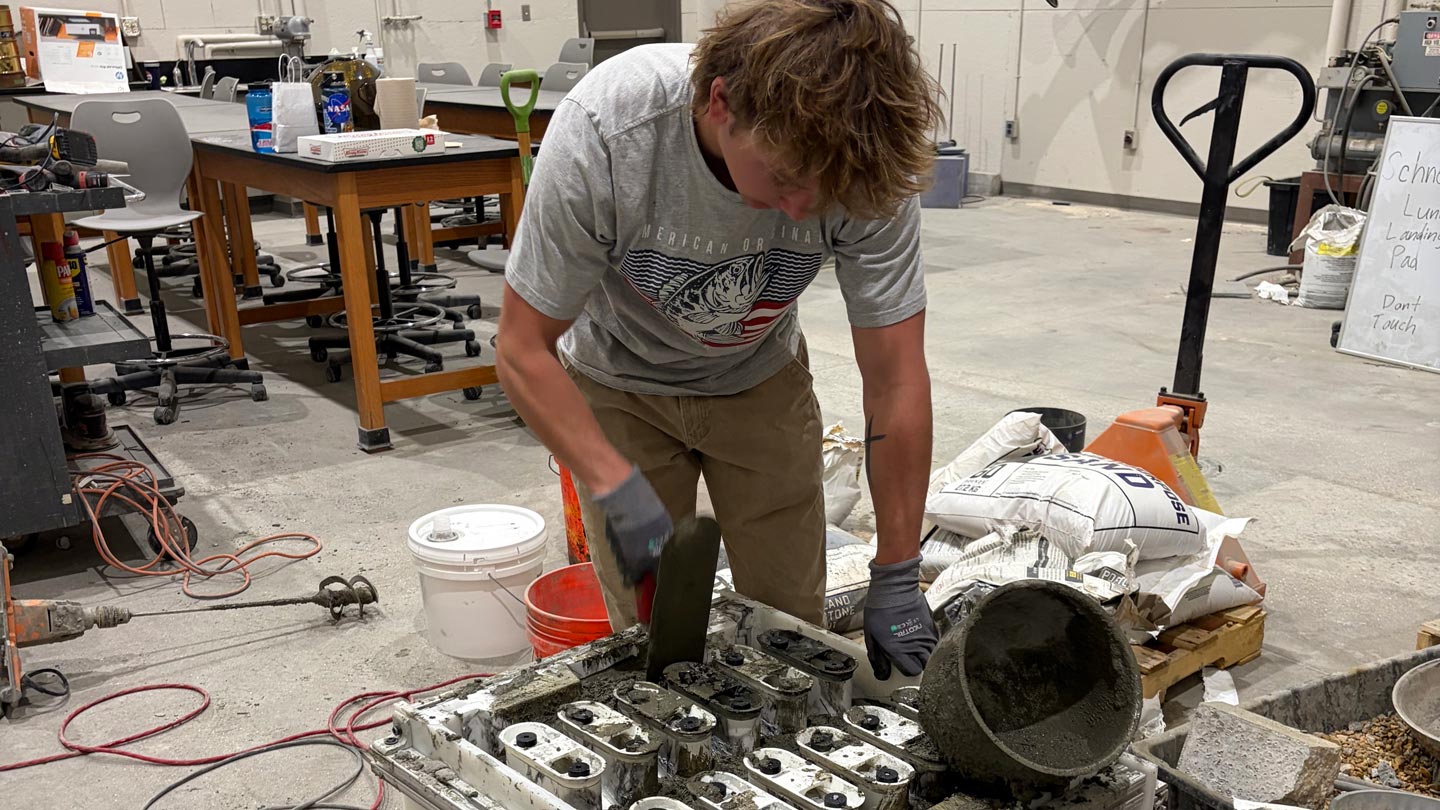
For the tests, the team assembled individual concrete components into a prototype structure measuring 12 feet across. The concrete serves as an Earth-based stand-in for construction materials that could eventually be produced from lunar resources. Sensors integrated into the structure recorded flow through the vent system as the team conducted three rocket-motor firings.
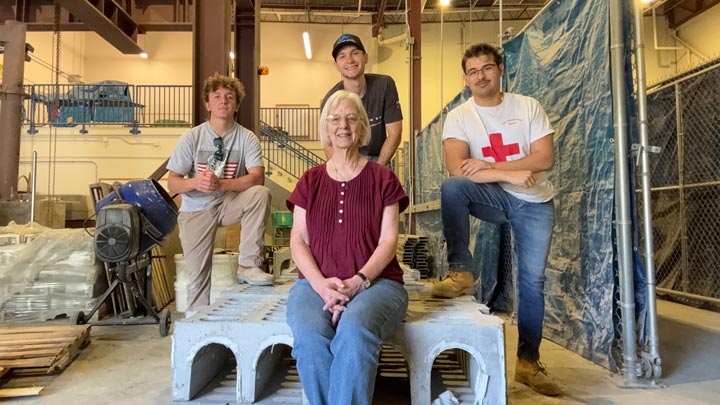
(F), Dr. Judith Schneider, professor of Mechanical and Aerospace Engineering and director of interdisciplinary Materials Science Program, poses with UAH students, (L-R), Andrew Angelucci, Isaac Menzel and Cadis Ammons atop prototype landing pad surface.
The interlocking design is central to the project's long-term vision. Transporting construction materials from Earth to the Moon is costly and logistically challenging. A modular landing pad made from materials processed from lunar regolith could offer a more practical path to building infrastructure on the lunar surface. Individual components could also make future pads easier to assemble, expand, maintain and repair.
Researchers are exploring ways to transform lunar regolith into durable construction materials through processes such as melting and sintering. By combining locally sourced materials with a modular design, the team aims to help make large-scale lunar infrastructure more feasible.
Hands-on student involvement is crucial
The project is also creating opportunities for UAH students to contribute directly to research supporting future space exploration. “The team gives the student researchers valuable hands-on experience with aerospace engineering challenges,” Schneider notes.
The student team includes Cadis Ammons, who is completing his Master of Science in Mechanical Engineering, and undergraduates who are pursuing their bachelor’s degree in Mechanical Engineering (Isaac Menzel and Matthew Allmon) and Civil Engineering (Andrew Angelucci).
Through their involvement, students gain experience in experimental testing, engineering design and the practical challenges of developing technology for demanding space environments. Their work also reflects UAH's commitment to preparing the next generation of engineers and researchers to contribute to NASA missions and the future of space exploration.
With the initial tests complete, the team is moving toward the next major milestone: building a 20-foot-diameter landing pad for delivery to NASA's Marshall Space Flight Center in Huntsville for additional testing and evaluation.
The larger prototype will provide an opportunity to further assess the design's performance and advance the technology toward the demands of future lunar missions. Continued research and testing will help determine how the vented, modular approach can be scaled and adapted for landing pads capable of supporting repeated spacecraft landings over time.
For UAH, the project connects the university's engineering expertise and student research opportunities with Huntsville’s longstanding role in advancing the nation's space program. By developing technology designed to make lunar landings safer and lunar infrastructure more resilient, UAH researchers and students are helping lay the groundwork for humanity's next steps on the Moon.