UAH optical expertise takes center stage as NASA’s Roman Space Telescope begins historic journey to explore distant worlds
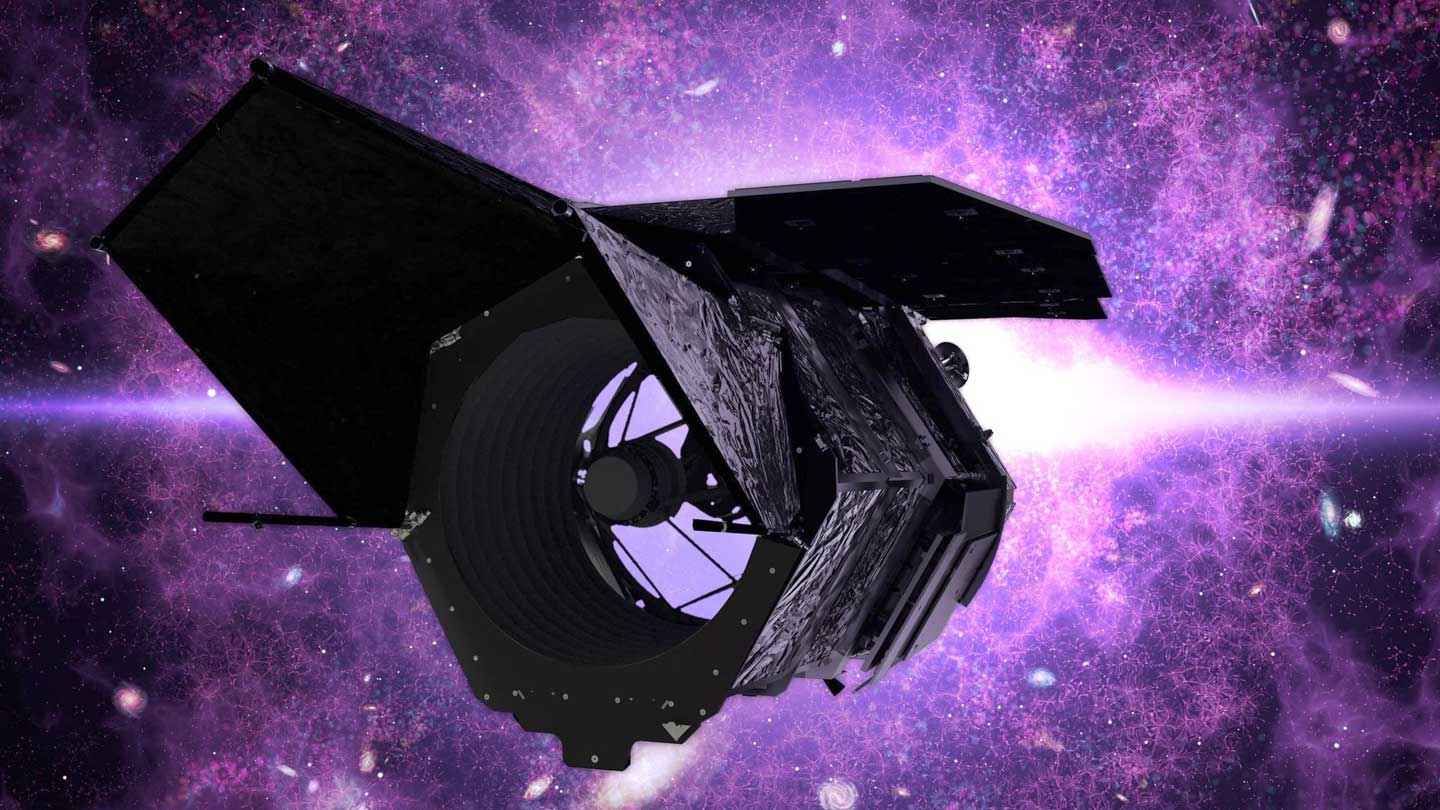
The Nancy Grace Roman space telescope will investigate dark energy and dark matter, conduct a statistical census of planetary systems and support a broad range of additional astrophysics research.
Years of research, modeling and software development at The University of Alabama in Huntsville (UAH), a part of The University of Alabama System, marked an exhilarating milestone this year as NASA’s Nancy Grace Roman Space Telescope lifted off in Florida on Aug. 30. The mission is carrying technology and data-processing capabilities supported by UAH’s Center for Applied Optics (CAO). The telescope is NASA's next-generation space observatory, designed to explore the universe on an extraordinarily wide scale, investigating dark energy and dark matter, as well as searching for planets beyond our solar system.
For Dr. Kevin Ludwick, a principal research scientist at UAH, witnessing the launch in person provided a remarkable opportunity to see years of scientific collaboration take flight. The researcher traveled to NASA’s Kennedy Space Center with his wife and two children to watch the telescope launch aboard a SpaceX Falcon Heavy rocket.
“The CAO has a long history of optics and sensor expertise, and my work with Roman is one of the CAO's many collaborations with NASA,” Ludwick says. “It was a wonderful experience to see the fruits of all our labor culminate in a successful launch! It was amazing to see the launch up close, as well as the successful return of the boosters to ground.”
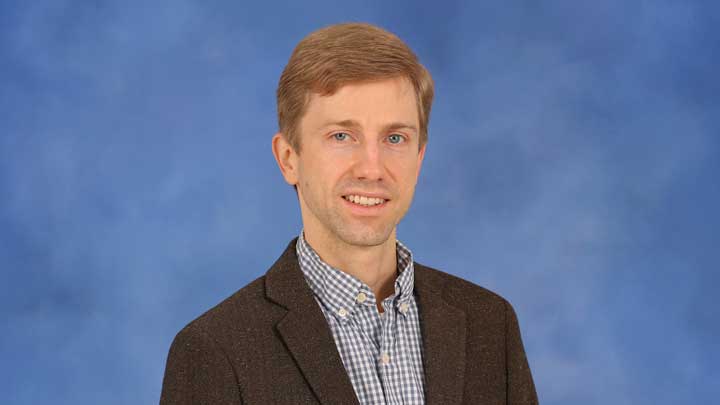
Dr. Kevin Ludwick, a principal research scientist with the UAH Center for Applied Optics.
Behind that launch are significant contributions from UAH’s CAO, whose longstanding expertise in optics and sensor technology has established the center as a trusted NASA collaborator. UAH supported software development, detector simulations and data processing for Roman’s Coronagraph Instrument (CGI) which will demonstrate new technology for directly imaging planets orbiting distant stars.
Roman carries two primary instruments: the Wide Field Instrument, designed for large-scale astronomical surveys, and the CGI, which will demonstrate technology for suppressing the overwhelming light of stars to reveal much fainter objects, including exoplanets.
“My work has been in development of software for CGI, mainly in producing calibrations for the electron-multiplying charge-coupled device (EMCCD) detectors and processing raw detector data to enable high-quality images for science,” Ludwick says. “I also maintain and develop the EMCCD detector simulator they use for data analysis.”
Other CAO contributions include tools that generate per-pixel detector noise maps, detect and flag cosmic rays, locate detector charge traps with subpixel accuracy and calibrate commanded voltage against commanded EM gain. These software tools help the telescope's camera produce clearer, more accurate pictures by identifying and correcting problems that can interfere with the images.
“I helped write the calculator for determining the best detector settings and number of frames to maximize signal-to-noise ratio (SNR) for a given observation, analog or photon-counted,” Ludwick adds.
Tackling one of astronomy’s greatest optical challenges
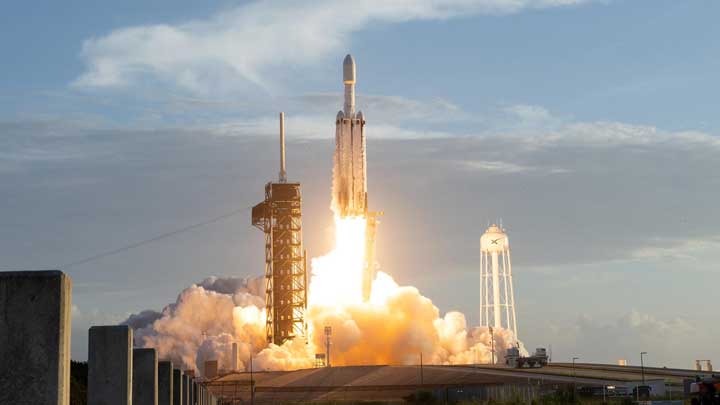
A SpaceX Falcon Heavy rocket launches with NASA’S Nancy Grace Roman Space Telescope onboard from Launch Complex 39A, Sunday, Aug. 30, 2026, at NASA’s Kennedy Space Center in Florida.
Roman’s Coronagraph Instrument represents a major technological advance in the effort to directly image planets beyond our solar system.
“Roman's CGI will serve as a technology demonstrator for a complex method of light suppression which has not been used on a space telescope before,” Ludwick says. “The instrument uses deformable mirrors to manipulate incoming light and cancel much of a star's overwhelming brightness through destructive interference, making it possible to detect the faint reflected light of orbiting planets.”
Imagine trying to photograph a firefly next to a powerful spotlight from thousands of miles away. The illumination from the spotlight overwhelms the firefly. That's essentially the challenge of imaging an exoplanet next to its host star, which means the technical hurdles are daunting.
“Each mirror is a single continuous sheet of glass actuated by a grid of pistons underneath to allow spatially precise reflections to enable this cancellation,” Ludwick explains. “Achieving the necessary precision requires repeated calculations on the ground, with results transmitted to the instrument through a process called ground-in-the-loop (GITL).
“There were challenges with accurately simulating the mirrors' piston responsiveness due to cross-talk, as one piston's motion naturally tugs on neighboring glass,” the researcher notes. “Precise optical modeling of the resulting variations of star light amplitude through the many optical elements of the Roman CGI was also difficult. The development of this process for wavefront and sensing control has been an amazing accomplishment for the team.”
Technology that will shape future missions
Roman’s coronagraph also lays the groundwork for NASA’s proposed Habitable Worlds Observatory (HWO), a future flagship mission designed to search for potentially habitable planets and study their atmospheres.
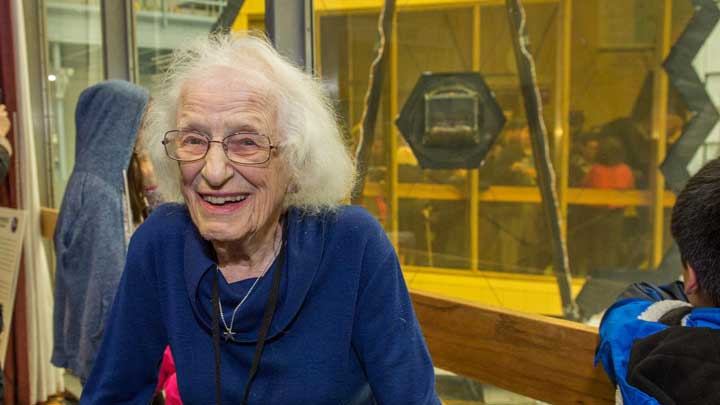
Dr. Nancy Grace Roman (1925–2018) was a pioneering astronomer and NASA’s first Chief of Astronomy, as well as the agency’s first female executive. Known as the “Mother of Hubble,” Grace was instrumental in making the Hubble Space Telescope a reality and establishing NASA’s space-based astronomy program. Her vision and leadership helped pave the way for next-generation observatories, including the James Webb Space Telescope.
“The modeling and analysis work being done for CGI is the foundational stepping stone for the HWO,” Ludwick says. “Finding an Earth-like planet will require HWO to achieve a raw optical contrast ratio of one part in 10 billion. Roman is designed to demonstrate space-based starlight suppression at contrast levels between one part in 100 million and one part in 1 billion. The current modeling success directly solves the core scaling problems HWO will face, including deformable mirrors with a higher density of actuators. Roman's post-processing algorithms will serve as a starting point for HWO in its planning and development.”
The UAH research scientist also recognized former CAO employees Bijan Nemati, Guillermo Gonzalez and Sam Miller for their contributions to Roman. “Nemati and Gonzalez continue supporting the mission through Nemati’s local company, Tellus1, along with Peter Williams, a UAH physics graduate student working there,” Ludwick says.
For UAH and Huntsville’s aerospace and research community, the telescope represents an opportunity to demonstrate how university expertise can contribute to transformative space science.
“Roman's launch is a big step forward in regional prestige and career opportunities,” Ludwick says. “The mission is designed to last five plus years, and the technology it demonstrates will help define astrophysics for the next two decades.”
The mission also offers inspiration for students considering careers in optics, engineering physics and space science. “Students starting their education today may be the senior engineers designing the mirrors and processing algorithms for HWO tomorrow,” Ludwick concludes.
Watching Roman lift off was a tangible demonstration of the university’s role in advancing the technologies that will help scientists pursue answers to one of humanity’s greatest questions: Are we alone in the universe?