Dr. Srinath Ekkad, new Dean of the UAH College of Engineering, sets out to build a unique model for the program at the heart of Huntsville’s technology ecosystem
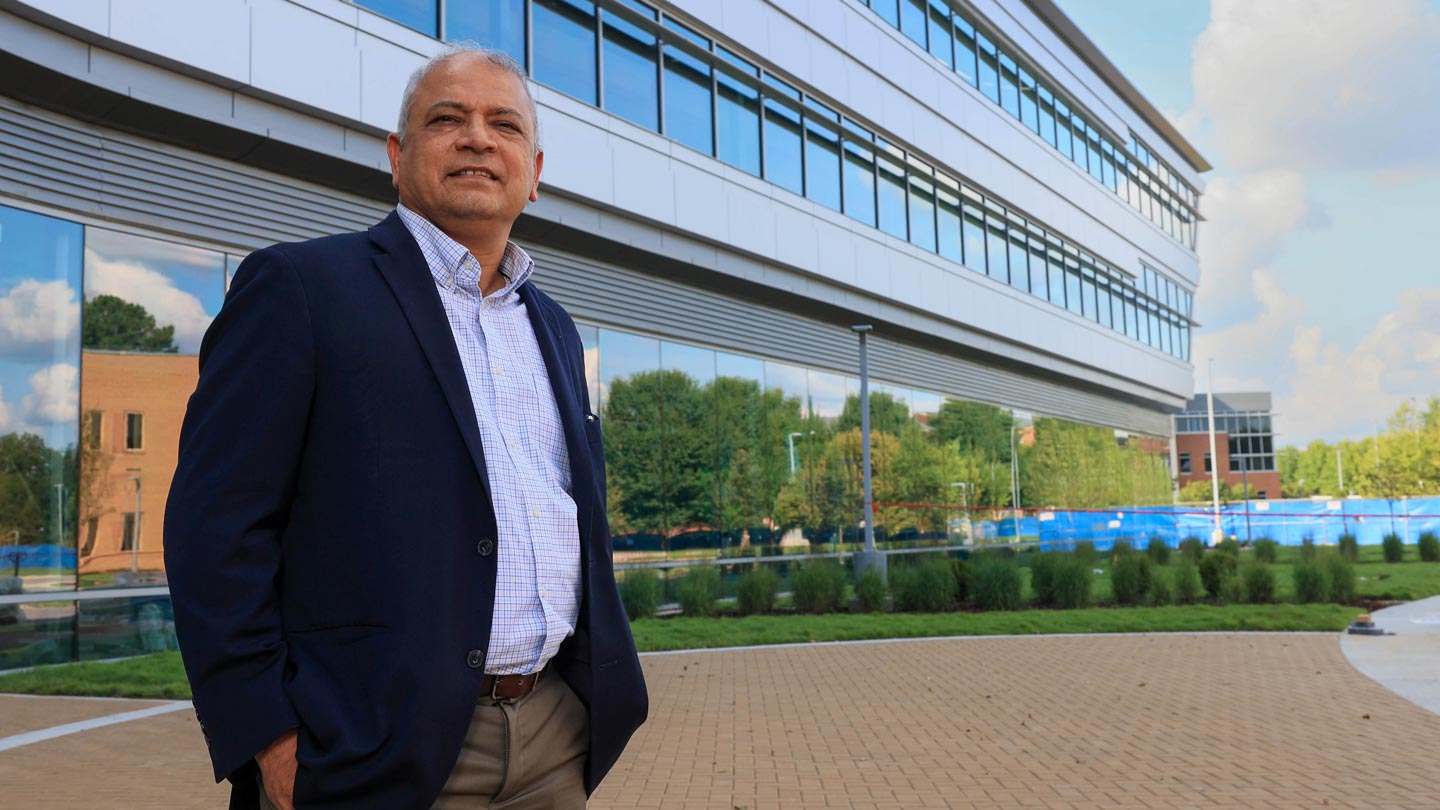
Dr. Srinath Ekkad, Dean UAH College of Engineering, standing in front of the Raymond B. Jones Engineering Building on the UAH campus, slated for opening in spring 2027.
In a city where engineering challenges are measured in missions, satellites, autonomous systems and the next generation of technologies, Dr. Srinath Ekkad believes The University of Alabama in Huntsville (UAH) has fundamental advantages few universities can match. As the newly appointed dean of UAH’s College of Engineering (COE), Ekkad is not looking to replicate the model of another engineering school, but instead sees an opportunity to build something unique at UAH, a college deeply embedded within the Huntsville technology ecosystem, where students, faculty, government agencies and industry partners work together to solve real-world problems. UAH is a part of The University of Alabama System.
“I want UAH engineering to be recognized as a premier engineering school for educating engineers and also solving technological challenges, but in a different way than other schools,” Ekkad says. “Because of where we are.”
That location is central to his vision. UAH boasts partnerships with Redstone Arsenal, NASA Marshall Space Flight Center and Cummings Research Park, with the flagship college accounting for more than 3,000 undergraduate and graduate students, or about 35% of the university's total enrollment. Ekkad also assumes the stewardship of the COE just as UAH prepares to unveil the more than 70,000 square-foot Raymond B. Jones Engineering Building, slated for classes in spring 2027.
“No other university has this kind of ecosystem around it,” Ekkad says. “The opportunity is to connect those resources intentionally, bringing together UAH’s academic expertise, research capabilities, students and the needs of Huntsville’s technology community.”
The new dean brings nearly three decades of experience to his new position centered on connecting engineering education and research with government and industry needs. During his time at Virginia Tech, he helped build and lead a funded research center supported by Rolls-Royce, working directly with the company’s engineers to understand their needs and match them with university capabilities.
“Every year, we would talk to their engineers and figure out what their needs are and what our capabilities are,” Ekkad says. “How do we match them up so that we can solve the problems that they have?”
That approach demonstrates the value of having university researchers involved when companies are defining the problems they want to solve, not simply after the problem has been identified.
Building on what makes UAH unique
Ekkad’s experience has shaped his philosophy of university-industry partnerships. “It should not be a transactional relationship,” he says. “It is an interconnected relationship where we are part of their decision-making.”
He sees tremendous potential to build that kind of partnership at UAH, where the university is embedded in one of the nation’s most concentrated aerospace, defense and technology communities.
“We have to come up with original ways of doing things,” Ekkad says. “Build on the ecosystem rather than trying to be something else that other schools are. We’re built differently.”
Ekkad sees Huntsville itself as an extraordinary extension of the classroom that provides priceless opportunities to encounter engineering challenges in real time.
“Imagine being an undergraduate student and having the opportunity to work on a NASA-related project or a defense technology project or an autonomous system or a propulsion system or even a cybersecurity challenge while you’re still an undergraduate,” Ekkad says.
That experience can begin while students are still pursuing their degrees, studying engineering concepts in the classroom while gaining professional experience with government or industry partners.
“At most universities, while you’re an undergraduate, you have to do a graduate internship or a co-op to get that experience,” he says. “Here, you can be doing it while you are a student. That makes it unique.”
Ekkad emphasizes that Huntsville’s engineering network encompasses far more than aerospace and propulsion.
“There are a lot of interesting needs the companies have here,” he says. “It’s not just mechanical and aerospace related. It’s beyond that: electrical engineering, antenna and signal technologies, control systems, autonomous systems, computing, cybersecurity and thermal management are all among the areas where Huntsville organizations are seeking engineering expertise.”
Instilling engineering confidence
Ekkad’s vision for experiential learning is about more than giving students professional experience. He wants them to develop the confidence to approach problems for which the answer is not already known.
“Students learn things in the classroom, but it’s all defined problems, and they know that we know the solution already,” he says. “In real engineering, we don’t know the answer. We’re going to look for it. That requires a different kind of thinking. Engineers must determine what information they need, find it, evaluate possible approaches and develop a solution. In the real world, the boss says, ‘Find me a solution.’ I call that engineering confidence”
That approach is increasingly important as artificial intelligence expands throughout the engineering workplace.
“Teaching them how to use AI in a better way means you need to give them more open-ended problems,” Ekkad says. “If you have an open-ended problem, each student starts at a different point and ends at a different point, a kind of creativity that demonstrates their ability to think beyond the classroom textbook. That confidence comes from blending technical fundamentals with real-world experience.”
An ‘innovation environment’ built on applied research
The model Ekkad emphasizes creates benefits across the entire ecosystem. Industry partners gain access to research expertise and emerging talent. Government organizations gain additional capacity to address complex technological challenges. Faculty members gain opportunities to pursue meaningful applied research. Students gain experience working on problems that matter.
Ekkad believes applied research can also serve as a foundation for broader research opportunities. “The point is to recognize that this opportunity exists right in our backyard. We recognize that we already have something here that we can connect to, that builds on our capability to do more applied research, research that can grow in unexpected directions that solve problems.”
Ekkad also wants the College of Engineering to help students understand the breadth of education available to them from the beginning of their college careers. Early exposure can help students discover possibilities they might not otherwise consider and better understand how different engineering disciplines work together. Industry partners can play an important role by helping students understand what engineers in different disciplines actually do.
“We’re going to bring our industry partners to come and talk to our freshmen and tell them what it means to be a mechanical engineer, what it means to be a systems engineer, what it means to be a chemical engineer,” the new dean says.
This is all part of a larger philosophy: UAH does not need to follow a predetermined model. It can build an educational experience around the distinctive opportunities available in Huntsville.
“We can’t be the same as everybody else. That’s what I’m saying. We have a unique opportunity to do something very, very different here.”
It all starts with the right mindset
Ultimately, Ekkad’s vision for the COE extends beyond research, rankings or enrollment. He wants to build a college that has a meaningful impact on its students, its industry and government partners and the broader Huntsville community. Success is also about creating an environment where people want to do their best work.
“Making people happy,” he says. “Happy people do better work. I want students, faculty and staff to look forward to coming to work, collaborating with one another and to feel invested in what they are building together.”
And while growth is important, Ekkad is focused on impact. “My goal is to bring all those pieces together, intentionally, creatively and with UAH at the center.”
Learn More
Contact
Russ Nelson
256-824-2101
russell.nelson@uah.edu